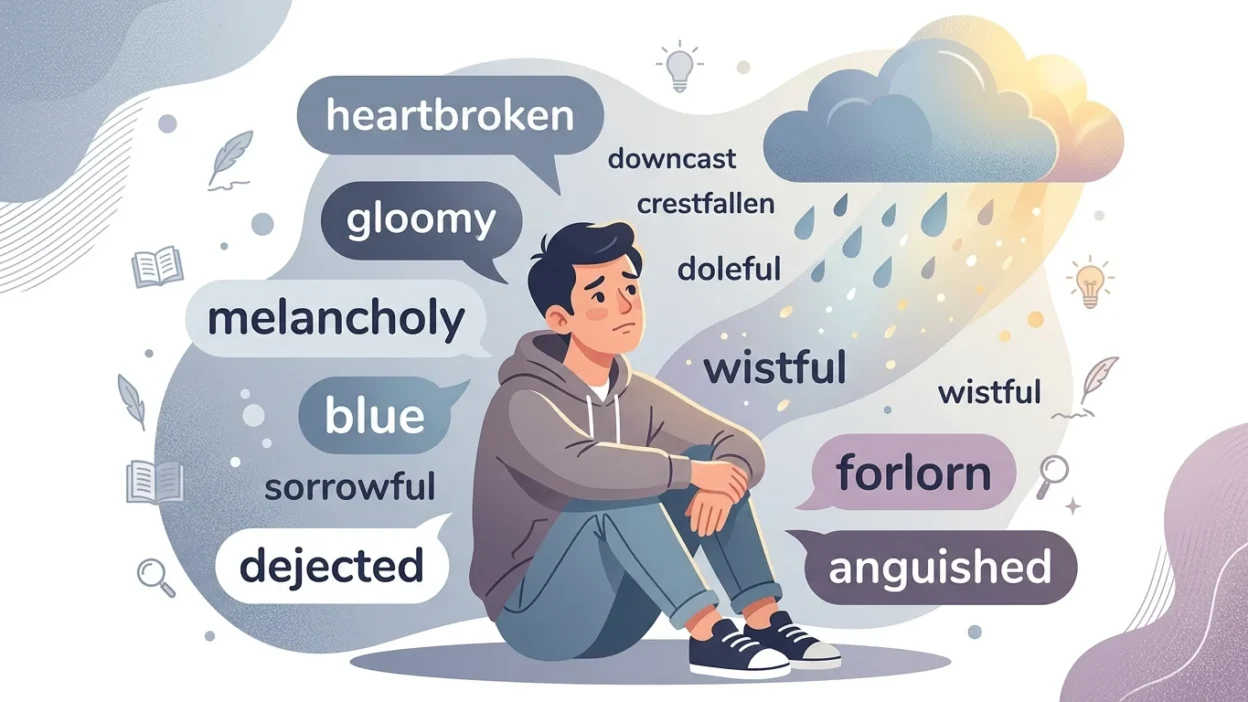
People often use the word sad to describe feelings of unhappiness, disappointment, grief, or emotional pain. While “sad” is a useful everyday word, relying on it repeatedly can make your writing feel repetitive and less expressive.
Learning different synonyms for sad helps students, ESL learners, writers, and content creators communicate emotions more accurately. Some words express mild disappointment, while others describe deep sorrow or heartbreak. Choosing the right synonym allows you to capture the exact feeling you want to convey.
In this guide, you’ll discover 30 useful synonyms for sad, along with simple meanings, example sentences, and notes about when each word works best.
What Does “Sad” Mean?
The word sad describes a state of unhappiness, sorrow, regret, or emotional pain. People may feel sad after losing something important, experiencing disappointment, or going through difficult situations.
Examples:
- She felt sad after saying goodbye to her friends.
- The movie had a sad ending.
- He looked sad when he heard the news.
The intensity of sadness can vary greatly. That’s why understanding different synonyms is so helpful.
30 Synonyms for Sad
1. Unhappy
Meaning: Feeling not happy or pleased.
Example: She was unhappy about the exam results.
Best Usage Context: Everyday situations and general disappointment.
2. Sorrowful
Meaning: Deeply sad because of loss or grief.
Example: The family was sorrowful after the funeral.
Best Usage Context: Serious emotional situations.
3. Miserable
Meaning: Extremely unhappy and uncomfortable.
Example: He felt miserable after losing his job.
Best Usage Context: Strong emotional distress.
4. Gloomy
Meaning: Feeling down or lacking hope.
Example: She seemed gloomy during the rainy afternoon.
Best Usage Context: Mild sadness or pessimism.
5. Heartbroken
Meaning: Very sad due to emotional loss.
Example: He was heartbroken after the breakup.
Best Usage Context: Relationships and personal loss.
6. Depressed
Meaning: Feeling intensely sad and discouraged.
Example: She felt depressed after months of setbacks.
Best Usage Context: Serious emotional struggles.
7. Downcast
Meaning: Looking sad and discouraged.
Example: He appeared downcast after hearing the decision.
Best Usage Context: Formal writing.
8. Melancholy
Meaning: A thoughtful, gentle sadness.
Example: The old song gave her a feeling of melancholy.
Best Usage Context: Literary descriptions.
9. Dejected
Meaning: Feeling disappointed and low in spirits.
Example: The team looked dejected after losing.
Best Usage Context: Failure or setbacks.
10. Crestfallen
Meaning: Embarrassed and disappointed.
Example: She looked crestfallen when her idea was rejected.
Best Usage Context: Personal disappointment.
11. Blue
Meaning: Feeling a little sad.
Example: I’ve been feeling blue lately.
Best Usage Context: Informal conversations.
12. Mournful
Meaning: Expressing grief or sorrow.
Example: The violin played a mournful tune.
Best Usage Context: Artistic or emotional settings.
13. Woeful
Meaning: Full of sadness and distress.
Example: His woeful expression worried everyone.
Best Usage Context: Formal or literary use.
14. Grief-Stricken
Meaning: Overwhelmed by grief.
Example: The grief-stricken mother thanked the community.
Best Usage Context: Major loss.
15. Despairing
Meaning: Having lost hope.
Example: He became despairing after repeated failures.
Best Usage Context: Hopeless situations.
16. Dismal
Meaning: Very gloomy and depressing.
Example: The weather matched her dismal mood.
Best Usage Context: Mood and atmosphere.
17. Somber
Meaning: Serious and sad.
Example: The meeting had a somber tone.
Best Usage Context: Formal events.
18. Heavyhearted
Meaning: Feeling emotional sadness.
Example: She left with a heavyhearted goodbye.
Best Usage Context: Emotional farewells.
19. Morose
Meaning: Quietly unhappy and withdrawn.
Example: He became morose after the argument.
Best Usage Context: Character descriptions.
20. Despondent
Meaning: Extremely discouraged.
Example: She felt despondent after several rejections.
Best Usage Context: Serious disappointment.
21. Low
Meaning: Feeling emotionally down.
Example: I’ve been feeling low this week.
Best Usage Context: Casual conversations.
22. Tearful
Meaning: Close to crying.
Example: She gave a tearful farewell speech.
Best Usage Context: Emotional moments.
23. Regretful
Meaning: Sad about past actions.
Example: He sounded regretful during the apology.
Best Usage Context: Mistakes and apologies.
24. Pensive
Meaning: Thoughtful with a hint of sadness.
Example: She sat quietly, looking pensive.
Best Usage Context: Reflective moods.
25. Lonesome
Meaning: Sad because of loneliness.
Example: The traveler felt lonesome far from home.
Best Usage Context: Isolation.
26. Hurt
Meaning: Emotionally wounded.
Example: She was hurt by his harsh words.
Best Usage Context: Personal conflicts.
27. Anguished
Meaning: Experiencing intense emotional pain.
Example: His anguished cry echoed through the room.
Best Usage Context: Extreme distress.
28. Distressed
Meaning: Upset and troubled.
Example: The news left everyone distressed.
Best Usage Context: Difficult circumstances.
29. Brokenhearted
Meaning: Deeply saddened by loss.
Example: She was brokenhearted after the tragedy.
Best Usage Context: Emotional loss.
30. Forlorn
Meaning: Pitifully sad and lonely.
Example: The abandoned puppy looked forlorn.
Best Usage Context: Literary and descriptive writing.
Comparison Guide: When to Use Different Synonyms for Sad
| Synonym | Level of Sadness | Best For |
|---|---|---|
| Unhappy | Mild | Everyday situations |
| Blue | Mild | Casual speech |
| Gloomy | Mild to Moderate | Mood descriptions |
| Dejected | Moderate | Failures and setbacks |
| Heartbroken | Strong | Relationships |
| Heavyhearted | Strong | Emotional farewells |
| Depressed | Very Strong | Serious emotional states |
| Grief-Stricken | Extreme | Death and major loss |
| Anguished | Extreme | Intense suffering |
| Melancholy | Gentle | Creative and literary writing |
How to Choose the Right Synonym
For Everyday Sadness
Use:
- Unhappy
- Blue
- Low
- Gloomy
These words sound natural in daily conversations.
For Disappointment
Use:
- Dejected
- Crestfallen
- Despondent
- Regretful
These fit situations involving setbacks or unmet expectations.
For Deep Emotional Pain
Use:
- Heartbroken
- Brokenhearted
- Anguished
- Grief-Stricken
Choose these when describing intense sorrow.
For Literary or Creative Writing
Use:
- Melancholy
- Forlorn
- Woeful
- Pensive
- Mournful
These add richness and emotional depth to storytelling.
For Formal Writing
Use:
- Somber
- Downcast
- Distressed
- Sorrowful
These are suitable for essays, reports, and professional contexts.
Why Learning Synonyms for Sad Matters
Expanding your emotional vocabulary helps you:
- Express feelings more accurately.
- Improve essays and creative writing.
- Avoid repeating the same words.
- Sound more fluent in English.
- Understand books, movies, and conversations better.
A wider vocabulary gives your communication greater clarity and impact.
Conclusion
The word sad is simple and useful, but English offers many alternatives that capture different shades of emotion. From mild unhappiness to overwhelming grief, these synonyms for sad help you describe feelings with greater precision and empathy.
Whether you’re an ESL learner building vocabulary, a student improving assignments, or a writer creating memorable characters, understanding these words can transform your communication. Practice using them in conversations, journal entries, and stories to become more confident and expressive in English.

Lucas Smith is a skilled language writer at Synomity.com, passionate about synonyms, vocabulary enrichment, and word meanings. He develops engaging content that helps readers strengthen communication skills and expand their understanding of language.