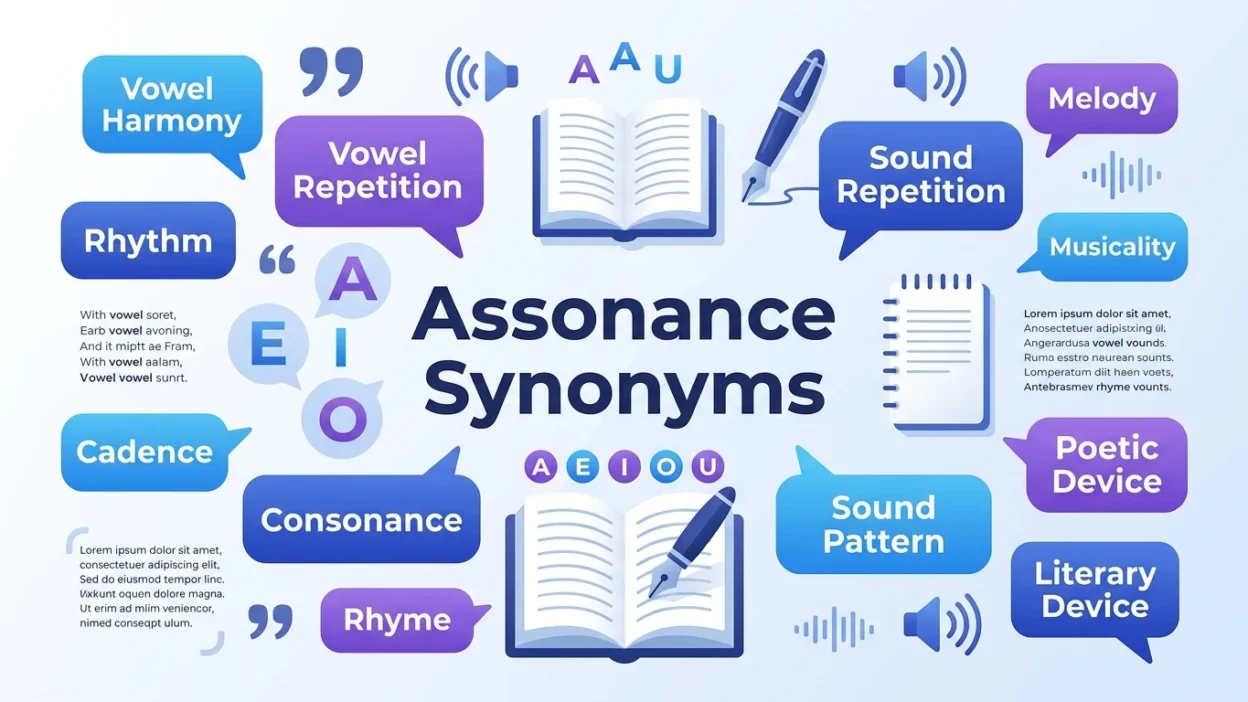
If you’re searching for assonance synonyms, you’re probably looking for alternative words or related literary terms that describe similar sound patterns in writing and speech.
Understanding these terms can help students, ESL learners, writers, poets, and content creators improve both their vocabulary and their writing skills.
Assonance is one of the most common literary devices used in poetry, songs, speeches, and storytelling. However, depending on the context, there are many related words and concepts that can be used instead of or alongside assonance. This guide explains the meaning of assonance in simple English and introduces 30 useful assonance synonyms and related terms with meanings, examples, and usage tips.
What Does “Assonance” Mean?
Assonance is the repetition of the same vowel sound in nearby words without necessarily repeating the same consonants. Writers use assonance to create rhythm, mood, and musical flow in their writing.
Simple definition:
Assonance is the repeated use of similar vowel sounds in words that are close together.
Example:
- The light of the fire shined brightly in the night.
The repeated long “i” sound creates a pleasant rhythm.
Common Usage Contexts
- Poetry
- Song lyrics
- Speeches
- Storytelling
- Creative writing
- Literary analysis
30 Best Assonance Synonyms and Related Terms
Note: Since assonance is a specific literary device, there are very few exact synonyms. The words below are close alternatives, related literary techniques, or broader terms often used in similar contexts.
1. Vowel Harmony
Meaning: Repetition of similar vowel sounds.
Example: The poem uses vowel harmony to sound smooth.
Best usage: Linguistics and poetry.
2. Vowel Repetition
Meaning: Repeating vowel sounds.
Example: The writer used vowel repetition for rhythm.
Best usage: Educational writing.
3. Sound Repetition
Meaning: Repeating sounds in nearby words.
Example: Sound repetition makes the sentence memorable.
Best usage: General literary discussions.
4. Phonetic Repetition
Meaning: Repeating speech sounds.
Example: Phonetic repetition adds musical quality.
Best usage: Linguistics.
5. Echoing Sounds
Meaning: Sounds that repeat naturally.
Example: The poem contains echoing sounds throughout.
Best usage: Creative writing.
6. Vocalic Repetition
Meaning: Repeating vowel sounds.
Example: Vocalic repetition strengthens rhythm.
Best usage: Academic discussions.
7. Euphony
Meaning: Pleasant, smooth sounds.
Example: The poet achieved euphony with soft vowels.
Best usage: Poetry and literature.
8. Melody
Meaning: A musical flow in language.
Example: The melody of the poem attracts readers.
Best usage: Creative writing.
9. Musicality
Meaning: Quality of sounding musical.
Example: Musicality improves spoken poetry.
Best usage: Poetry and speeches.
10. Rhythm
Meaning: Regular pattern of sounds.
Example: Rhythm makes the poem easier to read.
Best usage: Literature and music.
11. Cadence
Meaning: Natural flow of speech.
Example: The speaker’s cadence kept everyone interested.
Best usage: Public speaking.
12. Flow
Meaning: Smooth movement of words.
Example: Assonance improves the flow of writing.
Best usage: General writing.
13. Harmony
Meaning: Pleasant combination of sounds.
Example: The harmony of the words creates beauty.
Best usage: Poetry.
14. Sound Pattern
Meaning: Organized arrangement of sounds.
Example: Every poem has its own sound pattern.
Best usage: Literary analysis.
15. Sonic Pattern
Meaning: Pattern made by repeated sounds.
Example: The sonic pattern creates emphasis.
Best usage: Academic writing.
16. Alliteration
Meaning: Repetition of beginning consonant sounds.
Example: Peter Piper picked peppers.
Best usage: Poetry and creative writing.
17. Consonance
Meaning: Repetition of consonant sounds.
Example: The repeated “s” sound creates consonance.
Best usage: Literary analysis.
18. Rhyme
Meaning: Words ending with similar sounds.
Example: Time and rhyme form a rhyme pair.
Best usage: Poetry and songs.
19. Internal Rhyme
Meaning: Rhyming words within one line.
Example: The poem uses internal rhyme beautifully.
Best usage: Poetry.
20. Half Rhyme
Meaning: Partial sound matching.
Example: Half rhyme gives subtle musical effects.
Best usage: Modern poetry.
21. Slant Rhyme
Meaning: Nearly matching sounds.
Example: The poet preferred slant rhyme.
Best usage: Contemporary poetry.
22. Sound Device
Meaning: A technique using sound.
Example: Assonance is an important sound device.
Best usage: Literature classes.
23. Literary Device
Meaning: A writing technique.
Example: Assonance is a common literary device.
Best usage: Education.
24. Stylistic Device
Meaning: Technique that improves style.
Example: The author used stylistic devices effectively.
Best usage: Writing analysis.
25. Poetic Device
Meaning: A technique used in poetry.
Example: Every poetic device has a unique purpose.
Best usage: Poetry.
26. Verbal Pattern
Meaning: Pattern in spoken or written words.
Example: The verbal pattern makes the speech memorable.
Best usage: Public speaking.
27. Sound Effect
Meaning: An effect created through sounds.
Example: The sound effect adds emotion.
Best usage: Literature.
28. Phonetic Pattern
Meaning: Arrangement of speech sounds.
Example: The phonetic pattern is easy to notice.
Best usage: Linguistics.
29. Acoustic Pattern
Meaning: Audible arrangement of sounds.
Example: The acoustic pattern creates harmony.
Best usage: Academic language.
30. Audible Rhythm
Meaning: Rhythm heard through repeated sounds.
Example: Audible rhythm improves spoken poetry.
Best usage: Speeches and performances.
Comparison Guide: When to Use Different Assonance Synonyms
| Word | Best Used For | Tone |
|---|---|---|
| Assonance | Repeated vowel sounds | Technical |
| Vowel Harmony | Linguistics | Academic |
| Euphony | Pleasant sound | Literary |
| Rhythm | Poetry and music | General |
| Cadence | Speech | Formal |
| Musicality | Creative writing | Literary |
| Sound Pattern | Literary analysis | Neutral |
| Alliteration | Repeated consonant beginnings | Technical |
| Consonance | Repeated consonant sounds | Technical |
| Rhyme | Poetry | General |
| Literary Device | Teaching writing | Educational |
| Sound Device | Literary discussions | Neutral |
| Flow | Everyday writing | Casual |
| Harmony | Poetry | Literary |
| Sonic Pattern | Academic analysis | Formal |
How to Choose the Right Synonym
For Literary Analysis
Choose:
- Assonance
- Consonance
- Alliteration
- Sound Pattern
- Literary Device
These are commonly used in schools and literary discussions.
For Poetry and Creative Writing
Best choices:
- Euphony
- Musicality
- Rhythm
- Harmony
- Melody
These words describe how writing sounds and feels.
For Linguistics
Use:
- Vowel Harmony
- Vocalic Repetition
- Phonetic Pattern
- Acoustic Pattern
- Phonetic Repetition
These are more technical and suitable for language studies.
For Everyday Writing
Choose:
- Flow
- Rhythm
- Sound Effect
- Melody
- Echoing Sounds
These are easy to understand and work well in blogs and creative content.
For Teaching English
Use:
- Vowel Repetition
- Sound Repetition
- Literary Device
- Poetic Device
- Rhythm
These terms are beginner-friendly and easy for ESL learners.
Common Mistakes When Using Assonance Synonyms
- Don’t confuse assonance with alliteration. Assonance repeats vowel sounds, while alliteration repeats beginning consonant sounds.
- Consonance focuses on repeating consonant sounds, not vowels.
- Rhyme usually occurs at the ends of words, while assonance can appear anywhere.
- Euphony describes pleasant sounds in general, not only repeated vowels.
- Remember that many “assonance synonyms” are actually related literary terms rather than exact replacements.
Conclusion
Understanding assonance synonyms helps you recognize how writers create rhythm, beauty, and emotion through sound. Although assonance is a unique literary device, related terms like euphony, rhythm, musicality, consonance, alliteration, and sound pattern can help you describe similar techniques more accurately.
Whether you’re a student studying literature, an ESL learner improving English, or a writer crafting engaging content, knowing these related words will strengthen your vocabulary and improve your writing. The key is to choose the synonym that best matches your purpose, audience, and writing style.

John Morrison is a dedicated content writer at Synomity.com, focused on synonyms, vocabulary development, and word meanings. He creates clear, educational resources that help readers improve language skills and communicate with confidence.