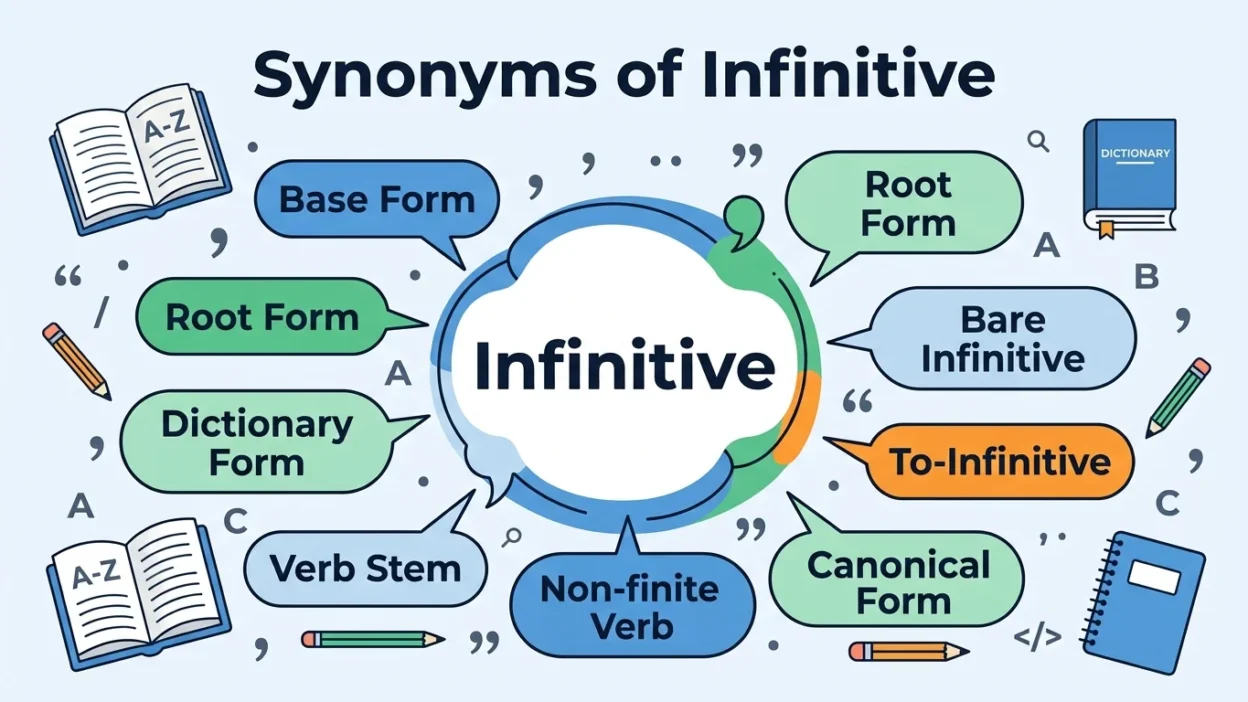
The phrase synonyms of infinitive is often searched by students, ESL learners, writers, and language enthusiasts who want to understand grammar terms more deeply and improve their English vocabulary.
Unlike common adjectives or verbs, infinitive is a grammatical term rather than an everyday descriptive word. Because of this, it does not have many direct synonyms. However, several related words and expressions can be used depending on the context, especially in grammar, linguistics, and language learning.
This guide explains the meaning of infinitive, explores 30 related terms and alternatives, and shows how each one is used. Whether you are studying English grammar, teaching language concepts, or creating educational content, this article will help you understand the topic in a simple and practical way.
What Does “Infinitive” Mean?
Meaning of Infinitive
An infinitive is the basic form of a verb. In English, it usually appears with the word to before the verb.
Examples include:
- To read
- To write
- To sing
- To learn
- To travel
Simple Explanation
An infinitive is the original form of a verb before it changes for tense, person, or number.
For example:
- To eat is an infinitive.
- Eats, ate, and eating are different verb forms.
Usage Context
People commonly use the word infinitive in:
- English grammar lessons
- Linguistics studies
- Language teaching
- Academic discussions
- ESL learning materials
Example:
“The teacher explained how to use the infinitive after certain verbs.”
30 Related Terms and Synonyms of Infinitive
1. Base Form
Meaning: The simplest form of a verb.
Example sentence:
Run is the base form of the verb.
Best usage context: Grammar explanations.
2. Verb Root
Meaning: The core part of a verb before endings are added.
Example sentence:
Students learned the verb root before studying tenses.
Best usage context: Linguistics.
3. Root Form
Meaning: The original version of a word or verb.
Example sentence:
The dictionary lists the root form first.
Best usage context: Language learning.
4. Basic Verb Form
Meaning: The unchanged version of a verb.
Example sentence:
Teachers introduce the basic verb form early in class.
Best usage context: ESL instruction.
5. Dictionary Form
Meaning: The verb form shown in dictionaries.
Example sentence:
Learners should memorize the dictionary form of verbs.
Best usage context: Vocabulary study.
6. Citation Form
Meaning: The standard form used for reference.
Example sentence:
The citation form helps students identify verbs quickly.
Best usage context: Linguistics.
7. Uninflected Form
Meaning: A verb without tense or grammatical endings.
Example sentence:
An infinitive is considered an uninflected form.
Best usage context: Formal grammar discussions.
8. Primary Form
Meaning: The original or first version of a word.
Example sentence:
The primary form appears before derived forms.
Best usage context: Academic writing.
9. Original Form
Meaning: The earliest or unchanged form.
Example sentence:
Students learned the original form before conjugation.
Best usage context: Language classes.
10. Verb Stem
Meaning: The part of a verb used to create other forms.
Example sentence:
The verb stem remains the same in many conjugations.
Best usage context: Linguistics.
11. Canonical Form
Meaning: The accepted standard version.
Example sentence:
Linguists often study the canonical form of verbs.
Best usage context: Formal linguistics.
12. Lexical Form
Meaning: The dictionary representation of a word.
Example sentence:
The lexical form helps organize vocabulary entries.
Best usage context: Lexicography.
13. Verb Entry
Meaning: The form listed in dictionaries.
Example sentence:
Every verb entry contains pronunciation details.
Best usage context: Dictionaries.
14. Non-finite Verb
Meaning: A verb that does not show tense.
Example sentence:
The infinitive is one type of non-finite verb.
Best usage context: Grammar studies.
15. Verbal Form
Meaning: A word derived from or functioning as a verb.
Example sentence:
An infinitive is considered a verbal form.
Best usage context: Grammar instruction.
16. Primitive Form
Meaning: The earliest stage of a word.
Example sentence:
Best usage context: Historical linguistics.
17. Underived Form
Meaning: A form that has not been modified.
Example sentence:
The infinitive is often treated as an underived form.
Best usage context: Advanced grammar.
18. Fundamental Form
Meaning: The most basic version.
Example sentence:
Students should learn the fundamental form first.
Best usage context: Educational materials.
19. Reference Form
Meaning: A standard form used for comparison.
Example sentence:
Teachers use the reference form in exercises.
Best usage context: Teaching grammar.
20. Core Form
Meaning: The essential structure of a verb.
Example sentence:
The core form stays unchanged.
Best usage context: Simplified grammar lessons.
21. Standard Form
Meaning: The accepted common version.
Example sentence:
The standard form appears in textbooks.
Best usage context: Educational writing.
22. Bare Infinitive
Meaning: An infinitive without the word “to.”
Example sentence:
After modal verbs, we use the bare infinitive.
Best usage context: English grammar.
23. To-infinitive
Meaning: An infinitive containing the word “to.”
Example sentence:
She wants to travel abroad.
Best usage context: ESL lessons.
24. Verb Pattern
Meaning: A structure showing verb usage.
Example sentence:
Some verb patterns require infinitives.
Best usage context: Teaching English.
25. Grammatical Form
Meaning: A structure used in grammar.
Example sentence:
The infinitive is an important grammatical form.
Best usage context: Academic grammar.
26. Basic Structure
Meaning: The simplest arrangement.
Example sentence:
Learners must understand the basic structure first.
Best usage context: Beginner ESL courses.
27. Verb Construction
Meaning: The way a verb is formed.
Example sentence:
This lesson explains verb construction.
Best usage context: Language instruction.
28. Elementary Form
Meaning: The simplest level of a word.
Example sentence:
The elementary form is easier for beginners.
Best usage context: Teaching children.
29. Principal Form
Meaning: The main or most important form.
Example sentence:
The principal form appears in grammar charts.
Best usage context: Academic studies.
30. Basic Expression
Meaning: The original way something is written.
Example sentence:
Students should identify the basic expression of verbs.
Best usage context: Introductory grammar lessons.
When to Use Different Synonyms of Infinitive
Quick Comparison Guide
| Term | Best Use | Tone |
|---|---|---|
| Base Form | ESL learning | Simple |
| Root Form | General grammar | Neutral |
| Dictionary Form | Vocabulary study | Educational |
| Non-finite Verb | Grammar analysis | Formal |
| Citation Form | Linguistics | Academic |
| Bare Infinitive | English grammar | Technical |
| To-infinitive | ESL teaching | Educational |
| Canonical Form | Linguistics | Formal |
| Standard Form | Textbooks | Neutral |
| Verb Stem | Advanced grammar | Academic |
How to Choose the Right Synonym
For Beginner ESL Learners
Choose terms such as:
- Base Form
- Root Form
- Basic Verb Form
- Dictionary Form
- Standard Form
These expressions are easy to understand and widely used in classrooms.
For Academic Writing
Consider using:
- Canonical Form
- Citation Form
- Lexical Form
- Non-finite Verb
- Verb Stem
These sound more technical and precise.
For Grammar Teaching
Useful options include:
- To-infinitive
- Bare Infinitive
- Verb Pattern
- Grammatical Form
- Fundamental Form
These terms frequently appear in English textbooks.
For Linguistics Discussions
Recommended words are:
- Underived Form
- Lexical Form
- Canonical Form
- Citation Form
These are common in language research and linguistic studies.
For Simplified Explanations
Choose:
- Base Form
- Original Form
- Core Form
- Basic Structure
- Elementary Form
These are ideal for younger students and beginners.
Why Understanding Infinitives Matters
Improves Grammar Skills
Learning infinitives helps students build stronger grammar foundations.
Supports Better Writing
Writers can create clearer sentences by understanding verb structures.
Enhances Speaking Ability
Knowing when to use infinitives improves fluency and sentence formation.
Helps ESL Learners
Infinitives are common in everyday English and appear frequently in exams, textbooks, and conversations.
Common Mistakes to Avoid
Assuming Infinitive Has Exact Synonyms
The term infinitive is a specific grammar concept. Most alternatives are related expressions rather than perfect synonyms.
Confusing Bare Infinitives and To-Infinitives
Remember:
- To eat = to-infinitive
- Eat = bare infinitive
Using Technical Terms in Casual Conversations
Words like canonical form and citation form are best reserved for academic discussions.
Conclusion
Understanding the synonyms of infinitive can make grammar learning easier and more interesting. Although infinitive is a specialized grammatical term, related expressions such as base form, root form, dictionary form, and non-finite verb help learners understand its meaning from different perspectives.
Students, teachers, writers, and ESL learners can benefit from knowing these alternatives because they provide greater clarity when studying language concepts. By choosing the right term for the right audience, grammar explanations become simpler, clearer, and more engaging.
Mastering infinitives and their related terms is an important step toward developing stronger English communication skills.