Words can have similar meanings, but they often carry different emotions, levels of formality, or subtle differences.
That is why understanding nuanced synonyms is important. Instead of using the same word repeatedly, you can choose a synonym that better matches your message, audience, or writing style.
Whether you are a student, an ESL learner, a writer, or a content creator, learning nuanced synonyms helps you communicate more naturally.
It improves your vocabulary, makes your writing more engaging, and helps you express ideas with greater accuracy.
In this guide, you’ll learn what nuanced synonyms are, explore 30 useful alternatives, understand when to use them, and discover practical tips for choosing the best synonym in different situations.
What Are Nuanced Synonyms?
Meaning of “Nuanced Synonyms”
Nuanced synonyms are words that have similar meanings but differ slightly in tone, emotion, strength, formality, or context.
For example, the words happy, joyful, content, and delighted all relate to positive feelings. However, each word expresses a different level of emotion.
Understanding these subtle differences helps you:
- Write more naturally.
- Avoid repetitive vocabulary.
- Match the right tone.
- Communicate more accurately.
- Improve academic and creative writing.
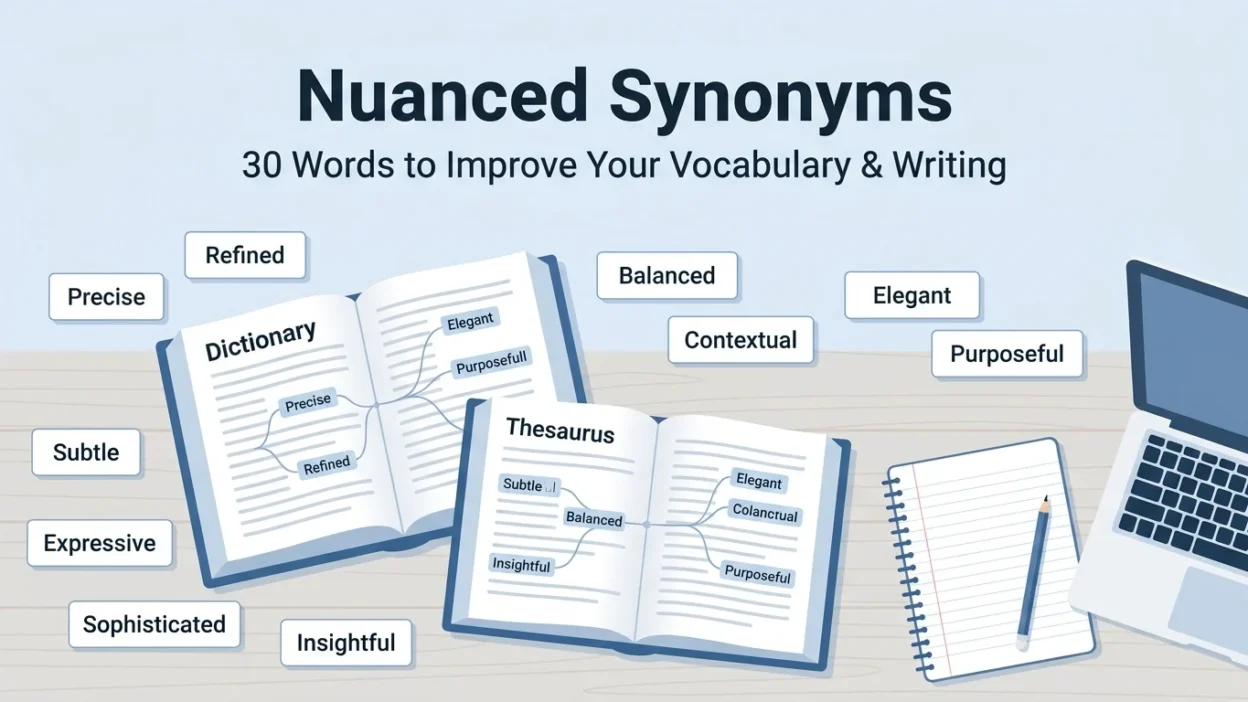
30 Nuanced Synonyms with Meanings, Examples, and Usage
1. Subtle
Meaning: Slight or not immediately obvious.
Example: The artist used subtle colors to create a peaceful feeling.
Best Usage Context: Small differences or gentle effects.
2. Refined
Meaning: Improved, polished, or elegant.
Example: Her refined writing impressed the editor.
Best Usage Context: Professional or sophisticated language.
3. Precise
Meaning: Exact and accurate.
Example: Choose precise words when writing reports.
Best Usage Context: Academic and technical writing.
4. Specific
Meaning: Clearly defined or detailed.
Example: Please give a specific example.
Best Usage Context: Instructions and explanations.
5. Detailed
Meaning: Including many important facts.
Example: The guide provides detailed instructions.
Best Usage Context: Tutorials and documentation.
6. Sophisticated
Meaning: Advanced or highly developed.
Example: The author uses sophisticated vocabulary.
Best Usage Context: Formal writing.
7. Expressive
Meaning: Showing thoughts or emotions clearly.
Example: Her expressive language made the story memorable.
Best Usage Context: Creative writing.
8. Descriptive
Meaning: Giving vivid details.
Example: The novel contains descriptive passages.
Best Usage Context: Storytelling.
9. Accurate
Meaning: Correct and free from mistakes.
Example: The explanation is accurate and easy to understand.
Best Usage Context: Educational content.
10. Careful
Meaning: Done with attention.
Example: Careful word choice improves clarity.
Best Usage Context: Editing and proofreading.
11. Thoughtful
Meaning: Showing careful consideration.
Example: His thoughtful response solved the problem.
Best Usage Context: Conversations and essays.
12. Delicate
Meaning: Gentle or sensitive.
Example: The teacher handled the topic delicately.
Best Usage Context: Sensitive discussions.
13. Balanced
Meaning: Fair and even.
Example: The article presents a balanced opinion.
Best Usage Context: Reviews and debates.
14. Insightful
Meaning: Showing deep understanding.
Example: Her insightful comments helped everyone.
Best Usage Context: Analysis and reviews.
15. Perceptive
Meaning: Quick to notice important details.
Example: He made a perceptive observation.
Best Usage Context: Critical thinking.
16. Meaningful
Meaning: Full of purpose or value.
Example: Their discussion was meaningful.
Best Usage Context: Personal and academic writing.
17. Contextual
Meaning: Related to the surrounding situation.
Example: Always understand words in their contextual meaning.
Best Usage Context: Language learning.
18. Intentional
Meaning: Done on purpose.
Example: Every word in the speech was intentional.
Best Usage Context: Writing and communication.
19. Elegant
Meaning: Graceful and effective.
Example: She wrote an elegant conclusion.
Best Usage Context: Literature and formal writing.
20. Polished
Meaning: Carefully improved.
Example: The final draft looks polished.
Best Usage Context: Professional writing.
21. Rich
Meaning: Full of detail or variety.
Example: The article contains rich vocabulary.
Best Usage Context: Descriptive writing.
22. Layered
Meaning: Having multiple meanings or ideas.
Example: The novel has layered characters.
Best Usage Context: Literary analysis.
23. Complex
Meaning: Made of many connected parts.
Example: Human emotions are complex.
Best Usage Context: Academic discussions.
24. Fine
Meaning: Showing small differences.
Example: There is a fine distinction between the terms.
Best Usage Context: Comparing meanings.
25. Distinctive
Meaning: Clearly different.
Example: Every writer has a distinctive style.
Best Usage Context: Branding and creativity.
26. Careful
Meaning: Paying close attention.
Example: A careful editor checks every sentence.
Best Usage Context: Revision and editing.
27. Nuanced
Meaning: Showing subtle differences.
Example: The speaker gave a nuanced explanation.
Best Usage Context: Critical thinking and analysis.
28. Well-Chosen
Meaning: Selected thoughtfully.
Example: The well-chosen examples clarified the lesson.
Best Usage Context: Teaching and presentations.
29. Purposeful
Meaning: Having a clear reason.
Example: Every sentence feels purposeful.
Best Usage Context: Essays and business writing.
30. Appropriate
Meaning: Suitable for the situation.
Example: Use appropriate language in formal emails.
Best Usage Context: Everyday communication.
Comparison Guide: When to Use Different Nuanced Synonyms
Quick Comparison Table
| Word | Best Used For | Tone |
|---|---|---|
| Subtle | Small differences | Neutral |
| Precise | Exact meanings | Formal |
| Refined | Elegant writing | Formal |
| Sophisticated | Advanced vocabulary | Professional |
| Expressive | Creative writing | Emotional |
| Descriptive | Storytelling | Neutral |
| Balanced | Fair discussions | Neutral |
| Insightful | Analysis | Intelligent |
| Polished | Final drafts | Professional |
| Layered | Literature | Academic |
| Elegant | Beautiful writing | Formal |
| Purposeful | Intentional communication | Professional |
How to Choose the Right Synonym
When You Want Accuracy
Choose:
- Precise
- Accurate
- Specific
- Fine
These words are ideal for academic papers, reports, and instructions.
When You Want Better Creative Writing
Choose:
- Expressive
- Descriptive
- Rich
- Elegant
- Layered
These make stories and blogs more vivid and engaging.
When You Need a Professional Tone
Choose:
- Refined
- Sophisticated
- Polished
- Balanced
- Purposeful
These work well in business writing and formal communication.
When Discussing Ideas or Analysis
Choose:
- Nuanced
- Insightful
- Perceptive
- Contextual
- Thoughtful
These are excellent for essays, reviews, and critical discussions.
When Writing for Everyday Readers
Choose:
- Meaningful
- Appropriate
- Careful
- Well-Chosen
- Specific
These are easy to understand and suitable for general audiences.
Why Learning Nuanced Synonyms Matters
Improve Vocabulary Naturally
Learning nuanced synonyms expands your vocabulary without memorizing difficult words.
Avoid Repetition
Using different but appropriate words keeps your writing fresh and interesting.
Match the Right Tone
Different situations require different language. The right synonym helps you sound formal, friendly, persuasive, or creative.
Write Like a Skilled Communicator
Professional writers rarely repeat the same word. They choose synonyms that best match the meaning and tone they want.
Become More Confident in English
Knowing subtle differences between similar words makes speaking and writing much easier.
Common Mistakes When Using Nuanced Synonyms
Choosing Words Only Because They Sound Fancy
A difficult word is not always the best choice. Always think about your audience.
Ignoring Context
Some synonyms fit formal writing but sound strange in casual conversations.
Forgetting Tone
Words with similar meanings can express different emotions or levels of politeness.
Using a Thesaurus Without Checking Meaning
Always read the definition and example before replacing a word.
Tips for Mastering Nuanced Synonyms
Read Regularly
Books, blogs, and newspapers show how experienced writers use different words naturally.
Learn Words in Sentences
Examples help you remember both meaning and context.
Practice Rewriting
Rewrite the same paragraph using different synonyms to see how the tone changes.
Build a Personal Vocabulary List
Keep a notebook of useful synonyms with meanings and examples.
Conclusion
Nuanced synonyms help you go beyond simple vocabulary by teaching you the subtle differences between similar words. Instead of choosing words based only on their dictionary definitions, you learn to consider tone, context, emotion, and purpose.
Whether you’re writing essays, creating content, improving your English, or simply expanding your vocabulary, understanding nuanced synonyms will make your communication clearer, richer, and more effective. Practice using these words in everyday writing, and you’ll gradually develop a more natural and confident writing style.

John Morrison is a dedicated content writer at Synomity.com, focused on synonyms, vocabulary development, and word meanings. He creates clear, educational resources that help readers improve language skills and communicate with confidence.