When describing a person, idea, object, or situation that has many different qualities or aspects, the word multifaceted is an excellent choice.
However, using the same word repeatedly can make your writing less engaging.
Learning multifaceted synonyms helps you express yourself more naturally while choosing the most accurate word for each situation.
Whether you’re a student writing an essay, an ESL learner expanding your vocabulary, a content creator crafting engaging articles, or a writer aiming for precision, understanding the subtle differences between similar words is an important skill.
The right synonym improves clarity, adds variety, and helps your message connect with readers.
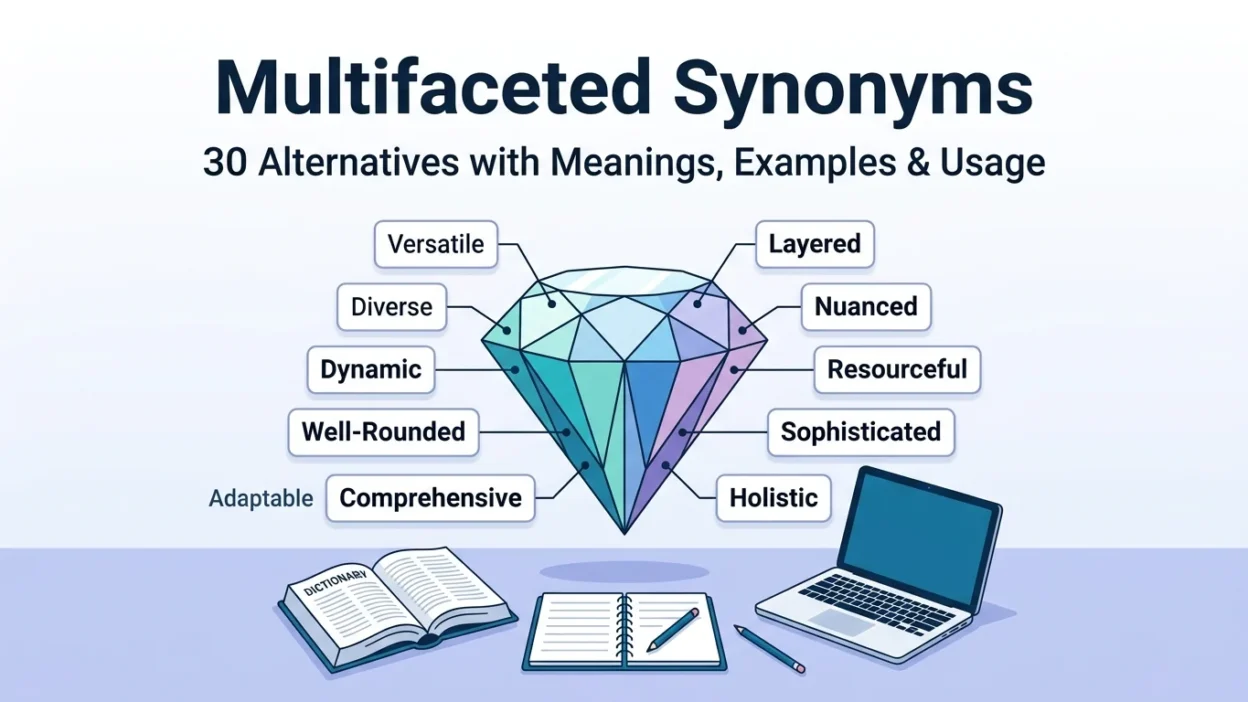
This guide explains the meaning of multifaceted, introduces 30 useful multifaceted synonyms, provides beginner-friendly meanings and examples, and shows you when each word works best.
What Does “Multifaceted” Mean?
Meaning of Multifaceted
The adjective multifaceted describes someone or something that has many different qualities, parts, abilities, or aspects.
It often refers to people with various talents, ideas with multiple viewpoints, or situations that are complex because they involve several factors.
Tone and Usage Context
The word multifaceted has a positive and professional tone. It is commonly used in:
- Academic writing
- Business communication
- Job descriptions
- Personal development
- Literature
- Journalism
Example:
A successful entrepreneur is often a multifaceted leader with skills in communication, management, and problem-solving.
30 Multifaceted Synonyms with Meanings, Examples, and Best Usage
1. Versatile
Meaning: Able to do many different things well.
Example: She is a versatile designer who works in print and digital media.
Best Usage Context: People with many talents.
2. Diverse
Meaning: Including many different types or varieties.
Example: The company has a diverse workforce.
Best Usage Context: Groups, cultures, or collections.
3. Complex
Meaning: Made up of many connected parts.
Example: Climate change is a complex issue.
Best Usage Context: Problems and systems.
4. Varied
Meaning: Having many different forms or types.
Example: His interests are varied.
Best Usage Context: Hobbies and experiences.
5. Dynamic
Meaning: Constantly changing or energetic.
Example: She has a dynamic personality.
Best Usage Context: Business and leadership.
6. Broad
Meaning: Covering many areas.
Example: He has broad knowledge of history.
Best Usage Context: Skills and education.
7. Comprehensive
Meaning: Complete and covering many topics.
Example: The report provides a comprehensive overview.
Best Usage Context: Research and reports.
8. Well-Rounded
Meaning: Skilled in many areas.
Example: Universities encourage well-rounded students.
Best Usage Context: Education and careers.
9. Adaptable
Meaning: Able to adjust easily.
Example: Adaptable employees succeed in changing workplaces.
Best Usage Context: Professional skills.
10. Flexible
Meaning: Able to change when needed.
Example: Flexible thinking leads to creative solutions.
Best Usage Context: Work and learning.
11. Resourceful
Meaning: Good at solving problems creatively.
Example: She is resourceful during emergencies.
Best Usage Context: Leadership.
12. Talented
Meaning: Naturally skilled.
Example: He is a talented musician.
Best Usage Context: Individual abilities.
13. Gifted
Meaning: Having exceptional natural ability.
Example: She is a gifted writer.
Best Usage Context: Education and arts.
14. Skilled
Meaning: Having learned abilities.
Example: Skilled workers improve productivity.
Best Usage Context: Jobs and professions.
15. Capable
Meaning: Able to perform successfully.
Example: She is capable of managing large projects.
Best Usage Context: Professional settings.
16. All-Around
Meaning: Good in many areas.
Example: He is an all-around athlete.
Best Usage Context: Sports and education.
17. Multi-Talented
Meaning: Having many talents.
Example: The artist is multi-talented.
Best Usage Context: Creative professionals.
18. Multifunctional
Meaning: Designed for several purposes.
Example: This multifunctional tool saves space.
Best Usage Context: Products and technology.
19. Layered
Meaning: Having several levels or meanings.
Example: The novel has layered themes.
Best Usage Context: Literature.
20. Nuanced
Meaning: Showing subtle differences.
Example: Her nuanced opinion impressed everyone.
Best Usage Context: Discussions and analysis.
21. Intricate
Meaning: Having many small connected details.
Example: The watch has an intricate design.
Best Usage Context: Art and engineering.
22. Elaborate
Meaning: Rich in detail.
Example: They created an elaborate plan.
Best Usage Context: Planning and design.
23. Inclusive
Meaning: Involving many different people or ideas.
Example: The school promotes an inclusive environment.
Best Usage Context: Education and workplaces.
24. Expansive
Meaning: Wide-ranging or extensive.
Example: She has expansive knowledge.
Best Usage Context: Knowledge and ideas.
25. Extensive
Meaning: Covering a large area or amount.
Example: He has extensive experience.
Best Usage Context: Resumes and reports.
26. Rich
Meaning: Full of variety or detail.
Example: The documentary offers rich historical insights.
Best Usage Context: Writing and storytelling.
27. Sophisticated
Meaning: Advanced and refined.
Example: The software includes sophisticated features.
Best Usage Context: Technology and business.
28. Dimensional
Meaning: Having several aspects.
Example: The character feels dimensional and realistic.
Best Usage Context: Literature and art.
29. Holistic
Meaning: Considering the whole instead of individual parts.
Example: The teacher uses a holistic approach.
Best Usage Context: Healthcare and education.
30. Far-Reaching
Meaning: Affecting many areas.
Example: The decision had far-reaching effects.
Best Usage Context: Politics and business.
Comparison Guide
When to Use Different Multifaceted Synonyms
| Synonym | Best For | Tone |
|---|---|---|
| Versatile | People with many skills | Positive |
| Well-Rounded | Students and professionals | Friendly |
| Diverse | Groups and cultures | Neutral |
| Comprehensive | Reports and research | Formal |
| Complex | Problems and systems | Neutral |
| Dynamic | Leadership | Professional |
| Holistic | Education and healthcare | Formal |
| Nuanced | Opinions and analysis | Academic |
| Sophisticated | Technology and business | Formal |
| Rich | Writing and storytelling | Creative |
| Multifunctional | Products and tools | Technical |
| Adaptable | Workplace skills | Professional |
How to Choose the Right Synonym
When Talking About People
Choose:
- Versatile
- Well-Rounded
- Multi-Talented
- Gifted
- Skilled
- Capable
These words highlight different abilities and talents.
When Describing Ideas or Problems
Choose:
- Complex
- Nuanced
- Layered
- Holistic
- Comprehensive
These fit essays, research papers, and discussions.
When Describing Products or Technology
Choose:
- Multifunctional
- Sophisticated
- Flexible
- Adaptable
These emphasize usefulness and functionality.
When Writing Creatively
Choose:
- Rich
- Intricate
- Elaborate
- Dimensional
- Dynamic
These make descriptions more vivid and engaging.
When Writing Professionally
Choose:
- Extensive
- Broad
- Comprehensive
- Expansive
- Far-Reaching
These are common in business reports, resumes, and academic writing.
Why Learning Multifaceted Synonyms Matters
Improve Vocabulary
Using different words makes your English stronger and more natural.
Avoid Repetition
Replacing repeated words keeps readers interested.
Match the Right Context
Each synonym fits different situations, audiences, and writing styles.
Strengthen Communication
The right word expresses your ideas more accurately.
Build Writing Confidence
A wider vocabulary helps you write essays, emails, articles, and stories with greater ease.
Common Mistakes to Avoid
Using Every Synonym Interchangeably
Not all synonyms have exactly the same meaning. Always consider context.
Choosing Difficult Words Unnecessarily
Simple words often communicate ideas more clearly.
Ignoring Tone
Formal writing usually requires different vocabulary than casual conversations.
Forgetting the Audience
Choose words your readers can easily understand.
Tips for Mastering Multifaceted Synonyms
Read Different Types of Content
Books, blogs, and newspapers expose you to varied vocabulary.
Learn Words in Context
Remember complete example sentences rather than isolated words.
Practice Daily
Use one new synonym each day in your writing.
Keep a Vocabulary Journal
Write down meanings, examples, and situations where each word fits best.
Conclusion
Learning multifaceted synonyms allows you to describe people, ideas, objects, and situations with greater accuracy and variety. Although many words share a similar meaning, each has its own tone, strength, and ideal context. By understanding these subtle differences, you’ll improve your vocabulary, avoid repetitive language, and become a more confident communicator.
Whether you’re writing essays, creating online content, improving your English, or preparing professional documents, choosing the right synonym helps your writing sound clearer, more engaging, and more natural. Practice these words regularly, and they’ll soon become a valuable part of your everyday vocabulary.

John Morrison is a dedicated content writer at Synomity.com, focused on synonyms, vocabulary development, and word meanings. He creates clear, educational resources that help readers improve language skills and communicate with confidence.