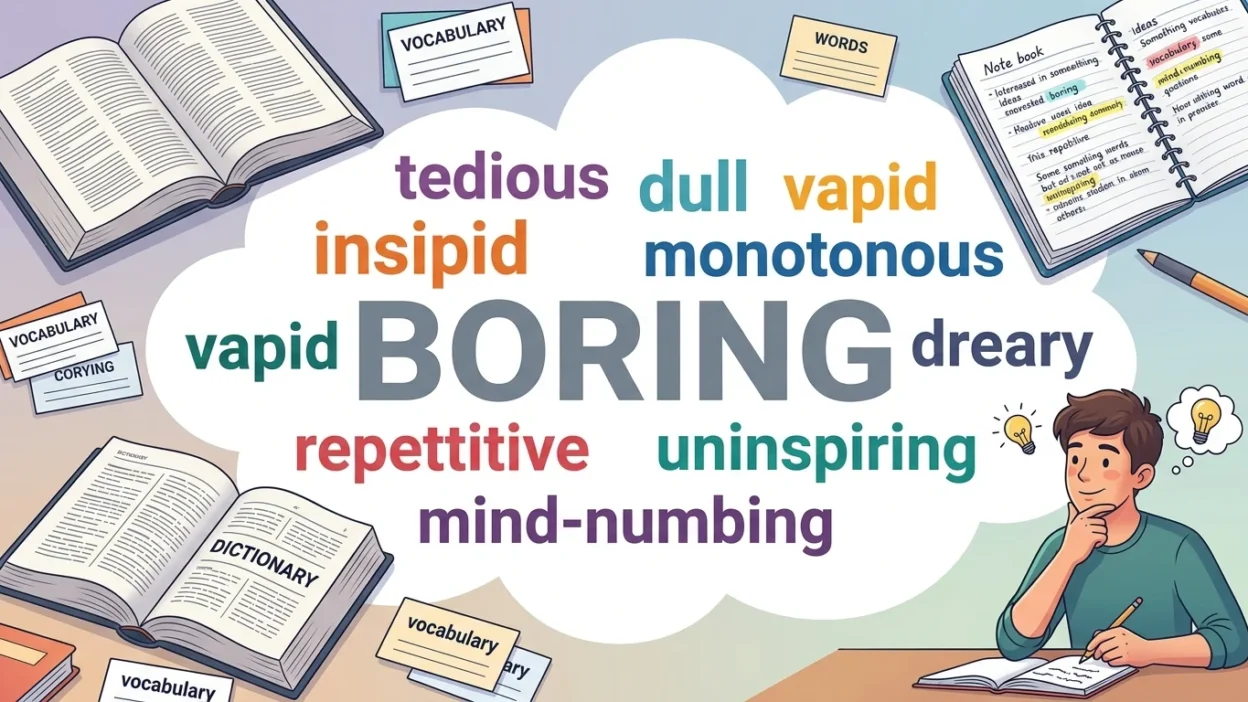
When exploring synonyms for boring, many learners discover that the word boring is among the most commonly-overused words in English, often leaving the reader unsure of what you truly mean. From my experience editing articles and guiding learners to improve vocabulary, I have seen how a simple upgrade in word choice can transform a sentence. Rather than depending on a vague description, choosing the right synonym from various alternatives adds flavor, substance, and useful information. With 50+ possible replacements, each option gently narrows the meaning and creates a more precise shade of expression.
A task that drags on can be called tedious, while weak writing may sound insipid, and an empty conversation can feel vapid or simply dull. This guide is carefully organized to help you pick the right word by considering tone, register, and context. Strong word-choice precision matters in both fiction and everyday communication because it helps you speak more genuinely and avoid sounding lazy. Even familiar words such as said, good, happy, big, small, walk, and look offer valuable replacement opportunities that contribute to writing stronger and more effectively.
If you prefer a single list, simply scroll through vocabulary boxes and select what fits best. Yet the broader question goes beyond finding a substitute; it involves understanding the framing behind each choice. The best writers know that vocabulary is not mere decoration. The goal is matching intent, audience, and the exact meaning you wish to convey.
Meaning of “Boring”
What Does “Boring” Mean?
The word boring describes something that fails to hold your attention or interest. It often refers to experiences, people, activities, books, conversations, or situations that feel dull, repetitive, or unexciting.
Tone and Usage Context
“Boring” is a common and neutral everyday word. You can use it in both spoken and written English.
Examples:
- The lecture was boring, and many students lost focus.
- I stopped reading the book because it became boring halfway through.
- Their conversation was so boring that nobody wanted to join in.
30 Synonyms for Boring
1. Dull
Meaning: Not interesting or exciting.
Example: The documentary felt dull after the first few minutes.
Best Usage Context: General situations and everyday descriptions.
2. Tedious
Meaning: Long, repetitive, and tiring.
Example: Filing hundreds of papers was a tedious task.
Best Usage Context: Work, chores, and lengthy activities.
3. Monotonous
Meaning: Lacking variety; always the same.
Example: The machine made a monotonous sound all day.
Best Usage Context: Repetitive routines and sounds.
4. Uninteresting
Meaning: Not attracting attention or curiosity.
Example: I found the article surprisingly uninteresting.
Best Usage Context: Formal and neutral writing.
5. Tiresome
Meaning: Making you feel impatient or exhausted.
Example: The endless complaints became tiresome.
Best Usage Context: Annoying repetition.
6. Dreary
Meaning: Dull and depressing.
Example: The rainy afternoon felt dreary.
Best Usage Context: Mood and atmosphere.
7. Mundane
Meaning: Ordinary and lacking excitement.
Example: Everyday household tasks can feel mundane.
Best Usage Context: Daily routines.
8. Dry
Meaning: Lacking emotion, humor, or excitement.
Example: The professor’s presentation was dry.
Best Usage Context: Speeches and academic subjects.
9. Flat
Meaning: Lacking energy or impact.
Example: The joke fell flat during the performance.
Best Usage Context: Entertainment and reactions.
10. Wearisome
Meaning: Causing tiredness through repetition.
Example: The wearisome debate lasted for hours.
Best Usage Context: Formal writing.
11. Humdrum
Meaning: Predictable and lacking excitement.
Example: He wanted to escape his humdrum lifestyle.
Best Usage Context: Daily life descriptions.
12. Repetitive
Meaning: Happening again and again.
Example: The song’s repetitive lyrics annoyed listeners.
Best Usage Context: Patterns and habits.
13. Lifeless
Meaning: Without energy or enthusiasm.
Example: The performance felt lifeless.
Best Usage Context: Artistic reviews.
14. Stale
Meaning: No longer fresh or interesting.
Example: The comedian relied on stale jokes.
Best Usage Context: Ideas and humor.
15. Colorless
Meaning: Lacking personality or excitement.
Example: The character seemed colorless.
Best Usage Context: Descriptions of people or writing.
16. Insipid
Meaning: Lacking flavor, interest, or vigor.
Example: The dialogue was insipid and forgettable.
Best Usage Context: Formal criticism.
17. Spiritless
Meaning: Without enthusiasm or life.
Example: Their spiritless response disappointed everyone.
Best Usage Context: Emotional reactions.
18. Listless
Meaning: Showing little energy or interest.
Example: The audience looked listless.
Best Usage Context: Describing behavior.
19. Uninspiring
Meaning: Failing to motivate or excite.
Example: The campaign delivered an uninspiring message.
Best Usage Context: Speeches and leadership.
20. Predictable
Meaning: Easy to guess; lacking surprises.
Example: The movie had a predictable ending.
Best Usage Context: Reviews and storytelling.
21. Slow
Meaning: Moving or progressing without excitement.
Example: The plot was too slow for younger viewers.
Best Usage Context: Films and books.
22. Sleep-Inducing
Meaning: So boring it makes you sleepy.
Example: The lecture was almost sleep-inducing.
Best Usage Context: Informal conversations.
23. Mind-Numbing
Meaning: Extremely boring or mentally exhausting.
Example: The repetitive data entry felt mind-numbing.
Best Usage Context: Strong emphasis.
24. Dragging
Meaning: Moving too slowly and losing interest.
Example: The meeting started dragging after lunch.
Best Usage Context: Casual speech.
25. Trite
Meaning: Overused and lacking originality.
Example: The speech was filled with trite expressions.
Best Usage Context: Formal critique.
26. Routine
Meaning: Ordinary and predictable.
Example: The job became routine after a few months.
Best Usage Context: Work and habits.
27. Mechanical
Meaning: Done without feeling or creativity.
Example: His delivery sounded mechanical.
Best Usage Context: Behavior and performances.
28. Prosaic
Meaning: Plain and unimaginative.
Example: The author’s description felt prosaic.
Best Usage Context: Literary writing.
29. Uneventful
Meaning: Without anything exciting happening.
Example: It was an uneventful weekend.
Best Usage Context: Experiences and events.
30. Ordinary
Meaning: Common and not special.
Example: The attraction turned out to be quite ordinary.
Best Usage Context: General descriptions.
Comparison Guide: When to Use Different Synonyms
Quick Reference Table
| Synonym | Tone | Best Used For |
|---|---|---|
| Dull | Neutral | Everyday situations |
| Tedious | Slightly Negative | Long tasks |
| Monotonous | Neutral | Repetition |
| Mundane | Neutral | Daily routines |
| Dry | Informal | Lectures and presentations |
| Dreary | Negative | Mood and atmosphere |
| Predictable | Neutral | Stories and movies |
| Uninspiring | Formal | Ideas and speeches |
| Mind-numbing | Strong | Extremely boring tasks |
| Trite | Formal | Overused ideas |
| Humdrum | Mild | Lifestyle descriptions |
| Uneventful | Neutral | Experiences and trips |
How to Choose the Right Synonym
For School Assignments and Essays
Use:
- Uninteresting
- Tedious
- Monotonous
- Uninspiring
- Trite
These words sound more polished and academic.
For Casual Conversations
Use:
- Dull
- Dry
- Dragging
- Sleep-inducing
- Predictable
They are easy to understand and commonly used.
For Strong Criticism
Use:
- Mind-numbing
- Insipid
- Wearisome
- Lifeless
- Dreary
These words emphasize how unpleasant or frustrating something feels.
For Daily Life and Routine
Use:
- Mundane
- Humdrum
- Routine
- Ordinary
- Repetitive
These are ideal for describing everyday experiences.
For Creative and Literary Writing
Use:
- Prosaic
- Colorless
- Spiritless
- Flat
- Stale
They add nuance and sophistication to descriptions.
Why Learning Synonyms for Boring Matters
Improve Your Vocabulary
Using varied vocabulary makes your communication richer and more precise.
Make Writing More Engaging
Readers appreciate word variety because it keeps content fresh and interesting.
Express Different Levels of Meaning
Not every boring experience feels the same. A lecture may be “dry,” while repetitive office work might be “tedious” or “mind-numbing.”
Build ESL Confidence
Understanding subtle differences between similar words helps learners sound more natural and fluent in English.
Conclusion
Learning these synonyms for boring allows you to move beyond repeating the same adjective in every situation. Each word carries its own shade of meaning, helping you describe experiences with greater accuracy and style.
Whether you’re reviewing a movie, writing an essay, describing a repetitive task, or improving your English vocabulary, choosing the right synonym can make your communication clearer and more effective. Start by practicing a few of these alternatives in your daily conversations and writing. Over time, you’ll develop a richer vocabulary and stronger command of English expression.

John Morrison is a dedicated content writer at Synomity.com, focused on synonyms, vocabulary development, and word meanings. He creates clear, educational resources that help readers improve language skills and communicate with confidence.