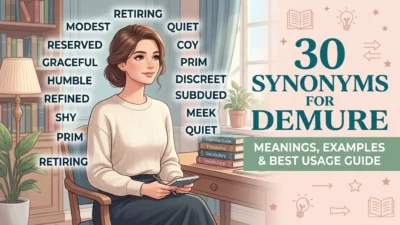
If you have ever wondered what demure means and how to express similar ideas using different words, this guide is for you. Learning synonyms helps students, ESL learners, writers, and content creators improve their vocabulary and communicate more clearly.
The English language offers many words that can replace or closely match the meaning of demure. Each synonym carries a slightly different tone, making it useful in specific situations. Understanding these subtle differences can help you choose the right word for essays, stories, conversations, and professional writing.
In this complete guide, you’ll learn the meaning of demure, explore 30 useful synonyms, see example sentences, and discover when each word works best.
What Does Demure Mean?
Demure is an adjective used to describe someone who is quiet, modest, reserved, or shy in a polite and attractive way.
A demure person usually behaves calmly, avoids drawing too much attention to themselves, and shows modesty in their actions, appearance, or speech.
Example:
She gave a demure smile when she received the award.
Tone and Usage
The word demure often has a positive tone. It is commonly used to describe:
- Modest behavior
- Reserved personality
- Polite manners
- Quiet confidence
- Conservative appearance
30 Synonyms of Demure
1. Modest
Meaning: Not showing off or boasting.
Example: She remained modest despite her success.
Best Usage Context: Humble behavior and achievements.
2. Reserved
Meaning: Quiet and not overly expressive.
Example: He was reserved during the meeting.
Best Usage Context: Personality descriptions.
3. Shy
Meaning: Nervous or uncomfortable around others.
Example: The shy student avoided speaking in class.
Best Usage Context: Social situations.
4. Timid
Meaning: Lacking confidence or courage.
Example: The timid child stood behind his mother.
Best Usage Context: Gentle and cautious behavior.
5. Quiet
Meaning: Not speaking much.
Example: She remained quiet throughout dinner.
Best Usage Context: General communication.
6. Humble
Meaning: Not proud or arrogant.
Example: He stayed humble after winning the competition.
Best Usage Context: Personal character.
7. Unassuming
Meaning: Not seeking attention.
Example: Despite her fame, she remained unassuming.
Best Usage Context: Personality traits.
8. Meek
Meaning: Gentle and submissive.
Example: The meek employee rarely argued.
Best Usage Context: Soft-spoken individuals.
9. Retiring
Meaning: Avoiding attention or publicity.
Example: Her retiring nature made her difficult to know.
Best Usage Context: Introverted personalities.
10. Coy
Meaning: Shy in a playful or attractive way.
Example: She gave him a coy glance.
Best Usage Context: Romantic situations.
11. Bashful
Meaning: Easily embarrassed.
Example: The bashful boy blushed when praised.
Best Usage Context: Social interactions.
12. Introverted
Meaning: Preferring solitude over large groups.
Example: She is introverted and enjoys reading alone.
Best Usage Context: Personality discussions.
13. Soft-Spoken
Meaning: Speaking gently and quietly.
Example: The teacher was soft-spoken and kind.
Best Usage Context: Speech and communication.
14. Proper
Meaning: Following accepted rules and manners.
Example: She always behaved in a proper manner.
Best Usage Context: Formal situations.
15. Polite
Meaning: Showing good manners.
Example: The polite guest thanked everyone.
Best Usage Context: Everyday interactions.
16. Ladylike
Meaning: Graceful and refined.
Example: Her ladylike behavior impressed the guests.
Best Usage Context: Traditional etiquette.
17. Well-Mannered
Meaning: Behaving respectfully.
Example: The well-mannered child greeted everyone.
Best Usage Context: Social conduct.
18. Restrained
Meaning: Controlled and moderate.
Example: He gave a restrained response.
Best Usage Context: Emotions and reactions.
19. Discreet
Meaning: Careful not to attract attention.
Example: She was discreet about her personal life.
Best Usage Context: Privacy and professionalism.
20. Conservative
Meaning: Traditional and cautious.
Example: She preferred conservative clothing styles.
Best Usage Context: Fashion and values.
21. Graceful
Meaning: Elegant and smooth in behavior.
Example: The graceful dancer moved beautifully.
Best Usage Context: Appearance and movement.
22. Gentle
Meaning: Kind and calm.
Example: He had a gentle personality.
Best Usage Context: Character descriptions.
23. Subdued
Meaning: Quiet and not intense.
Example: Her subdued reaction surprised everyone.
Best Usage Context: Emotions and moods.
24. Self-Effacing
Meaning: Avoiding praise and attention.
Example: The self-effacing leader credited the team.
Best Usage Context: Professional settings.
25. Prim
Meaning: Very proper and formal.
Example: Her prim manners reflected strict upbringing.
Best Usage Context: Formal behavior.
26. Decorous
Meaning: Respectful and socially acceptable.
Example: The audience remained decorous throughout the event.
Best Usage Context: Formal occasions.
27. Reserved-Mannered
Meaning: Calm and not expressive.
Example: His reserved-mannered approach earned trust.
Best Usage Context: Personality descriptions.
28. Composed
Meaning: Calm and controlled.
Example: She remained composed during the interview.
Best Usage Context: Stressful situations.
29. Respectful
Meaning: Showing consideration for others.
Example: The respectful student listened carefully.
Best Usage Context: Social and professional settings.
30. Dignified
Meaning: Calm, serious, and worthy of respect.
Example: She maintained a dignified attitude.
Best Usage Context: Leadership and formal situations.
Quick Comparison Guide
| Synonym | Best For | Tone |
|---|---|---|
| Modest | Humility | Positive |
| Reserved | Quiet personality | Neutral |
| Shy | Social nervousness | Neutral |
| Coy | Flirtation | Playful |
| Meek | Gentle submission | Soft |
| Humble | Character traits | Positive |
| Discreet | Privacy | Professional |
| Restrained | Controlled emotions | Formal |
| Graceful | Elegant behavior | Positive |
| Dignified | Respectable conduct | Formal |
How to Choose the Right Synonym
Choosing the best synonym depends on the tone and situation.
For Humility
Use:
- Modest
- Humble
- Self-Effacing
- Unassuming
These words emphasize a lack of arrogance.
For Shyness
Use:
- Shy
- Bashful
- Timid
- Coy
These words focus on social behavior and confidence levels.
For Quiet Personalities
Use:
- Reserved
- Introverted
- Soft-Spoken
- Retiring
These words describe people who naturally prefer less attention.
For Formal or Professional Writing
Use:
- Discreet
- Restrained
- Decorous
- Dignified
These synonyms sound polished and professional.
For Elegance and Good Manners
Use:
- Graceful
- Polite
- Proper
- Well-Mannered
- Ladylike
These words highlight refinement and respectful behavior.
Common Mistakes When Using Demure Synonyms
Using “Shy” and “Reserved” as Exact Matches
A shy person may feel nervous, while a reserved person simply chooses not to share much.
Using “Meek” Positively in Every Situation
Meek can sometimes suggest weakness, while demure usually sounds more positive.
Using “Coy” in Formal Writing
Coy often has a playful or romantic tone, making it unsuitable for professional contexts.
Why Learning Demure Synonyms Matters
Expanding your vocabulary helps you:
- Write more naturally
- Avoid repetition
- Express precise meanings
- Improve essays and assignments
- Create engaging content
- Communicate confidently in English
Whether you are a student, ESL learner, writer, or content creator, understanding demure synonyms gives you more flexibility and accuracy in your writing.
Conclusion
The word demure describes someone who is modest, reserved, and politely quiet. While it is a useful word, English offers many alternatives that fit different situations. Words such as modest, reserved, humble, graceful, discreet, and dignified can help you express subtle differences in personality and behavior.
By understanding the meanings, examples, and usage contexts of these 30 synonyms, you can choose the most accurate word for every situation. The right synonym makes your writing clearer, more engaging, and more professional.

John Morrison is a dedicated content writer at Synomity.com, focused on synonyms, vocabulary development, and word meanings. He creates clear, educational resources that help readers improve language skills and communicate with confidence.