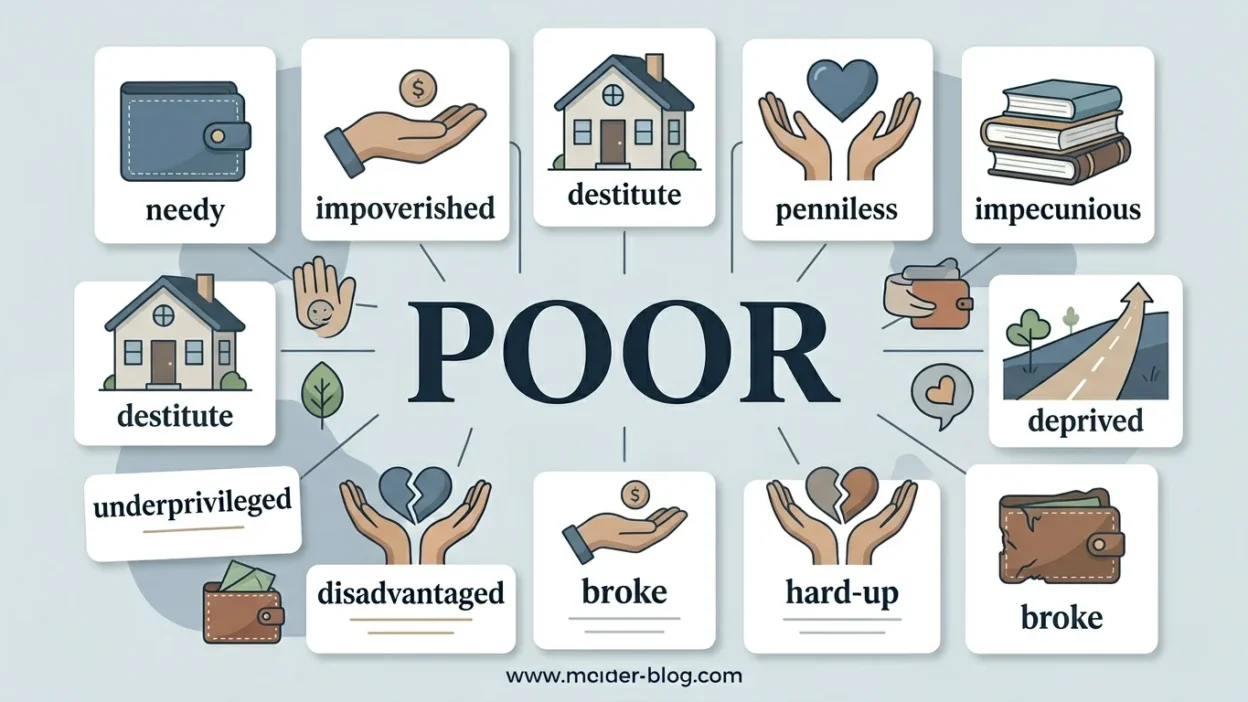
The simple term poor is often used to describe people lacking money, means, and the ability to obtain basic comforts in life. Exploring synonyms for poor reveals how a family living in this condition may experience poverty, while the word itself suggests hardship that can affect everyday choices and opportunities. Through years of writing about language, I have found that understanding these distinctions helps readers recognize how vocabulary reflects real human experiences rather than abstract definitions.
Additional words such as impecunious, impoverished, and penniless introduce deeper layers of meaning. Impecunious often points to the consequence of unwise habits, perhaps describing an actor facing financial struggles that developed over time. Impoverished implies a former state of greater plenty that has been reduced, while an aristocracy may have lost its wealth. The mean of a synonym can apply differently depending on context, reminding us that synonyms rarely share identical meanings.
At other moments, destitute refers to severe hardship, while temporary shortages of funds can leave someone feeling penniless. The story of a widow left with three small children, struggling without support and focused on being resilient, helps illustrate how these words connect language with empathy and deeper understanding
Meaning of the Keyword “Poor”
What Does “Poor” Mean?
The word poor generally means lacking enough money or resources. However, it can also describe something of low quality, an unsatisfactory performance, bad conditions, or evoke compassion for someone experiencing hardship.
Tone and Usage Context
- Tone: Neutral, sympathetic, critical, or descriptive depending on context.
- Usage Context: Financial situations, quality assessments, performance reviews, health conditions, and expressions of empathy.
Example:
The family faced poor living conditions but remained hopeful about the future.
30 Synonyms for Poor
1. Needy
Meaning: Lacking basic necessities or financial support.
Example:
The charity helps needy families.
Best Usage Context: Financial hardship and social support.
2. Impoverished
Meaning: Extremely poor and lacking resources.
Example:
The organization worked in impoverished communities.
Best Usage Context: Formal discussions about poverty.
3. Destitute
Meaning: Having no money or possessions.
Example:
After the disaster, many people became destitute.
Best Usage Context: Severe financial hardship.
4. Penniless
Meaning: Having no money at all.
Example:
He arrived in the city penniless.
Best Usage Context: Informal and narrative writing.
5. Indigent
Meaning: Poor and in need of assistance.
Example:
The clinic provides services to indigent patients.
Best Usage Context: Legal and formal contexts.
6. Underprivileged
Meaning: Lacking social and economic advantages.
Example:
The program supports underprivileged children.
Best Usage Context: Education and community work.
7. Disadvantaged
Meaning: Facing unfavorable circumstances.
Example:
Disadvantaged groups often need additional support.
Best Usage Context: Social and educational discussions.
8. Broke
Meaning: Having little or no money.
Example:
I’m broke until payday.
Best Usage Context: Everyday conversations.
9. Hard-up
Meaning: Experiencing financial difficulties.
Example:
Many students are hard-up during college.
Best Usage Context: Informal speech.
10. Insolvent
Meaning: Unable to pay debts.
Example:
The company became insolvent.
Best Usage Context: Business and finance.
11. Bankrupt
Meaning: Legally declared unable to repay debts.
Example:
The retailer filed for bankruptcy.
Best Usage Context: Financial and legal discussions.
12. Deprived
Meaning: Lacking necessities or opportunities.
Example:
Children in deprived areas need support.
Best Usage Context: Social issues.
13. Unfortunate
Meaning: Experiencing bad luck or hardship.
Example:
It was an unfortunate situation.
Best Usage Context: Sympathetic descriptions.
14. Miserable
Meaning: Extremely unhappy or uncomfortable.
Example:
He felt miserable after losing his job.
Best Usage Context: Emotional states.
15. Wretched
Meaning: In a very unhappy condition.
Example:
The refugees lived in wretched conditions.
Best Usage Context: Strong emotional descriptions.
16. Inferior
Meaning: Lower in quality.
Example:
The product was inferior to its competitors.
Best Usage Context: Comparisons.
17. Substandard
Meaning: Below the accepted standard.
Example:
The inspection revealed substandard materials.
Best Usage Context: Quality assessments.
18. Inadequate
Meaning: Not sufficient or good enough.
Example:
The training was inadequate.
Best Usage Context: Performance evaluations.
19. Unsatisfactory
Meaning: Not meeting expectations.
Example:
The results were unsatisfactory.
Best Usage Context: Reviews and feedback.
20. Deficient
Meaning: Lacking an important quality or element.
Example:
The report was deficient in detail.
Best Usage Context: Academic and professional writing.
21. Weak
Meaning: Lacking strength or effectiveness.
Example:
The argument was weak.
Best Usage Context: Performance and reasoning.
22. Mediocre
Meaning: Average and not impressive.
Example:
The film received mediocre reviews.
Best Usage Context: Criticism and evaluations.
23. Bad
Meaning: Not good in quality or performance.
Example:
He had a bad experience.
Best Usage Context: Everyday language.
24. Awful
Meaning: Extremely bad.
Example:
The weather was awful.
Best Usage Context: Informal emphasis.
25. Terrible
Meaning: Very poor or unpleasant.
Example:
She gave a terrible presentation.
Best Usage Context: General criticism.
26. Pathetic
Meaning: Inadequate in a disappointing way.
Example:
The effort was pathetic.
Best Usage Context: Strong criticism.
27. Pitiful
Meaning: Deserving sympathy.
Example:
The abandoned animal looked pitiful.
Best Usage Context: Compassionate descriptions.
28. Meager
Meaning: Small and insufficient.
Example:
They survived on meager wages.
Best Usage Context: Limited resources.
29. Scant
Meaning: Barely enough.
Example:
There was scant evidence.
Best Usage Context: Formal writing.
30. Sparse
Meaning: Thinly distributed or limited.
Example:
The region has sparse vegetation.
Best Usage Context: Descriptions of quantity.
Comparison Guide: When to Use Different Synonyms
| Situation | Best Synonyms |
|---|---|
| Financial hardship | Needy, Impoverished, Destitute, Penniless |
| Formal discussions | Indigent, Insolvent, Deprived |
| Everyday conversations | Broke, Hard-up, Bad |
| Poor quality | Inferior, Substandard, Inadequate |
| Negative evaluations | Unsatisfactory, Mediocre, Terrible |
| Sympathy and compassion | Pitiful, Unfortunate, Wretched |
| Limited amounts | Meager, Scant, Sparse |
How to Choose the Right Synonym
For Financial Poverty
Use:
- Needy
- Impoverished
- Destitute
- Penniless
These emphasize a lack of money or resources.
For Low Quality
Use:
- Inferior
- Substandard
- Inadequate
- Mediocre
These describe products, work, or performance.
For Informal Conversations
Use:
- Broke
- Bad
- Awful
- Terrible
These are common in everyday English.
For Sympathy and Hardship
Use:
- Pitiful
- Unfortunate
- Miserable
- Wretched
These express empathy or emotional difficulty.
For Limited Resources
Use:
- Meager
- Scant
- Sparse
These highlight insufficiency or scarcity.
Why Learning Synonyms for Poor Matters
Expanding your vocabulary offers several benefits:
- It prevents repetitive writing.
- It improves essays and assignments.
- It strengthens storytelling skills.
- It allows more accurate communication.
- It boosts confidence in English.
- It helps you understand subtle differences in tone.
Choosing the right synonym ensures that your message sounds natural, precise, and appropriate for the situation.
Conclusion
Learning synonyms for poor helps you understand the many ways this versatile word is used in English. From financial hardship and low quality to emotional struggle and limited resources, each synonym carries its own shade of meaning.
By mastering these alternatives, students, ESL learners, writers, and content creators can communicate more effectively and express ideas with greater clarity. The key is not simply memorizing lists but understanding when and why each word fits a particular context.

Evelyn Mia is a passionate language writer and vocabulary enthusiast at Synomity.com, specializing in synonyms, word meanings, and language learning. She creates informative content that helps readers expand vocabulary and communicate more effectively.