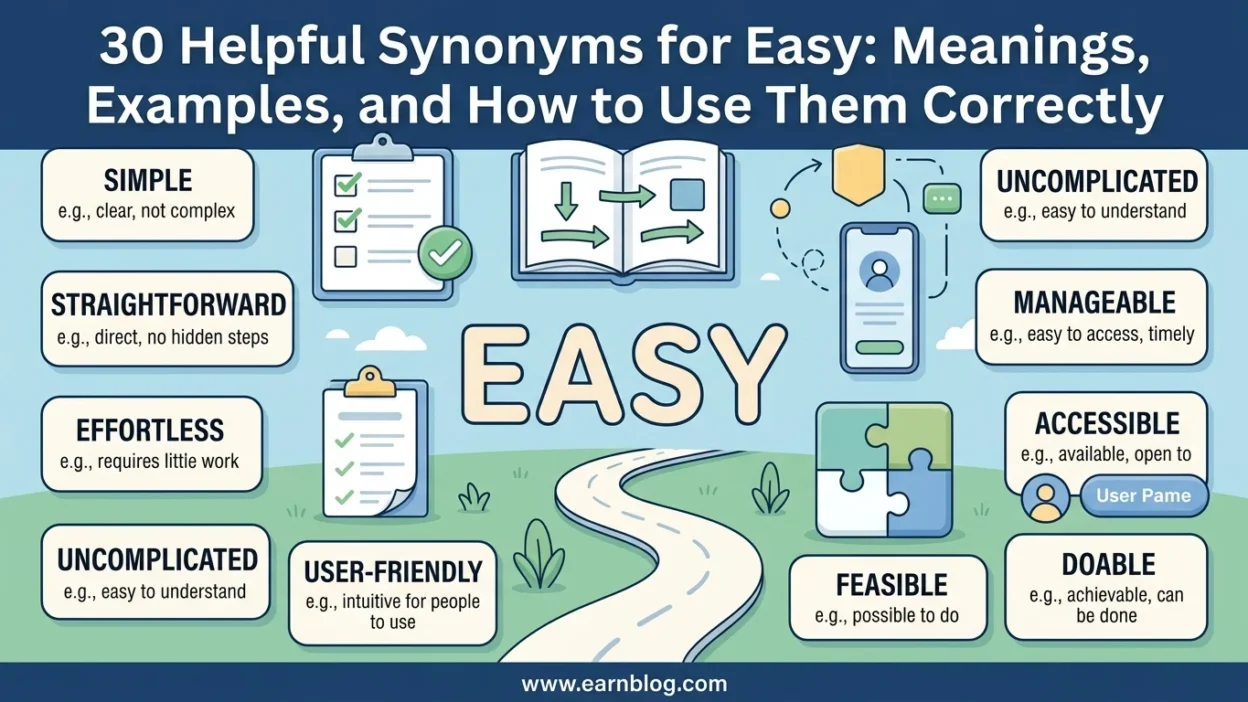
In an academic context, understanding synonyms for easy helps writers choose language that sounds polished while remaining clear and accessible. The word easy should be used sparingly to describe ideas that are not intellectually challenging, since overly simplistic or colloquial language may undermine the professionalism and credibility of a text, especially in formal assignments. Drawing from my experience in editing educational content, I have found it recommended to choose precise alternatives that better match the intended tone.
For example, terms such as simple, straightforward, and effortless are useful synonyms in writing when greater accuracy is needed. As shown below in many style guides, students looking for suitable vocabulary in an academic paper can benefit from reviewing a table of top suggestions. Resources from the BachelorPrint-Team often encourage writers to use other words that fit the situation more appropriately.
More generally, selecting the right synonym improves clarity and strengthens the impact of your message without sacrificing readability or precision, making communication both effective and professional.
Meaning of the Keyword “Easy”
What Does “Easy” Mean?
The word easy generally means something that is not difficult and can be done with little effort. It can also describe someone who is relaxed, situations that are comfortable, or processes that are convenient and straightforward.
Tone and Usage Context
- Tone: Positive, casual, reassuring, and practical.
- Usage Context: Schoolwork, daily activities, instructions, relationships, problem-solving, and comfort.
Example:
The teacher gave us an easy assignment that everyone could complete quickly.
30 Synonyms for Easy
1. Simple
Meaning: Not complicated or difficult.
Example:
The instructions were simple to follow.
Best Usage Context: Directions and explanations.
2. Effortless
Meaning: Requiring little or no effort.
Example:
She made public speaking look effortless.
Best Usage Context: Skills and achievements.
3. Straightforward
Meaning: Clear and uncomplicated.
Example:
The application process was straightforward.
Best Usage Context: Procedures and tasks.
4. Uncomplicated
Meaning: Free from complexity.
Example:
We need an uncomplicated solution.
Best Usage Context: Problem-solving.
5. Manageable
Meaning: Easy enough to handle.
Example:
The workload felt manageable.
Best Usage Context: Responsibilities and tasks.
6. Convenient
Meaning: Suitable and easy to use.
Example:
Online banking is convenient.
Best Usage Context: Daily life.
7. Comfortable
Meaning: Relaxed and at ease.
Example:
The chair was comfortable.
Best Usage Context: Physical and emotional comfort.
8. Relaxed
Meaning: Calm and free from stress.
Example:
He seemed relaxed before the exam.
Best Usage Context: Emotions and atmosphere.
9. Smooth
Meaning: Free from difficulties or interruptions.
Example:
The meeting went smoothly.
Best Usage Context: Processes and events.
10. Painless
Meaning: Causing little discomfort.
Example:
The procedure was painless.
Best Usage Context: Medical situations.
11. Light
Meaning: Not demanding or heavy.
Example:
She had a light workload.
Best Usage Context: Work and responsibilities.
12. Undemanding
Meaning: Requiring little effort.
Example:
The role was relatively undemanding.
Best Usage Context: Jobs and activities.
13. Breezy
Meaning: Casual and easygoing.
Example:
His breezy attitude impressed everyone.
Best Usage Context: Informal descriptions.
14. User-friendly
Meaning: Easy for people to use.
Example:
The software is user-friendly.
Best Usage Context: Technology.
15. Accessible
Meaning: Easy to understand or reach.
Example:
The guide made science accessible.
Best Usage Context: Education and services.
16. Elementary
Meaning: Very basic and simple.
Example:
The math problem was elementary.
Best Usage Context: Learning contexts.
17. Basic
Meaning: Simple and fundamental.
Example:
He learned the basic rules.
Best Usage Context: Teaching and instruction.
18. Routine
Meaning: Regular and familiar.
Example:
The checkup was routine.
Best Usage Context: Everyday activities.
19. Familiar
Meaning: Well-known and easy to recognize.
Example:
The process felt familiar.
Best Usage Context: Repeated experiences.
20. Natural
Meaning: Happening easily without force.
Example:
Their conversation felt natural.
Best Usage Context: Communication and behavior.
21. Fluid
Meaning: Smooth and effortless.
Example:
Her movements were fluid.
Best Usage Context: Performance and movement.
22. Seamless
Meaning: Without difficulties or interruptions.
Example:
The transition was seamless.
Best Usage Context: Business and technology.
23. Handy
Meaning: Useful and convenient.
Example:
This app is handy for travelers.
Best Usage Context: Everyday tools.
24. Practical
Meaning: Sensible and easy to apply.
Example:
She offered practical advice.
Best Usage Context: Problem-solving.
25. Feasible
Meaning: Possible and achievable.
Example:
The proposal seems feasible.
Best Usage Context: Planning and projects.
26. Achievable
Meaning: Able to be accomplished.
Example:
The goal is achievable.
Best Usage Context: Motivation and objectives.
27. Doable
Meaning: Possible to complete successfully.
Example:
The assignment is doable.
Best Usage Context: Informal encouragement.
28. Effort-free
Meaning: Done without noticeable effort.
Example:
He appeared effort-free during the performance.
Best Usage Context: Describing skill.
29. Trouble-free
Meaning: Without problems or complications.
Example:
We had a trouble-free vacation.
Best Usage Context: Experiences and events.
30. Easygoing
Meaning: Relaxed and tolerant.
Example:
She has an easygoing personality.
Best Usage Context: Personality traits.
Comparison Guide: When to Use Different Synonyms
| Situation | Best Synonyms |
|---|---|
| School and learning | Simple, Elementary, Basic |
| Tasks and responsibilities | Manageable, Doable, Achievable |
| Technology and services | User-friendly, Accessible, Seamless |
| Relaxed personalities | Easygoing, Relaxed, Breezy |
| Problem-solving | Practical, Feasible, Straightforward |
| Comfort and ease | Comfortable, Natural, Smooth |
| Everyday convenience | Handy, Convenient, Routine |
How to Choose the Right Synonym
For School and Education
Use:
- Simple
- Elementary
- Basic
These emphasize clarity and ease of understanding.
For Goals and Projects
Use:
- Feasible
- Achievable
- Doable
These focus on possibility and success.
For Technology
Use:
- User-friendly
- Accessible
- Seamless
These describe systems that are easy to navigate.
For Relaxed Situations
Use:
- Relaxed
- Easygoing
- Breezy
These highlight comfort and a stress-free attitude.
For Smooth Experiences
Use:
- Smooth
- Fluid
- Trouble-free
These suggest a lack of obstacles or interruptions.
Why Learning Synonyms for Easy Matters
Expanding your vocabulary helps you:
- Avoid repetitive writing.
- Improve essays and assignments.
- Communicate ideas more clearly.
- Sound more natural in English.
- Strengthen storytelling and content creation.
- Build confidence in speaking and writing.
Understanding the subtle differences between similar words allows you to select the most accurate expression for each situation.
Conclusion
Learning synonyms for easy helps you move beyond basic vocabulary and express yourself with greater precision. Whether you’re describing a simple task, a relaxed personality, a convenient process, or an achievable goal, choosing the right synonym improves clarity and style.
For students, ESL learners, writers, and content creators, mastering these alternatives can make communication more engaging and effective. The more you practice using them, the more natural and confident your English will become.

Lucas Smith is a skilled language writer at Synomity.com, passionate about synonyms, vocabulary enrichment, and word meanings. He develops engaging content that helps readers strengthen communication skills and expand their understanding of language.