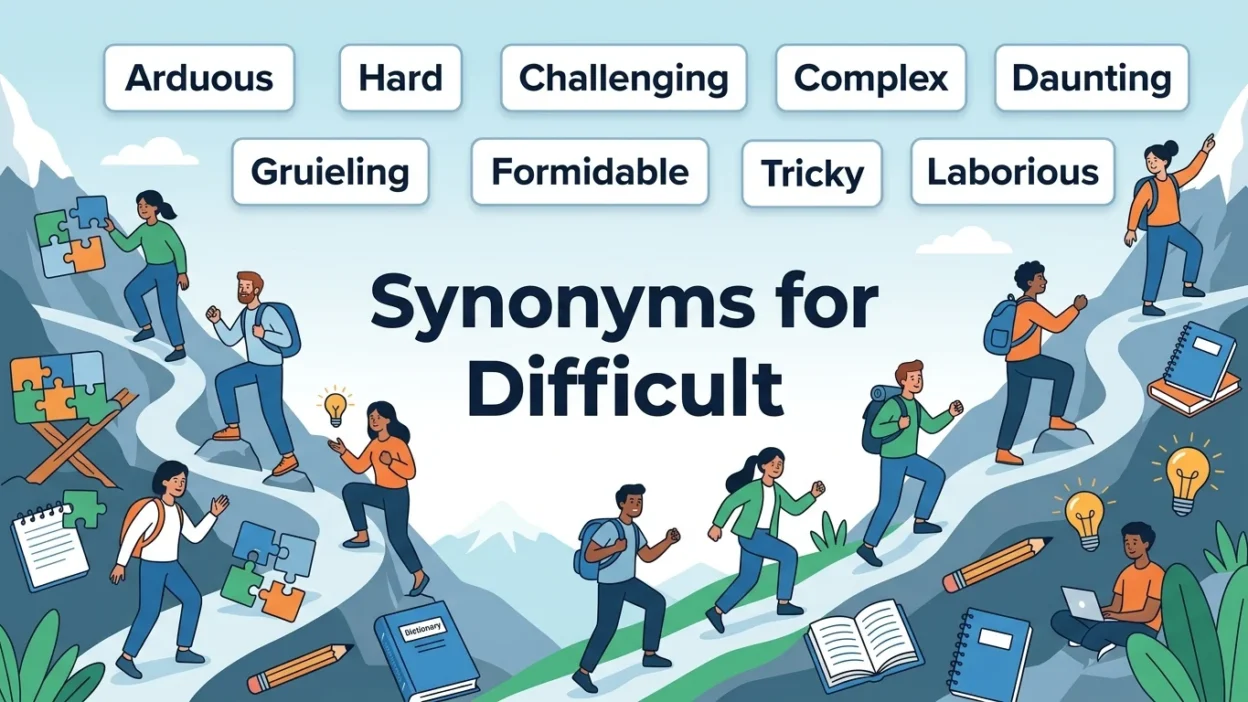
Understanding synonyms for difficult helps readers choose the right word with confidence, matching tone, meaning, and context in everyday communication. From my experience with language and editing content, the picture formed in a reader’s mind often depends on choosing the right word based on the level of effort, emotional weight, and the specific situation being described. Some tasks feel merely demanding, while others require great exertion before meaningful progress becomes visible.
A truly difficult experience may involve obstacles that must be surmounted and puzzles that need to be resolved. In uncertain moments, people often need both skill and courage, especially when the outcome remains uncertain. These qualities encourage individuals to move forward rather than consider giving up, even when challenges become overwhelming.
The image of a difficult ascent up a mountain captures this idea perfectly. The climb can be hard, physically arduous, and constantly testing one’s patience and determination at every step. Through such experiences, people often discover just how capable they truly are.
Meaning of “Difficult”
What Does “Difficult” Mean?
The word difficult describes something that is not easy to do, understand, achieve, or deal with. It often refers to tasks, situations, people, or problems that require extra effort, skill, patience, or time.
For example:
- Solving a complicated math problem can be difficult.
- Learning a new language may feel difficult at first.
- Handling a stressful situation can also be difficult emotionally.
The tone of “difficult” is neutral and widely used in both formal and informal English.
30 Synonyms for Difficult
1. Hard
Meaning: Not easy to do or understand.
Example: The exam was hard for many students.
Best Usage Context: Everyday conversations and general writing.
2. Challenging
Meaning: Requiring effort and skill.
Example: Running a business is challenging.
Best Usage Context: Positive or motivational situations.
3. Complicated
Meaning: Having many confusing parts.
Example: The instructions were complicated.
Best Usage Context: Processes, systems, and explanations.
4. Complex
Meaning: Made up of interconnected parts.
Example: Human emotions are complex.
Best Usage Context: Academic and professional writing.
5. Tough
Meaning: Difficult and demanding.
Example: It was a tough decision to make.
Best Usage Context: Casual speech and informal writing.
6. Arduous
Meaning: Requiring great effort.
Example: The hikers faced an arduous journey.
Best Usage Context: Formal descriptions of hard work.
7. Demanding
Meaning: Needing a lot of time or energy.
Example: Parenting can be demanding.
Best Usage Context: Responsibilities and jobs.
8. Tricky
Meaning: Difficult because it requires careful handling.
Example: The puzzle was tricky to solve.
Best Usage Context: Informal situations.
9. Problematic
Meaning: Causing difficulties or concerns.
Example: The proposal proved problematic.
Best Usage Context: Professional discussions.
10. Laborious
Meaning: Requiring a lot of effort.
Example: Cleaning the entire house was laborious.
Best Usage Context: Formal writing.
11. Grueling
Meaning: Extremely tiring and difficult.
Example: They completed a grueling workout.
Best Usage Context: Physical challenges.
12. Daunting
Meaning: Intimidating because of difficulty.
Example: Starting a new career felt daunting.
Best Usage Context: Emotional experiences.
13. Formidable
Meaning: Inspiring respect because of difficulty.
Example: She faced a formidable opponent.
Best Usage Context: Serious challenges.
14. Intricate
Meaning: Detailed and complicated.
Example: The design was intricate.
Best Usage Context: Art, systems, and craftsmanship.
15. Knotty
Meaning: Difficult to solve.
Example: They debated a knotty issue.
Best Usage Context: Problems and discussions.
16. Burdensome
Meaning: Hard because it creates stress.
Example: Debt became burdensome.
Best Usage Context: Obligations and responsibilities.
17. Exacting
Meaning: Demanding high standards.
Example: The teacher was exacting.
Best Usage Context: Expectations and requirements.
18. Taxing
Meaning: Physically or mentally exhausting.
Example: The negotiations were taxing.
Best Usage Context: Stressful situations.
19. Painstaking
Meaning: Requiring careful effort.
Example: The restoration work was painstaking.
Best Usage Context: Detailed tasks.
20. Onerous
Meaning: Involving heavy effort or responsibility.
Example: The contract imposed onerous duties.
Best Usage Context: Formal writing.
21. Unmanageable
Meaning: Too difficult to control.
Example: The workload became unmanageable.
Best Usage Context: Work and responsibilities.
22. Awkward
Meaning: Difficult to deal with comfortably.
Example: It was an awkward conversation.
Best Usage Context: Social situations.
23. Thorny
Meaning: Full of complications.
Example: The committee faced a thorny issue.
Best Usage Context: Sensitive topics.
24. Rigorous
Meaning: Extremely strict or demanding.
Example: Medical training is rigorous.
Best Usage Context: Education and standards.
25. Severe
Meaning: Very serious or intense.
Example: The weather conditions were severe.
Best Usage Context: Serious circumstances.
26. Herculean
Meaning: Requiring extraordinary effort.
Example: Rebuilding the city was a Herculean task.
Best Usage Context: Major achievements.
27. Perplexing
Meaning: Confusing and difficult to understand.
Example: The mystery was perplexing.
Best Usage Context: Puzzles and confusion.
28. Involved
Meaning: Complicated and detailed.
Example: The explanation was involved.
Best Usage Context: Formal communication.
29. Cumbersome
Meaning: Difficult because it is large or inefficient.
Example: The old system was cumbersome.
Best Usage Context: Processes and objects.
30. Impossible
Meaning: So difficult that it cannot be done.
Example: The deadline seemed impossible.
Best Usage Context: Extreme situations.
Comparison Guide: When to Use Different Synonyms
Quick Reference Table
| Synonym | Best For | Tone |
|---|---|---|
| Hard | Everyday situations | Neutral |
| Challenging | Growth opportunities | Positive |
| Tough | Casual conversations | Informal |
| Complex | Academic topics | Formal |
| Complicated | Confusing processes | Neutral |
| Daunting | Emotional reactions | Thoughtful |
| Grueling | Physical effort | Intense |
| Problematic | Professional issues | Formal |
| Tricky | Small difficulties | Informal |
| Impossible | Extreme difficulty | Strong |
How to Choose the Right Synonym
For Everyday Use
Use:
- Hard
- Tough
- Tricky
- Challenging
These words sound natural in daily conversations.
For Academic and Professional Writing
Use:
- Complex
- Complicated
- Problematic
- Exacting
- Rigorous
- Onerous
These choices create a more polished tone.
For Emotional Experiences
Use:
- Daunting
- Taxing
- Burdensome
- Awkward
These highlight how a situation feels emotionally.
For Extreme Difficulty
Use:
- Grueling
- Herculean
- Formidable
- Impossible
These emphasize intense struggle or effort.
For Detailed or Technical Tasks
Use:
- Intricate
- Painstaking
- Involved
- Laborious
These work well when discussing precision and complexity.
Why Learning Synonyms for Difficult Matters
Improve Vocabulary Naturally
Using different words prevents repetition and strengthens communication skills.
Make Writing More Engaging
Readers stay interested when writers vary their language thoughtfully.
Express Exact Meanings
Each synonym carries a slightly different tone, helping you communicate more accurately.
Build Confidence in English
Students and ESL learners become better speakers and writers through vocabulary expansion.
Conclusion
Understanding these synonyms for difficult allows you to express ideas with greater accuracy and confidence. While “difficult” remains a useful everyday word, alternatives such as “challenging,” “complex,” “daunting,” and “grueling” add nuance and depth to your communication.
The key is to match the synonym to the situation, tone, and audience. With practice, you’ll naturally choose words that make your writing clearer, more engaging, and more effective. Keep exploring new vocabulary, and you’ll continue strengthening your English skills one word at a time.

John Morrison is a dedicated content writer at Synomity.com, focused on synonyms, vocabulary development, and word meanings. He creates clear, educational resources that help readers improve language skills and communicate with confidence.