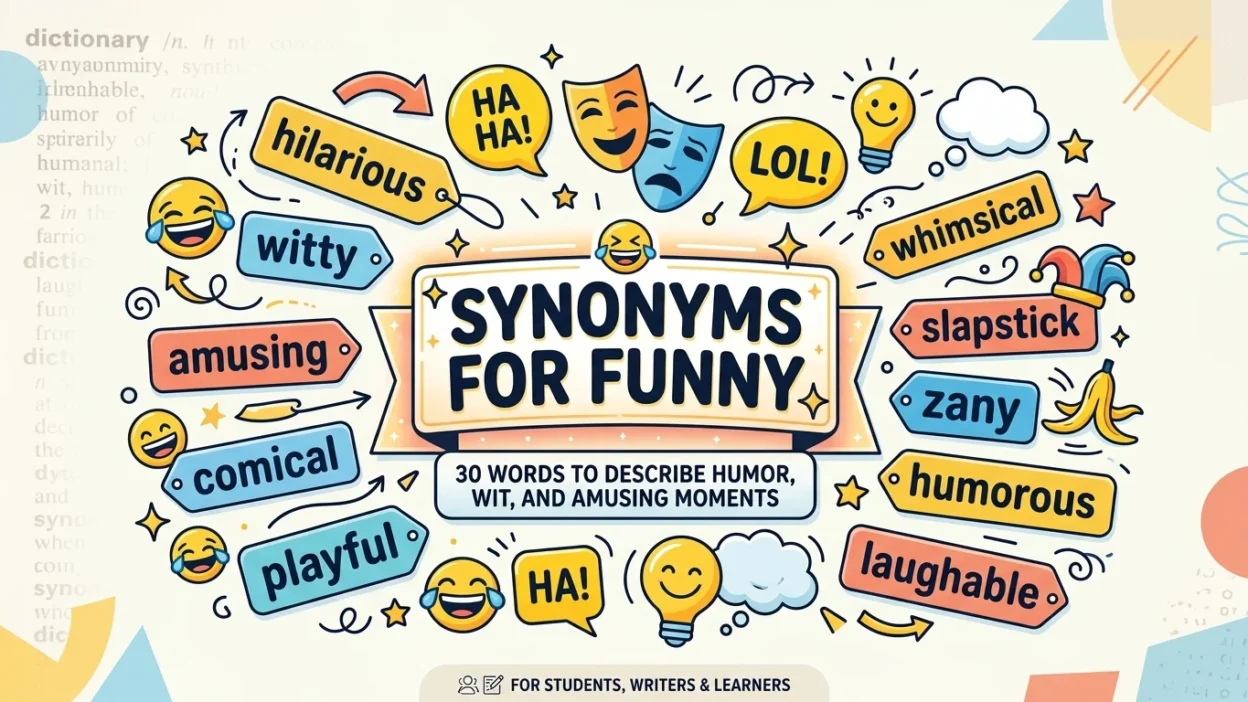
Understanding synonyms for funny helps writers and learners describe humor with more precision and natural expression. Humor appears in many forms, from amusing and entertaining moments to deeply humorous, comic, and comical situations that shape how a story feels. A simple joke may be laughable, while others become truly hilarious, rib-tickling, or sidesplitting.
Celebrations can turn riotous and uproarious, leaving behind warm memories, shared laughter, and lasting energy. Personality also influences humor, as a witty and quick-witted friend may use bon mot and clever remarks delivered with jocular, facetious, droll, or waggish charm, while others shine through playful, silly, jolly, and lighthearted attitudes that feel naturally welcoming.
More creative expressions can be whimsical, sparkling, and scintillating, and a timely gag or bit of slapstick keeps audiences divertingly engaged. Some humor is openly risible or absolutely killing, transforming a priceless experience into something emotionally rich and unforgettable. At the same time, laughter may emerge from the curious, peculiar, odd, unusual, strange, weird, or queer details of everyday life, where comedy embraces the bizarre, wacky, zany, and before stretching into the absurd, ridiculous, ludicrous, preposterous, and farcical. From my experience, recognizing these differences helps writers, students, and language learners choose words more precisely, creating descriptions that feel authentic rather than repetitive.
Meaning of “Funny”
What Does “Funny” Mean?
The word funny describes something that causes laughter, amusement, or enjoyment. It can refer to jokes, stories, situations, people, or behaviors that make others smile or laugh.
Depending on the context, “funny” can also mean unusual or strange. However, in everyday English, it most commonly refers to humor and entertainment.
Tone and Usage Context
- Casual conversations: “That video was really funny.”
- Formal writing: Alternatives like “amusing” or “humorous” may sound more appropriate.
- Creative storytelling: Words such as “hilarious” or “comical” add stronger emotional impact.
- Describing personalities: Terms like “witty” and “playful” highlight someone’s style of humor.
30 Synonyms for Funny
1. Amusing
Meaning: Causing mild laughter or enjoyment.
Example Sentence: The cartoon was amusing enough to brighten my day.
Best Usage Context: Light humor and pleasant entertainment.
2. Hilarious
Meaning: Extremely funny.
Example Sentence: Her impression of the teacher was hilarious.
Best Usage Context: Strong laughter and unforgettable humor.
3. Humorous
Meaning: Having a sense of humor.
Example Sentence: The author’s humorous style attracts many readers.
Best Usage Context: Formal writing and literary discussions.
4. Comical
Meaning: Funny because it appears ridiculous.
Example Sentence: His comical dance moves entertained the audience.
Best Usage Context: Visual humor and performances.
5. Witty
Meaning: Clever and funny in an intelligent way.
Example Sentence: She made a witty comment during the meeting.
Best Usage Context: Smart conversations and quick responses.
6. Entertaining
Meaning: Enjoyable and enjoyable to watch or hear.
Example Sentence: The host delivered an entertaining speech.
Best Usage Context: Shows, presentations, and performances.
7. Silly
Meaning: Funny in a childish or foolish manner.
Example Sentence: The children enjoyed making silly faces.
Best Usage Context: Playful and informal situations.
8. Playful
Meaning: Lighthearted and fun.
Example Sentence: His playful jokes made everyone comfortable.
Best Usage Context: Friendly interactions.
9. Laughable
Meaning: So absurd that it causes laughter.
Example Sentence: The excuse sounded laughable.
Best Usage Context: Ridiculous situations.
10. Jocular
Meaning: Cheerful and joking.
Example Sentence: The coach maintained a jocular attitude.
Best Usage Context: Friendly and good-natured humor.
11. Whimsical
Meaning: Unusually playful or imaginative.
Example Sentence: The story had a whimsical charm.
Best Usage Context: Creative writing and fantasy.
12. Ridiculous
Meaning: Extremely unreasonable or absurd.
Example Sentence: The misunderstanding became ridiculous.
Best Usage Context: Highlighting absurdity.
13. Droll
Meaning: Funny in a dry or unusual way.
Example Sentence: His droll observations impressed the audience.
Best Usage Context: Subtle humor.
14. Side-Splitting
Meaning: Extremely funny.
Example Sentence: The comedian’s performance was side-splitting.
Best Usage Context: Intense laughter.
Meaning: So funny that people cannot stop laughing.
Best Usage Context: Very strong reactions.
16. Cheeky
Meaning: Slightly rude but amusing.
Example Sentence: The child gave a cheeky response.
Best Usage Context: Informal British English.
17. Mischievous
Meaning: Playfully causing harmless trouble.
Example Sentence: His mischievous grin suggested another prank.
Best Usage Context: Children’s behavior and playful acts.
18. Lighthearted
Meaning: Cheerful and carefree.
Example Sentence: The film offered lighthearted entertainment.
Best Usage Context: Positive and uplifting humor.
19. Goofy
Meaning: Silly and amusing.
Example Sentence: He is known for his goofy personality.
Best Usage Context: Casual conversations.
20. Quirky
Meaning: Unusual in an appealing way.
Example Sentence: Her quirky jokes surprised everyone.
Best Usage Context: Unique personalities.
21. Farcical
Meaning: Exaggerated and absurdly funny.
Example Sentence: The situation became farcical.
Best Usage Context: Comedy and satire.
22. Satirical
Meaning: Using humor to criticize society.
Example Sentence: The article had a satirical tone.
Best Usage Context: Political and social commentary.
23. Bantering
Meaning: Friendly teasing conversation.
Example Sentence: Their bantering kept the mood relaxed.
Best Usage Context: Close relationships.
24. Comic
Meaning: Related to comedy.
Example Sentence: The actor possessed excellent comic timing.
Best Usage Context: Theater and entertainment.
25. Jesting
Meaning: Speaking playfully or jokingly.
Example Sentence: He was jesting, not being serious.
Best Usage Context: Informal humor.
26. Ticklish
Meaning: Likely to laugh easily.
Example Sentence: She has a ticklish sense of humor.
Best Usage Context: Personal descriptions.
27. Irreverent
Meaning: Humor that ignores traditional respect.
Example Sentence: The show’s irreverent jokes divided viewers.
Best Usage Context: Bold comedy styles.
28. Zany
Meaning: Wildly unconventional and funny.
Example Sentence: The cartoon featured zany adventures.
Best Usage Context: Energetic comedy.
29. Deadpan
Meaning: Delivering jokes with a serious expression.
Example Sentence: His deadpan delivery made the joke better.
Best Usage Context: Dry humor.
30. Rib-Tickling
Meaning: Extremely amusing.
Example Sentence: The storyteller shared rib-tickling anecdotes.
Best Usage Context: Family-friendly entertainment.
Comparison Guide: When to Use Different Synonyms
Quick Reference Table
| Synonym | Humor Strength | Tone | Best For |
|---|---|---|---|
| Amusing | Mild | Neutral | Everyday situations |
| Hilarious | Very Strong | Casual | Big laughs |
| Humorous | Moderate | Formal | Writing and speeches |
| Witty | Moderate | Intelligent | Clever remarks |
| Silly | Mild | Playful | Children and friends |
| Comical | Moderate | Visual | Performances |
| Satirical | Moderate | Critical | Social commentary |
| Deadpan | Moderate | Dry | Subtle comedy |
| Goofy | Moderate | Casual | Personalities |
| Lighthearted | Mild | Positive | Family content |
How to Choose the Right Synonym
For Strong Laughter
Use:
- Hilarious
- Side-splitting
- Rib-tickling
These words work when something causes intense laughter.
For Smart and Clever Humor
Use:
- Witty
- Droll
- Deadpan
- Humorous
These fit professional settings and intelligent conversations.
For Playful and Friendly Humor
Use:
- Silly
- Playful
- Goofy
- Bantering
- Jocular
These create a warm and relaxed tone.
For Unusual or Creative Humor
Use:
- Quirky
- Whimsical
- Zany
- Comical
These describe imaginative and distinctive styles.
For Critical or Bold Humor
Use:
- Satirical
- Irreverent
- Farcical
- Laughable
These are useful when humor highlights flaws or absurd situations.
Why Learning Synonyms for Funny Matters
Expanding your vocabulary improves communication skills. Instead of repeatedly using the same word, you can express different shades of meaning with confidence.
For students and ESL learners, knowing various synonyms strengthens reading comprehension and writing ability. Writers and content creators can produce more engaging work by matching their word choices to the intended mood and audience.
Using precise vocabulary also helps you sound more natural and fluent in English.
Conclusion
Understanding and using different synonyms for funny allows you to communicate with greater clarity and creativity. While “funny” remains a useful everyday word, alternatives such as “amusing,” “witty,” “hilarious,” and “satirical” offer more specific meanings and tones.
Whether you’re writing an essay, creating online content, improving your English vocabulary, or simply looking for better ways to describe humor, these 30 synonyms provide valuable tools for expression. Practice using them in conversations and writing, and you’ll soon discover how richer vocabulary makes communication more engaging and effective.

Evelyn Mia is a passionate language writer and vocabulary enthusiast at Synomity.com, specializing in synonyms, word meanings, and language learning. She creates informative content that helps readers expand vocabulary and communicate more effectively.