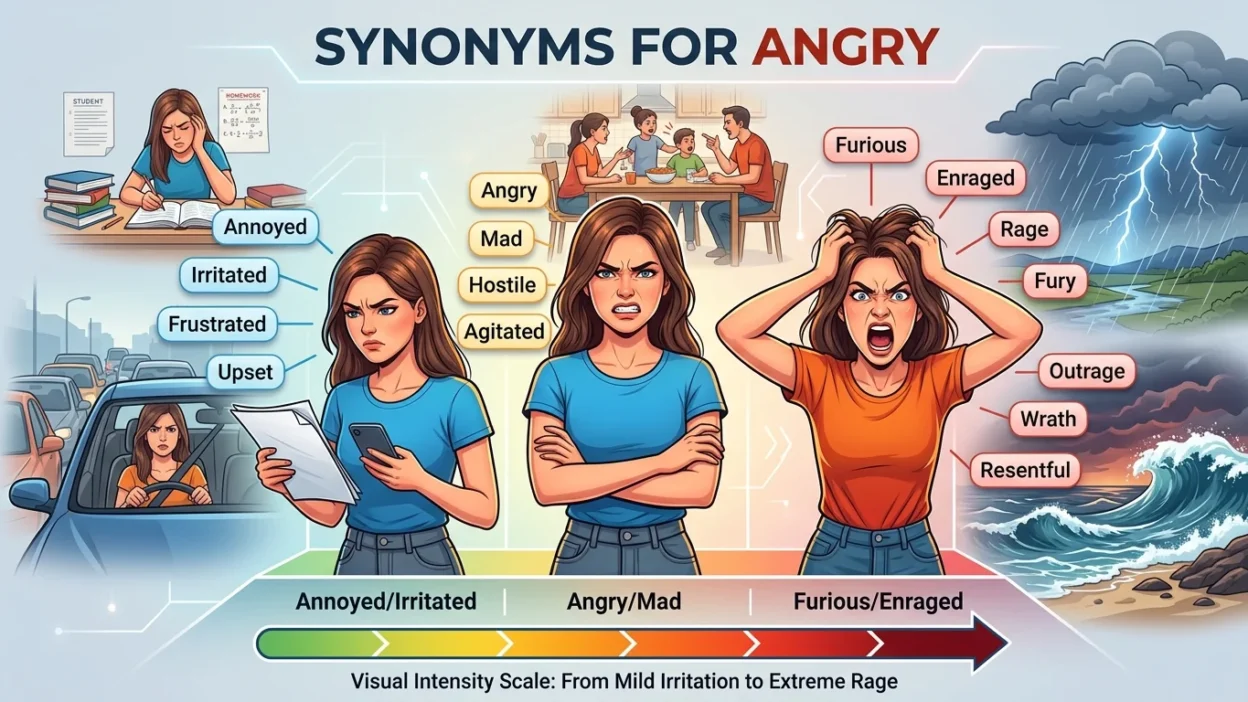
Learning synonyms for angry helps people understand how a common emotion can appear in different ways, from mild reactions to powerful feelings and responses.
The word angry is connected to anger, mad, upset, annoyance, frustration, irritation, displeasure, resentment, agitation, hostility, and impatience. In daily life, situations involving traffic, homework, parents, children, or difficult weather can trigger these emotions. This emotional state often affects a person’s mood, behavior, reaction, and expression, making it hard to think straight when strong feelings take control.
Through studying language and communication, I have found that the intensity of a feeling changes the word we choose. A mild negative emotion may be described as feeling disturbed, offended, or provoked, while a heated conflict may create an aggressive temper and a stronger emotional response. As emotions become more intense, words such as furious, enraged, raging, rage, fury, outrage, and wrath become more suitable. People also use the phrase see red when emotions feel overwhelming and difficult to control.
In nature, examples can help with understanding strong emotions. An angry sea with stormy, turbulent, and tempestuous waves may ferociously crash onto a beach, showing the power of human emotions. During moments of anger, practicing anger management, taking time to blow off steam, or choosing to count to 10 can help prevent actions that may lead to regret. These related words explain different levels of anger and show how people react in challenging situations.
Understanding the Meaning of “Angry”
The word angry describes a feeling of strong displeasure, annoyance, frustration, or hostility toward someone or something.
Tone of the Word “Angry”
The tone of “angry” is generally negative and emotional. It can range from mild irritation to extreme rage depending on the situation.
Common Usage Contexts
- Everyday conversations
- Academic writing
- Storytelling and fiction
- Workplace communication
- Emotional expression
For example:
“She was angry because her project was unfairly criticized.”
However, using different synonyms can help describe the exact intensity of the emotion.
30 Synonyms for Angry
1. Mad
Meaning: Feeling angry or upset.
Example Sentence: He was mad when he missed the last bus.
Best Usage Context: Casual conversations.
2. Annoyed
Meaning: Slightly angry because something is irritating.
Example Sentence: I felt annoyed by the constant noise.
Best Usage Context: Minor frustrations.
3. Irritated
Meaning: Feeling bothered or disturbed.
Example Sentence: She became irritated by the repeated interruptions.
Best Usage Context: Formal and informal situations.
4. Frustrated
Meaning: Angry because something is difficult or unsuccessful.
Example Sentence: He felt frustrated after failing the exam.
Best Usage Context: Challenges and obstacles.
5. Upset
Meaning: Emotionally disturbed or unhappy.
Example Sentence: She was upset about the misunderstanding.
Best Usage Context: Mild emotional anger.
6. Cross
Meaning: Slightly angry or annoyed.
Example Sentence: My teacher looked cross after the class became noisy.
Best Usage Context: British English.
7. Agitated
Meaning: Nervous, disturbed, and somewhat angry.
Example Sentence: The customer became agitated while waiting.
Best Usage Context: Emotional tension.
8. Resentful
Meaning: Angry because of unfair treatment.
Example Sentence: He felt resentful about being ignored.
Best Usage Context: Long-term negative feelings.
9. Offended
Meaning: Hurt or angry because of something disrespectful.
Example Sentence: She was offended by the rude comment.
Best Usage Context: Personal interactions.
10. Indignant
Meaning: Angry because something seems unfair.
Example Sentence: The citizens were indignant about the decision.
Best Usage Context: Moral or social issues.
11. Bitter
Meaning: Angry and unhappy for a long time.
Example Sentence: He remained bitter after losing the opportunity.
Best Usage Context: Lasting disappointment.
12. Outraged
Meaning: Extremely angry and shocked.
Example Sentence: The public was outraged by the scandal.
Best Usage Context: Serious situations.
13. Furious
Meaning: Extremely angry.
Example Sentence: She was furious when her work was stolen.
Best Usage Context: Intense anger.
14. Enraged
Meaning: Filled with intense anger.
Example Sentence: The unfair accusation enraged him.
Best Usage Context: Strong emotional reactions.
15. Livid
Meaning: Extremely angry.
Example Sentence: My manager was livid about the mistake.
Best Usage Context: Severe anger.
16. Irate
Meaning: Very angry.
Example Sentence: The irate customer demanded a refund.
Best Usage Context: Formal writing.
17. Incensed
Meaning: Extremely angry due to unfair treatment.
Example Sentence: She was incensed by the false claims.
Best Usage Context: Formal communication.
18. Wrathful
Meaning: Full of strong anger.
Example Sentence: The king appeared wrathful after hearing the news.
Best Usage Context: Literary writing.
19. Hostile
Meaning: Showing anger and opposition.
Example Sentence: The discussion became hostile.
Best Usage Context: Conflict situations.
20. Antagonistic
Meaning: Actively opposed and unfriendly.
Example Sentence: His antagonistic attitude created tension.
Best Usage Context: Professional or social conflicts.
21. Heated
Meaning: Filled with strong emotion and anger.
Example Sentence: They had a heated argument.
Best Usage Context: Discussions and debates.
22. Temperamental
Meaning: Easily angered.
Example Sentence: The actor was known for being temperamental.
Best Usage Context: Personality descriptions.
23. Fuming
Meaning: Extremely angry.
Example Sentence: He was fuming after hearing the news.
Best Usage Context: Informal speech.
24. Seething
Meaning: Quietly but intensely angry.
Example Sentence: She sat there seething with anger.
Best Usage Context: Hidden anger.
25. Raging
Meaning: Expressing very strong anger.
Example Sentence: The coach was raging after the loss.
Best Usage Context: Extreme emotions.
26. Vexed
Meaning: Annoyed or troubled.
Example Sentence: He seemed vexed by the delay.
Best Usage Context: Formal writing.
27. Exasperated
Meaning: Very annoyed and frustrated.
Example Sentence: The teacher was exasperated by the constant excuses.
Best Usage Context: Repeated problems.
28. Displeased
Meaning: Not happy or satisfied.
Example Sentence: The manager was displeased with the results.
Best Usage Context: Professional settings.
29. Provoked
Meaning: Made angry by someone’s actions.
Example Sentence: His comments provoked the audience.
Best Usage Context: Cause-and-effect situations.
30. Infuriated
Meaning: Made extremely angry.
Example Sentence: The unfair decision infuriated the players.
Best Usage Context: Very strong anger.
Comparison Guide: When to Use Different Synonyms
Quick Reference Table
| Synonym | Level of Anger | Best Situation |
|---|---|---|
| Annoyed | Mild | Small irritations |
| Irritated | Mild | Repeated disturbances |
| Frustrated | Mild-Medium | Difficult situations |
| Upset | Mild | Emotional disappointment |
| Resentful | Medium | Unfair treatment |
| Indignant | Medium | Moral disagreement |
| Furious | Strong | Serious anger |
| Irate | Strong | Formal contexts |
| Livid | Very Strong | Extreme anger |
| Enraged | Very Strong | Intense emotional reactions |
| Fuming | Very Strong | Informal speech |
| Outraged | Extreme | Public scandals or injustice |
How to Choose the Right Synonym
For Mild Anger
Use these words when the situation is not very serious:
- Annoyed
- Irritated
- Cross
- Upset
- Vexed
For Frustration and Disappointment
These words work well when problems cause emotional stress:
- Frustrated
- Exasperated
- Agitated
- Displeased
- Provoked
For Anger Caused by Unfairness
Choose these when discussing injustice or disrespect:
- Indignant
- Resentful
- Offended
- Bitter
- Incensed
For Strong Anger
Use these words when emotions are intense:
- Furious
- Irate
- Livid
- Enraged
- Infuriated
For Extreme Anger
These words express the highest level of anger:
- Outraged
- Raging
- Wrathful
- Seething
- Fuming
Why Learning Synonyms for Angry Matters
Better Writing
Using varied vocabulary makes essays, articles, and stories more interesting.
More Accurate Communication
Different words express different levels of anger.
Improved English Skills
Learning synonyms expands vocabulary and improves fluency.
Stronger Storytelling
Writers can create more realistic characters and emotions.
Common Mistakes When Using Angry Synonyms
Using Strong Words for Minor Problems
Incorrect:
“I was enraged because my coffee was cold.”
Better:
“I was annoyed because my coffee was cold.”
Ignoring Context
Words like wrathful sound literary, while mad sounds casual.
Repeating the Same Word
Instead of using “angry” repeatedly, vary your vocabulary with appropriate alternatives.
Conclusion
Understanding and using different synonyms for angry can greatly improve your vocabulary and communication skills. While words like annoyed, irritated, and frustrated describe mild anger, stronger terms such as furious, livid, enraged, and outraged express much more intense emotions. By learning the meaning, tone, and context of each synonym, students, ESL learners, writers, and content creators can communicate more clearly and effectively. The key is choosing the word that best matches the situation and level of emotion you want to express.

Evelyn Mia is a passionate language writer and vocabulary enthusiast at Synomity.com, specializing in synonyms, word meanings, and language learning. She creates informative content that helps readers expand vocabulary and communicate more effectively.