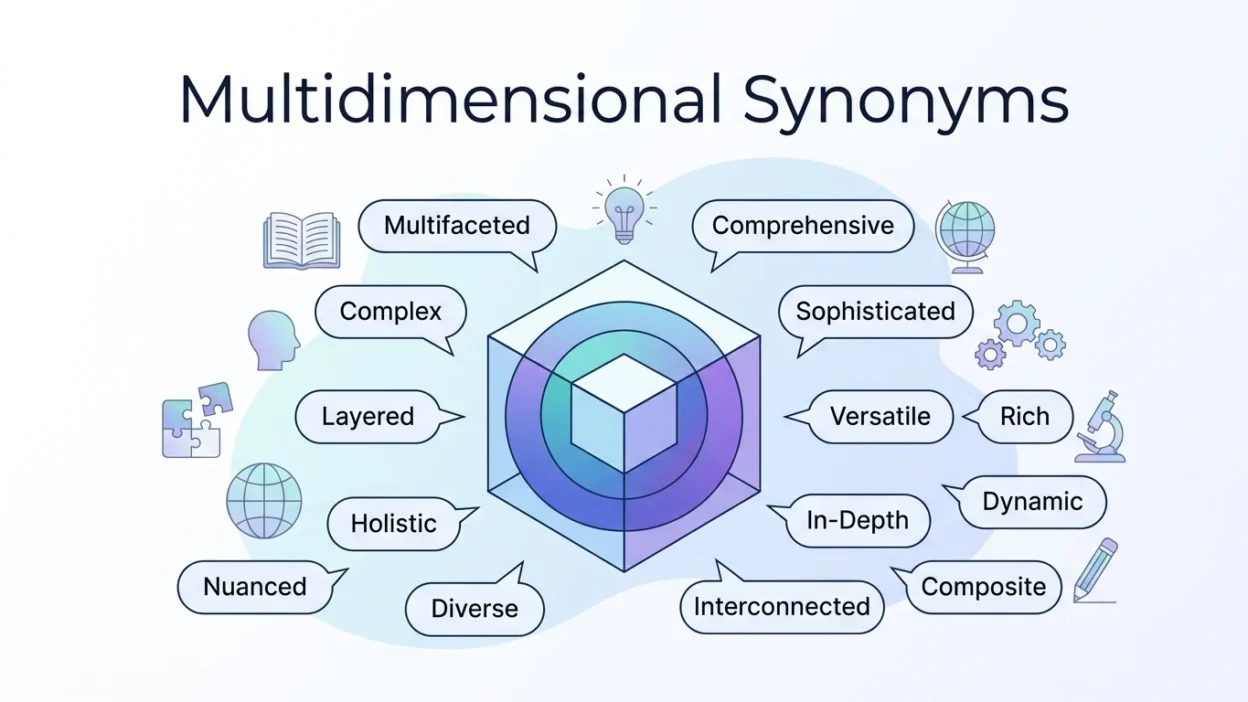
The word multidimensional describes something that has many different aspects, layers, perspectives, or dimensions.
It is commonly used when talking about people, ideas, problems, characters, research, business, science, psychology, and creative writing.
Learning multidimensional synonyms helps you express complex ideas more accurately and avoid repeating the same word.
Whether you’re a student writing an essay, an ESL learner expanding your vocabulary, or a content creator looking for stronger word choices, understanding the different meanings and uses of multidimensional synonyms can improve your communication.
Some alternatives emphasize complexity, while others highlight variety, depth, or multiple viewpoints.
This guide explains the meaning of multidimensional, introduces 30 useful synonyms, provides simple definitions, example sentences, and usage notes, and helps you choose the best word for different situations.
What Does “Multidimensional” Mean?
Simple Meaning
Multidimensional means having many different parts, aspects, qualities, or dimensions rather than just one. It describes something that is complex, layered, or viewed from multiple perspectives.
Tone and Usage Context
The word multidimensional has a formal but widely accepted tone. It is commonly used in academic writing, psychology, business, science, literature, education, and everyday conversations when describing people, ideas, situations, or objects with many characteristics.
30 Multidimensional Synonyms with Meanings, Examples, and Usage
1. Complex
Meaning: Made up of many connected parts.
Example: Climate change is a complex global issue.
Best Usage Context: General writing and academic discussions.
2. Multifaceted
Meaning: Having many different features or sides.
Example: She has a multifaceted personality.
Best Usage Context: People, projects, and ideas.
3. Layered
Meaning: Having several levels or meanings.
Example: The novel has a layered storyline.
Best Usage Context: Literature and storytelling.
4. Diverse
Meaning: Showing many different types or qualities.
Example: The company has a diverse workforce.
Best Usage Context: People, cultures, and groups.
5. Comprehensive
Meaning: Covering many areas completely.
Example: The report offers a comprehensive analysis.
Best Usage Context: Reports and research.
6. All-Encompassing
Meaning: Including almost everything.
Example: The policy provides an all-encompassing solution.
Best Usage Context: Formal writing.
7. Broad
Meaning: Covering a wide range.
Example: She has broad knowledge of history.
Best Usage Context: General communication.
8. Extensive
Meaning: Large in scope or size.
Example: The research required extensive data.
Best Usage Context: Academic writing.
9. Intricate
Meaning: Very detailed and complicated.
Example: The design features intricate patterns.
Best Usage Context: Art, design, and engineering.
10. Sophisticated
Meaning: Highly developed or advanced.
Example: The software uses sophisticated technology.
Best Usage Context: Technology and business.
11. Nuanced
Meaning: Containing subtle differences.
Example: The speaker gave a nuanced explanation.
Best Usage Context: Writing and communication.
12. Dynamic
Meaning: Constantly changing or active.
Example: The market is dynamic and competitive.
Best Usage Context: Business and economics.
13. Versatile
Meaning: Able to perform many functions.
Example: This tool is versatile and reliable.
Best Usage Context: Products and skills.
14. Rich
Meaning: Full of variety or detail.
Example: The documentary offers rich historical information.
Best Usage Context: Content and descriptions.
15. Detailed
Meaning: Including many facts or parts.
Example: The guide provides detailed instructions.
Best Usage Context: Educational writing.
16. In-Depth
Meaning: Thorough and complete.
Example: The article offers an in-depth review.
Best Usage Context: Reviews and analysis.
17. Holistic
Meaning: Looking at the whole instead of individual parts.
Example: Doctors recommend a holistic approach to health.
Best Usage Context: Healthcare and education.
18. Composite
Meaning: Made from several different parts.
Example: The portrait is a composite image.
Best Usage Context: Design and science.
19. Interconnected
Meaning: Connected with one another.
Example: The systems are closely interconnected.
Best Usage Context: Technology and business.
20. Interrelated
Meaning: Related to each other.
Example: These social issues are interrelated.
Best Usage Context: Academic discussions.
21. Many-Sided
Meaning: Having several aspects.
Example: He has a many-sided personality.
Best Usage Context: Character descriptions.
22. Well-Rounded
Meaning: Balanced with many strengths.
Example: She is a well-rounded student.
Best Usage Context: Education and personal development.
23. Varied
Meaning: Including different types.
Example: The museum has varied collections.
Best Usage Context: General writing.
24. Multi-Layered
Meaning: Having several layers or meanings.
Example: The film tells a multi-layered story.
Best Usage Context: Literature and movies.
25. Polyhedral
Meaning: Having many sides or faces.
Example: The scientist described the crystal as polyhedral.
Best Usage Context: Mathematics and science.
26. Dimensional
Meaning: Having measurable aspects or dimensions.
Example: Engineers created a dimensional model.
Best Usage Context: Engineering and design.
27. Expansive
Meaning: Wide-ranging or broad.
Example: She has an expansive understanding of economics.
Best Usage Context: Knowledge and discussions.
28. Inclusive
Meaning: Covering many groups or ideas.
Example: The policy is inclusive and fair.
Best Usage Context: Social and workplace communication.
29. Elaborate
Meaning: Carefully developed with many details.
Example: The architect presented an elaborate plan.
Best Usage Context: Planning and design.
30. Profound
Meaning: Deep and meaningful.
Example: His multidimensional thinking led to profound insights.
Best Usage Context: Philosophy, education, and analysis.
Multidimensional Synonyms Comparison Guide
When to Use Different Multidimensional Synonyms
| Synonym | Best Used For | Tone |
|---|---|---|
| Complex | Problems, systems | Neutral |
| Multifaceted | People, ideas | Professional |
| Layered | Stories, emotions | Creative |
| Diverse | Groups, cultures | Neutral |
| Comprehensive | Reports | Formal |
| Holistic | Healthcare, education | Professional |
| Nuanced | Opinions, writing | Academic |
| Sophisticated | Technology | Formal |
| Versatile | Skills, tools | Neutral |
| Well-Rounded | Students, personalities | Positive |
| In-Depth | Research | Formal |
| Rich | Content, descriptions | Neutral |
How to Choose the Right Multidimensional Synonym
For Academic Writing
Use words like comprehensive, complex, nuanced, holistic, interrelated, and in-depth when writing essays, reports, or research papers.
For Describing People
Choose multifaceted, well-rounded, many-sided, versatile, and dynamic to describe personalities, skills, or talents.
For Creative Writing
Words such as layered, multi-layered, rich, intricate, and profound work well when describing stories, characters, or emotions.
For Business and Professional Writing
Use comprehensive, inclusive, dynamic, expansive, interconnected, and sophisticated to describe organizations, strategies, or systems.
For Science and Technical Fields
Select dimensional, polyhedral, composite, interrelated, and complex when discussing scientific concepts or engineering topics.
Frequently Asked Questions
What does multidimensional mean?
Multidimensional means having many aspects, qualities, layers, or dimensions instead of only one.
What is the closest synonym for multidimensional?
Multifaceted is one of the closest synonyms because it also means having many different sides or features.
Is multidimensional a formal word?
Yes. It is commonly used in academic, professional, scientific, and business writing, but it also appears in everyday English.
Which synonym is best for describing a person?
Multifaceted, well-rounded, versatile, and many-sided are excellent choices for describing people.
Which synonym is best for research writing?
Comprehensive, complex, holistic, nuanced, and in-depth are commonly used in academic and research writing.
Conclusion
Understanding multidimensional synonyms helps you express complex ideas with greater accuracy and variety. While multidimensional is an excellent word for describing people, ideas, systems, and situations with many aspects, choosing alternatives like multifaceted, complex, layered, holistic, or comprehensive can make your writing more engaging and precise. By learning when and how to use each synonym, you’ll build stronger vocabulary skills and communicate with greater confidence in both academic and everyday English.
Evelyn Mia is a passionate language writer and vocabulary enthusiast at Synomity.com, specializing in synonyms, word meanings, and language learning. She creates informative content that helps readers expand vocabulary and communicate more effectively.