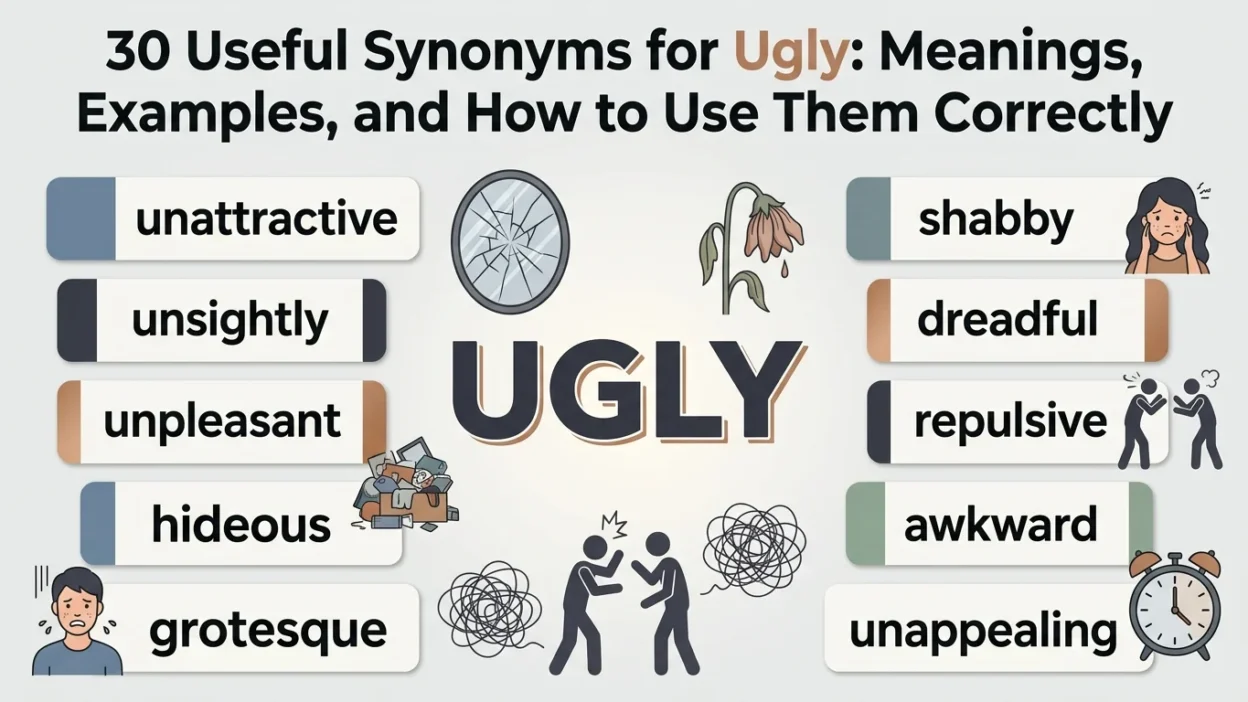
When exploring synonyms for ugly, learners quickly discover that the word reaches far beyond physical appearance, offering useful insights into emotion and daily experiences. In everyday life, a domestic trip can become stressful as airfares keep surging, hotel room rates start soaring, and gas prices at the pump climb north of $4 a gallon. That difficult combination creates pressure on households, can squeeze family margins, and later appear in survey data. From my experience in writing about language, these real-life examples often help learners understand how a single word carries both emotional and practical meanings.
Popular culture adds another perspective. Artists like Rodrigo may reveal an ugly side through jealousy, obsession, and self-destructive decision-making, choosing to rant about feckless exes. In sports and public conversations, sarcasm can become equally ugly. During one tense exchange, Dream coach Karl Smesko challenged an obvious foul and appeared to hope the dispute would momentarily shut out the noise. Such moments can strain relationships and influence how people interpret emotions and conflict.
The most memorable lessons sometimes emerge from ordinary scenes. I often recall stories where someone plops into a folding metal lawn chair while others perch on Gertrude, the famously ugly couch that Pops called a chesterfield. Nearby, Zara observes the exchange unfold. These vivid moments show how language connects objects, people, and experiences through thoughtful descriptive choices.
Understanding the Meaning of “Demure”
Although this article focuses on synonyms for ugly, understanding the word demure can strengthen your vocabulary and descriptive skills.
Demure means quiet, modest, reserved, and polite in behavior or appearance. A demure person usually avoids drawing attention to themselves and behaves gracefully.
Tone and Usage Context
- Tone: Gentle, elegant, modest, and respectful.
- Usage Context: Literature, fashion, personality descriptions, and social situations.
Example:
She wore a demure outfit and greeted everyone with a warm smile.
The word often carries a positive meaning associated with understated elegance.
30 Synonyms for Demure
1. Modest
Meaning: Not showing off achievements or appearance.
Example: She remained modest despite winning the award.
Best Usage Context: Personality and accomplishments.
2. Reserved
Meaning: Quiet and emotionally controlled.
Example: He appeared reserved during the discussion.
Best Usage Context: Social interactions.
3. Shy
Meaning: Nervous around unfamiliar people.
Example: The shy child stayed close to her mother.
Best Usage Context: Everyday conversations.
4. Bashful
Meaning: Easily embarrassed in social situations.
Example: He gave a bashful smile.
Best Usage Context: Friendly descriptions.
5. Coy
Meaning: Pretending to be shy in a playful way.
Example: She responded with a coy glance.
Best Usage Context: Romantic writing.
6. Unassuming
Meaning: Humble and not attention-seeking.
Example: The actor remained unassuming.
Best Usage Context: Positive personality traits.
7. Humble
Meaning: Not arrogant or boastful.
Example: She stayed humble throughout her success.
Best Usage Context: Character descriptions.
8. Meek
Meaning: Gentle and quiet.
Example: The meek student rarely interrupted.
Best Usage Context: Personality discussions.
9. Retiring
Meaning: Avoiding the spotlight.
Example: He had a retiring nature.
Best Usage Context: Formal descriptions.
10. Quiet
Meaning: Calm and not talkative.
Example: She remained quiet during class.
Best Usage Context: General situations.
11. Soft-spoken
Meaning: Speaking gently.
Example: The doctor was soft-spoken.
Best Usage Context: Communication style.
12. Prim
Meaning: Proper and careful about behavior.
Example: Her prim manners impressed everyone.
Best Usage Context: Traditional descriptions.
13. Proper
Meaning: Following accepted social standards.
Example: He behaved in a proper manner.
Best Usage Context: Etiquette discussions.
14. Ladylike
Meaning: Graceful and polite.
Example: She carried herself in a ladylike way.
Best Usage Context: Traditional contexts.
15. Well-mannered
Meaning: Showing good manners.
Example: The children were well-mannered.
Best Usage Context: Social behavior.
16. Polite
Meaning: Respectful toward others.
Example: Always be polite to guests.
Best Usage Context: Everyday interactions.
17. Courteous
Meaning: Thoughtful and respectful.
Example: The receptionist remained courteous.
Best Usage Context: Professional settings.
18. Respectful
Meaning: Showing consideration.
Example: The audience remained respectful.
Best Usage Context: Formal and social situations.
19. Graceful
Meaning: Elegant in movement and behavior.
Example: She handled criticism gracefully.
Best Usage Context: Conduct and appearance.
20. Elegant
Meaning: Stylish and refined.
Example: The elegant dress suited the occasion.
Best Usage Context: Fashion and design.
21. Refined
Meaning: Sophisticated and polished.
Example: He had refined manners.
Best Usage Context: Formal descriptions.
22. Dignified
Meaning: Calm and worthy of respect.
Example: She gave a dignified response.
Best Usage Context: Serious situations.
23. Discreet
Meaning: Careful and private.
Example: The assistant was discreet.
Best Usage Context: Confidential matters.
24. Restrained
Meaning: Controlled and moderate.
Example: His reaction was restrained.
Best Usage Context: Emotional responses.
25. Introverted
Meaning: Preferring quieter environments.
Example: Many introverted people enjoy solitude.
Best Usage Context: Personality discussions.
26. Composed
Meaning: Calm and self-controlled.
Example: She remained composed under pressure.
Best Usage Context: Stressful situations.
27. Sedate
Meaning: Serious and calm.
Example: The ceremony had a sedate atmosphere.
Best Usage Context: Formal writing.
28. Decorous
Meaning: Proper and socially acceptable.
Example: His decorous behavior earned praise.
Best Usage Context: Academic contexts.
29. Chaste
Meaning: Simple and modest.
Example: The room featured chaste decoration.
Best Usage Context: Literature and style.
30. Self-effacing
Meaning: Avoiding praise and attention.
Example: The self-effacing leader thanked the team.
Best Usage Context: Professional and literary writing.
Comparison Guide: When to Use Different Synonyms
| Situation | Best Synonyms |
| Everyday modesty | Modest, Humble, Polite |
| Quiet personalities | Reserved, Quiet, Introverted |
| Shyness | Shy, Bashful, Coy |
| Elegant modesty | Graceful, Elegant, Refined |
| Good manners | Courteous, Respectful, Well-mannered |
| Emotional control | Composed, Restrained, Dignified |
| Avoiding attention | Unassuming, Retiring, Self-effacing |
| Formal conduct | Proper, Decorous, Prim |
How to Choose the Right Synonym
For Humble Personalities
Use: Modest, Humble, Unassuming. These highlight simplicity and modesty.
For Quiet People
Use: Reserved, Quiet, Introverted. These describe people who naturally avoid attention.
For Elegant Behavior
Use: Demure, Graceful, Refined, Elegant. These emphasize poise and sophistication.
For Good Manners
Use: Polite, Courteous, Respectful, Well-mannered. These suit professional and everyday situations.
For Calm Self-Control
Use: Composed, Restrained, Dignified. These describe emotional maturity.
Why Expanding Your Vocabulary Matters
Learning alternatives and nuanced meanings can help you avoid repetitive writing, improve essays and assignments, communicate more accurately, build confidence in speaking English, write more engaging stories and content, and understand subtle differences between words. A richer vocabulary makes your communication clearer and more effective.
Conclusion
Exploring synonyms for ugly helps you describe unpleasant appearances, situations, and behaviors with greater precision. At the same time, understanding words like demure expands your descriptive vocabulary and improves your awareness of tone and context.
The goal isn’t simply to memorize word lists. Instead, focus on understanding meanings, examples, and appropriate usage. With practice, you’ll choose words more naturally, express yourself more clearly, and become a stronger English communicator.

John Morrison is a dedicated content writer at Synomity.com, focused on synonyms, vocabulary development, and word meanings. He creates clear, educational resources that help readers improve language skills and communicate with confidence.