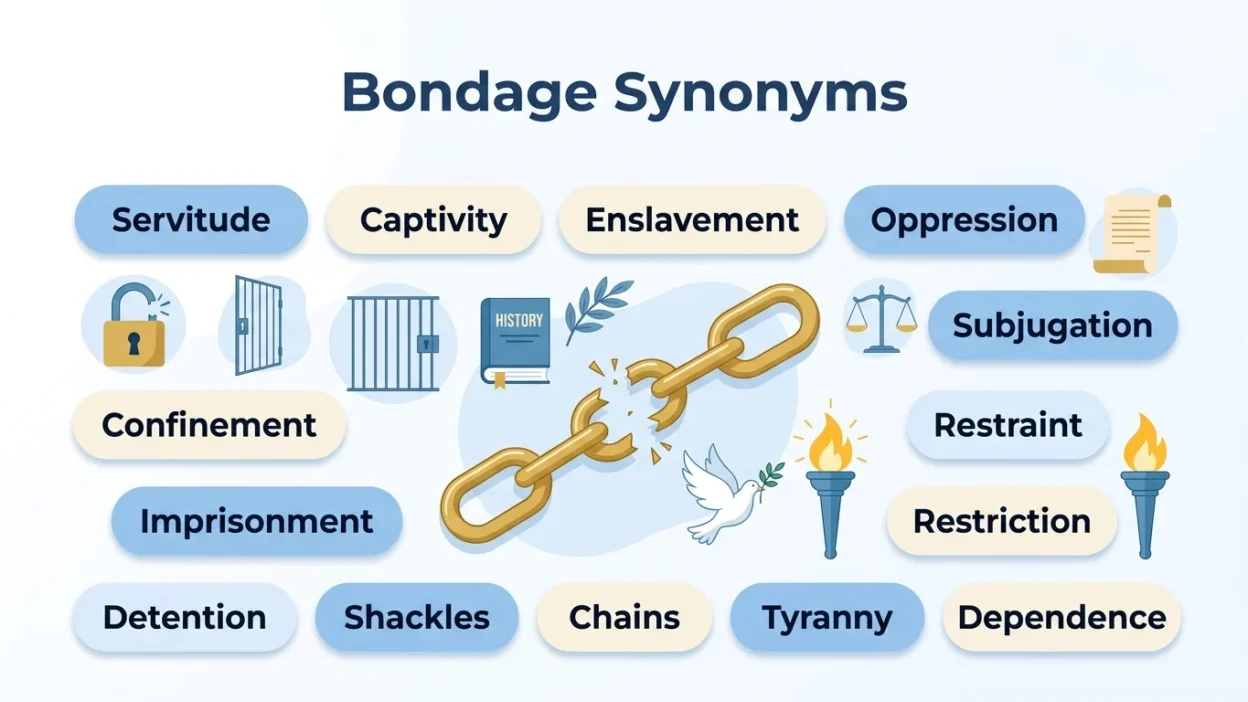
The word bondage has several meanings in English, but in general and historical usage, it refers to a state of being bound, restricted, controlled, or lacking freedom.
It commonly appears in history, literature, law, religion, and figurative writing to describe slavery, captivity, oppression, or dependence.
Learning bondage synonyms helps you understand these different meanings and choose the most appropriate word for your writing.
Whether you’re a student, an ESL learner, a writer, or a content creator, expanding your vocabulary with bondage synonyms can make your writing clearer and more precise. Some synonyms emphasize physical restraint, while others describe emotional, social, legal, or economic forms of restriction.
This guide explains the meaning of bondage, introduces 30 useful bondage synonyms, and includes simple meanings, example sentences, usage notes, a comparison table, and practical tips for choosing the right synonym.
What Does “Bondage” Mean?
Simple Meaning
Bondage means the state of being controlled, restricted, imprisoned, enslaved, or deprived of freedom.
Tone and Usage Context
The word bondage has a formal and serious tone. It is most commonly used in historical, literary, legal, religious, and figurative contexts to describe situations involving slavery, captivity, oppression, or dependence.
30 Bondage Synonyms with Meanings, Examples, and Usage
1. Slavery
Meaning: The condition of being owned or forced to work for another person.
Example: Many countries have abolished slavery.
Best Usage Context: History and social studies.
2. Captivity
Meaning: The state of being imprisoned or held.
Example: The animal spent years in captivity.
Best Usage Context: Wildlife and history.
3. Servitude
Meaning: Working under another person’s control.
Example: The workers lived in servitude.
Best Usage Context: Historical writing.
4. Enslavement
Meaning: The act of making someone a slave.
Example: The book discusses the enslavement of millions.
Best Usage Context: History.
5. Oppression
Meaning: Unfair treatment through power or authority.
Example: People protested against oppression.
Best Usage Context: Politics and society.
6. Subjugation
Meaning: Bringing people under control.
Example: The kingdom resisted subjugation.
Best Usage Context: History and politics.
7. Confinement
Meaning: Being kept within limits.
Example: His confinement lasted several weeks.
Best Usage Context: Medical and legal writing.
8. Imprisonment
Meaning: The state of being in prison.
Example: The court ordered his imprisonment.
Best Usage Context: Law.
9. Detention
Meaning: Being held by authorities.
Example: The suspect remained in detention.
Best Usage Context: Legal discussions.
10. Restraint
Meaning: Limitation of movement or action.
Example: The restraint prevented injuries.
Best Usage Context: General and legal writing.
11. Restriction
Meaning: A limit on freedom or activity.
Example: Travel restrictions were introduced.
Best Usage Context: Everyday and formal writing.
12. Constraint
Meaning: Something that limits actions.
Example: Budget constraints delayed the project.
Best Usage Context: Business and academics.
13. Control
Meaning: Power over people or situations.
Example: The ruler maintained strict control.
Best Usage Context: General writing.
14. Domination
Meaning: Complete control over others.
Example: The empire sought regional domination.
Best Usage Context: Politics and history.
15. Suppression
Meaning: Preventing freedom or expression.
Example: The suppression of free speech caused concern.
Best Usage Context: Political discussions.
16. Dependence
Meaning: Relying heavily on someone or something.
Example: Financial dependence limited her choices.
Best Usage Context: Social and economic writing.
17. Subordination
Meaning: Being placed in a lower position.
Example: Employees accepted subordination to management.
Best Usage Context: Workplace and legal contexts.
18. Yoke
Meaning: A symbol of heavy control or burden.
Example: The nation struggled under the yoke of colonial rule.
Best Usage Context: Historical and literary writing.
19. Shackles
Meaning: Chains or figurative restrictions.
Example: Education helped break the shackles of poverty.
Best Usage Context: Figurative language.
20. Chains
Meaning: Physical or symbolic restraints.
Example: The novel describes breaking free from chains.
Best Usage Context: Literature.
21. Limitation
Meaning: A restriction on ability or freedom.
Example: Every system has its limitations.
Best Usage Context: General writing.
22. Incarceration
Meaning: Being confined in prison.
Example: His incarceration lasted five years.
Best Usage Context: Legal writing.
23. Internment
Meaning: Detention during conflict or emergencies.
Example: Many civilians faced internment during the war.
Best Usage Context: History.
24. Bond
Meaning: A tie or obligation.
Example: Family bonds are often very strong.
Best Usage Context: Figurative writing.
25. Obligation
Meaning: A duty that limits personal choice.
Example: She fulfilled her legal obligation.
Best Usage Context: Everyday and legal English.
26. Commitment
Meaning: A responsibility or promise.
Example: His commitment required years of hard work.
Best Usage Context: Personal and professional writing.
27. Oblivion of Freedom
Meaning: Loss of personal liberty.
Example: The novel explores the oblivion of freedom under tyranny.
Best Usage Context: Literary writing.
28. Tyranny
Meaning: Cruel or unfair rule.
Example: Citizens fought against tyranny.
Best Usage Context: History and politics.
29. Vassalage
Meaning: A state of serving a more powerful ruler.
Example: The kingdom remained in vassalage for decades.
Best Usage Context: Medieval history.
30. Thralldom
Meaning: A state of slavery or complete control.
Example: The hero escaped years of thralldom.
Best Usage Context: Historical and literary works.
Bondage Synonyms Comparison Guide
When to Use Different Bondage Synonyms
| Synonym | Best Used For | Tone |
|---|---|---|
| Slavery | Historical discussions | Serious |
| Captivity | Wildlife and history | Neutral |
| Servitude | Historical writing | Formal |
| Enslavement | Social history | Formal |
| Oppression | Politics and society | Serious |
| Subjugation | History | Formal |
| Restraint | General use | Neutral |
| Restriction | Everyday writing | Neutral |
| Imprisonment | Legal writing | Formal |
| Chains | Literature | Figurative |
| Shackles | Symbolic writing | Creative |
| Tyranny | Political writing | Serious |
How to Choose the Right Bondage Synonym
For Historical Writing
Use slavery, enslavement, servitude, subjugation, vassalage, and thralldom when discussing historical events.
For Legal Writing
Choose imprisonment, detention, incarceration, restraint, and restriction in legal or official contexts.
For Political Discussions
Use oppression, tyranny, suppression, control, and domination when describing political systems or abuse of power.
For Literary and Creative Writing
Words like chains, shackles, yoke, captivity, and bond create vivid imagery and symbolism.
For Everyday Writing
Use restriction, constraint, limitation, dependence, and obligation when discussing ordinary situations involving limits or responsibilities.
Common Mistakes When Using Bondage Synonyms
Confusing “Bondage” with “Bond”
A bond often means a connection or relationship, while bondage refers to restriction or loss of freedom.
Using “Slavery” Too Broadly
Slavery has a specific historical and legal meaning and should not replace every use of bondage.
Mixing “Restriction” and “Captivity”
A restriction is simply a limit, while captivity usually means being physically confined.
Using Figurative Terms in Formal Writing
Creative words like chains, shackles, and yoke work best in literature and speeches rather than technical reports.
Frequently Asked Questions
What does bondage mean?
Bondage means the state of being controlled, restricted, enslaved, imprisoned, or deprived of freedom.
What is the closest synonym for bondage?
Servitude, captivity, and slavery are among the closest synonyms, depending on the context.
Is bondage a formal word?
Yes. It is mainly used in historical, legal, literary, and religious contexts.
Which synonym is best for historical writing?
Slavery, enslavement, servitude, and subjugation are excellent choices.
Which synonym is best for figurative writing?
Chains, shackles, yoke, and bond create strong symbolic imagery.
Conclusion
Understanding bondage synonyms helps you describe restriction, dependence, captivity, and loss of freedom with greater precision. While bondage is a broad term, alternatives such as servitude, captivity, oppression, subjugation, restraint, and restriction each carry distinct meanings suited to different contexts. By choosing the right synonym, you can make your writing more accurate, engaging, and expressive.

Evelyn Mia is a passionate language writer and vocabulary enthusiast at Synomity.com, specializing in synonyms, word meanings, and language learning. She creates informative content that helps readers expand vocabulary and communicate more effectively.