
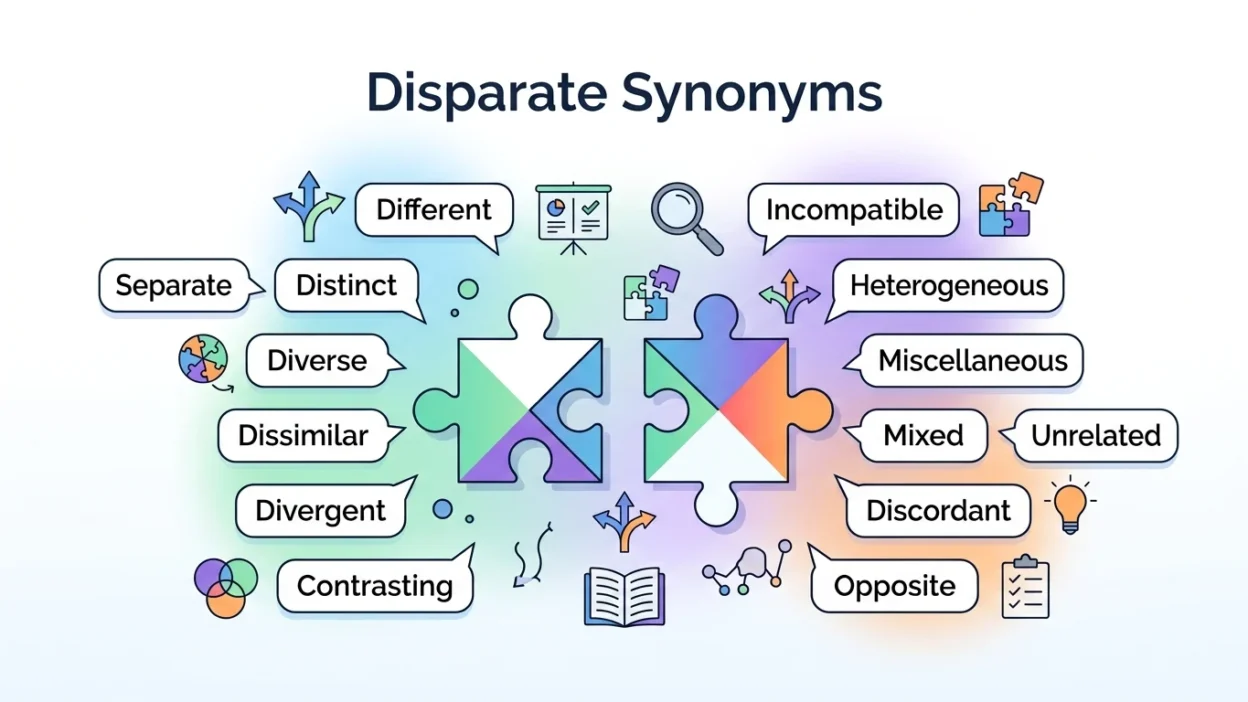
The word disparate is commonly used to describe things that are very different from one another and do not naturally fit together.
It often appears in academic writing, business reports, journalism, literature, and everyday English when comparing people, ideas, cultures, data, or objects.
Learning disparate synonyms helps you avoid repetition and choose the most accurate word for different situations.
Whether you’re a student, an ESL learner, a writer, or a content creator, understanding the subtle differences between disparate synonyms can improve your vocabulary and writing skills.
Some alternatives emphasize contrast, while others highlight variety, diversity, or complete separation.
This guide explains the meaning of disparate, introduces 30 useful disparate synonyms, and includes simple definitions, example sentences, usage notes, a comparison table, and practical tips for choosing the right synonym.
What Does “Disparate” Mean?
Simple Meaning
Disparate means completely different, unrelated, or distinct from one another.
Tone and Usage Context
The word disparate has a formal tone and is commonly used in academic writing, business communication, journalism, research, literature, and professional discussions.
30 Disparate Synonyms with Meanings, Examples, and Usage
1. Different
Meaning: Not the same.
Example: The two cultures have different traditions.
Best Usage Context: Everyday English.
2. Distinct
Meaning: Clearly separate or different.
Example: Each department has a distinct role.
Best Usage Context: Academic and business writing.
3. Diverse
Meaning: Showing many different types.
Example: The city has a diverse population.
Best Usage Context: Culture and education.
4. Varied
Meaning: Including many different kinds.
Example: The museum has a varied collection.
Best Usage Context: General writing.
5. Unrelated
Meaning: Having no connection.
Example: The two events are unrelated.
Best Usage Context: Formal communication.
6. Separate
Meaning: Existing independently.
Example: The company has separate offices.
Best Usage Context: General writing.
7. Dissimilar
Meaning: Not alike.
Example: Their opinions are dissimilar.
Best Usage Context: Academic writing.
8. Contrasting
Meaning: Showing obvious differences.
Example: The report compared contrasting viewpoints.
Best Usage Context: Essays and reports.
9. Opposite
Meaning: Completely different in nature.
Example: Their personalities are opposite.
Best Usage Context: Everyday English.
10. Contrary
Meaning: Opposing or conflicting.
Example: The evidence suggests a contrary conclusion.
Best Usage Context: Formal writing.
11. Divergent
Meaning: Moving in different directions.
Example: The researchers presented divergent theories.
Best Usage Context: Academic and scientific writing.
12. Diverging
Meaning: Becoming increasingly different.
Example: Their goals are diverging over time.
Best Usage Context: Business and research.
13. Incompatible
Meaning: Unable to exist together successfully.
Example: Their schedules are incompatible.
Best Usage Context: Technology and relationships.
14. Conflicting
Meaning: Opposing each other.
Example: Witnesses gave conflicting statements.
Best Usage Context: Legal and journalism.
15. Independent
Meaning: Not influenced by another.
Example: The projects are independent.
Best Usage Context: Business and education.
16. Unconnected
Meaning: Without any relationship.
Example: The stories are completely unconnected.
Best Usage Context: Formal writing.
17. Isolated
Meaning: Separate from others.
Example: The village remained isolated.
Best Usage Context: Geography and literature.
18. Disconnected
Meaning: Not joined together.
Example: The ideas seemed disconnected.
Best Usage Context: General communication.
19. Miscellaneous
Meaning: Made up of different kinds.
Example: The box contained miscellaneous items.
Best Usage Context: Lists and descriptions.
20. Mixed
Meaning: Combined from different sources.
Example: The team had mixed opinions.
Best Usage Context: Everyday writing.
21. Assorted
Meaning: A variety of different types.
Example: The store sells assorted chocolates.
Best Usage Context: Retail and product descriptions.
22. Heterogeneous
Meaning: Made up of different kinds.
Example: The research group was heterogeneous.
Best Usage Context: Scientific and academic writing.
23. Multifarious
Meaning: Having great variety.
Example: The library contains multifarious resources.
Best Usage Context: Formal and literary writing.
24. Diverse in Nature
Meaning: Different in characteristics.
Example: The participants were diverse in nature.
Best Usage Context: Educational writing.
25. Contradictory
Meaning: Expressing opposite ideas.
Example: His statements were contradictory.
Best Usage Context: Legal and academic writing.
26. Unequal
Meaning: Not equal in size, quality, or amount.
Example: The opportunities were unequal.
Best Usage Context: Social discussions.
27. Uneven
Meaning: Not balanced or equal.
Example: Development across regions was uneven.
Best Usage Context: Economics and geography.
28. Polar
Meaning: Completely opposite.
Example: Their opinions were polar opposites.
Best UsageContext: Informal and descriptive writing.
29. Discordant
Meaning: Not in agreement.
Example: The report highlighted discordant findings.
Best Usage Context: Music, research, and literature.
30. Contrasted
Meaning: Compared because of clear differences.
Example: The article contrasted two disparate approaches.
Best Usage Context: Essays and comparisons.
Disparate Synonyms Comparison Guide
When to Use Different Disparate Synonyms
| Synonym | Best Used For | Tone |
|---|---|---|
| Different | Everyday conversations | Neutral |
| Distinct | Business and academics | Formal |
| Diverse | Culture and education | Neutral |
| Dissimilar | Comparisons | Formal |
| Divergent | Research | Academic |
| Incompatible | Technology and relationships | Professional |
| Contrasting | Essays | Formal |
| Heterogeneous | Science | Academic |
| Miscellaneous | Collections | Neutral |
| Discordant | Research and literature | Formal |
| Unrelated | Reports | Neutral |
| Opposite | Casual speech | Informal |
How to Choose the Right Disparate Synonym
For Academic Writing
Use distinct, dissimilar, divergent, heterogeneous, contrasting, and contradictory when writing essays, reports, or research papers.
For Everyday Conversations
Choose different, separate, mixed, opposite, and unrelated because they are simple and natural.
For Business and Professional Writing
Use independent, distinct, incompatible, divergent, and unconnected in reports and workplace communication.
For Creative Writing
Words like discordant, multifarious, isolated, polar, and contrasting add vivid descriptions.
For Science and Research
Select heterogeneous, divergent, independent, unequal, and contradictory when discussing data or scientific studies.
Common Mistakes When Using Disparate Synonyms
Confusing “Disparate” with “Desperate”
These words have different meanings. Disparate means very different, while desperate means feeling hopeless or in great need.
Using “Different” in Formal Writing
Although correct, distinct, dissimilar, or divergent may sound more precise in academic contexts.
Mixing “Diverse” and “Disparate”
Diverse often has a positive meaning of variety, while disparate emphasizes significant differences.
Using “Opposite” Too Broadly
Not all disparate things are complete opposites. They may simply be unrelated or different.
Frequently Asked Questions
What does disparate mean?
Disparate means completely different, separate, or unrelated from one another.
What is the closest synonym for disparate?
Dissimilar, distinct, and different are among the closest synonyms, depending on the context.
Is disparate a formal word?
Yes. It is most commonly used in academic, professional, and formal writing.
Which synonym is best for research writing?
Divergent, heterogeneous, distinct, and contrasting are excellent choices.
Which synonym is best for everyday English?
Different, separate, mixed, and unrelated are easy to understand and commonly used.
Conclusion
Learning disparate synonyms helps you describe differences more accurately and effectively. While disparate is an excellent word for describing things that are significantly different or unrelated, alternatives such as distinct, dissimilar, divergent, heterogeneous, and contrasting can better suit specific contexts. By understanding each synonym’s meaning and best usage, you can improve your vocabulary, strengthen your writing, and communicate with greater confidence.

Evelyn Mia is a passionate language writer and vocabulary enthusiast at Synomity.com, specializing in synonyms, word meanings, and language learning. She creates informative content that helps readers expand vocabulary and communicate more effectively.