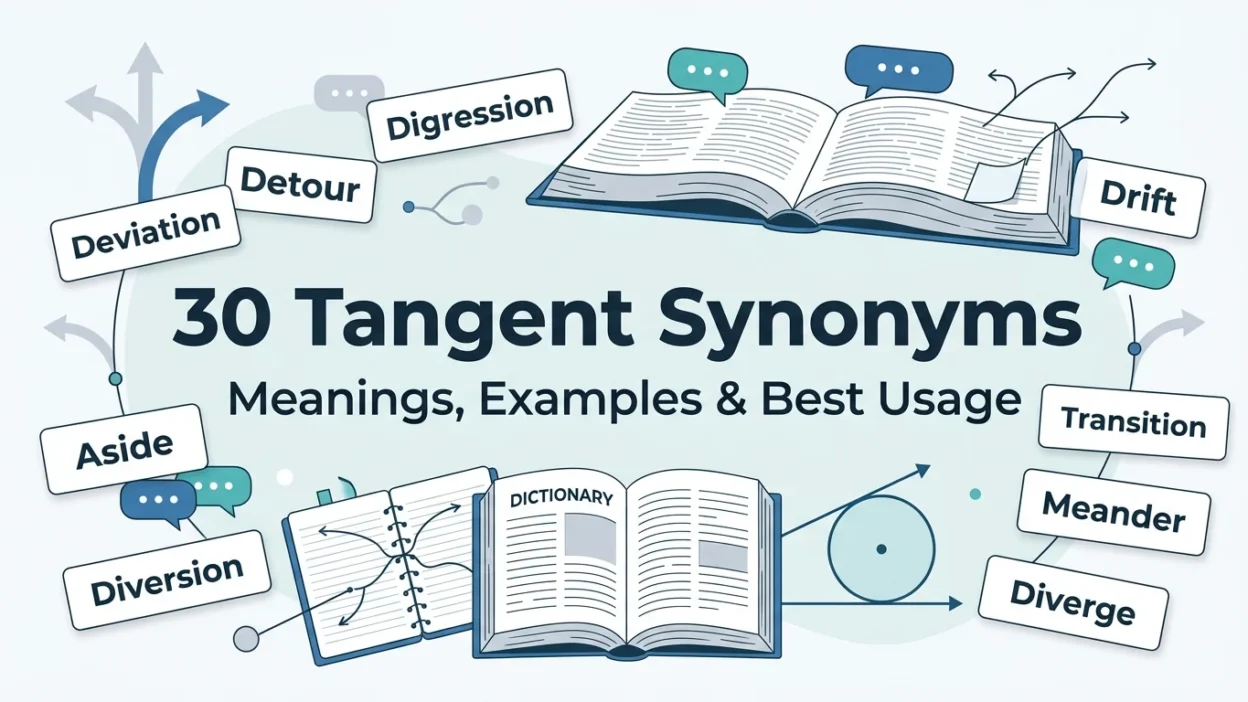
The word tangent is used in several different ways, making it an interesting and useful part of the English language.
In mathematics, a tangent is a line that touches a curve at exactly one point. In everyday conversation, however, tangent often describes a sudden shift away from the main topic.
For example, if someone starts talking about an unrelated subject during a discussion, they are said to “go off on a tangent.”
Learning tangent synonyms can improve your vocabulary and help you choose the most appropriate word for different situations.
Whether you’re a student writing essays, an ESL learner building English skills, or a content creator aiming for more engaging writing, understanding these alternatives will make your communication clearer and more precise.
Since tangent has multiple meanings, there are only a few true synonyms. This guide includes both true synonyms and closely related alternatives that fit different contexts, helping you use the right word naturally.
What Does “Tangent” Mean?
Simple Meaning
A tangent is something that touches another thing at one point or moves slightly away from the main subject. In everyday English, it usually refers to changing the topic of a conversation unexpectedly.
Tone
- Informal
- Academic
- Mathematical
- Conversational
- Descriptive
Common Usage
The word tangent is commonly used in:
- Everyday conversations
- Essays and reports
- Mathematics
- Public speaking
- Meetings
- Blog writing
Examples:
- She went off on a tangent during the meeting.
- The teacher explained the tangent of a circle.
- His story took an interesting tangent.
30 Tangent Synonyms and Related Words
1. Digression
Meaning: A temporary move away from the main topic.
Example: His speech included a funny digression about childhood.
Best Usage: Essays, conversations, speeches.
2. Detour
Meaning: A different route or change from the original path.
Example: Our discussion took a detour toward travel.
Best Usage: Conversations and journeys.
3. Deviation
Meaning: Moving away from the expected direction.
Example: The report contains a slight deviation from the original plan.
Best Usage: Formal and academic writing.
4. Aside
Meaning: A brief comment separate from the main subject.
Example: The speaker made a humorous aside.
Best Usage: Writing and speeches.
5. Diversion
Meaning: A change in focus or direction.
Example: The conversation became a welcome diversion.
Best Usage: General English.
6. Departure
Meaning: Leaving the usual course.
Example: This idea is a departure from tradition.
Best Usage: Formal writing.
7. Interruption
Meaning: A break in the normal flow.
Example: The interruption delayed the presentation.
Best Usage: Meetings and discussions.
8. Parenthesis
Meaning: An additional remark within a discussion.
Example: He added a brief parenthesis before continuing.
Best Usage: Literary writing.
9. Side Note
Meaning: Extra information related to the main topic.
Example: As a side note, the event starts earlier tomorrow.
Best Usage: Casual writing.
10. Offshoot
Meaning: Something that develops from the main subject.
Example: The project became an offshoot of earlier research.
Best Usage: Academic and business writing.
11. Branch
Meaning: A division from the main subject.
Example: Linguistics is a branch of language studies.
Best Usage: Educational content.
12. Extension
Meaning: An added part connected to the original.
Example: The article serves as an extension of previous research.
Best Usage: Academic writing.
13. Spin-Off
Meaning: Something developed from another idea.
Example: The show became a successful spin-off.
Best Usage: Media and business.
14. Sidetrack
Meaning: To distract from the main topic.
Example: Let’s not get sidetracked.
Best Usage: Everyday conversations.
15. Distraction
Meaning: Something that shifts attention.
Example: Phone calls became a distraction.
Best Usage: Daily communication.
16. Peripheral Idea
Meaning: A less important related idea.
Example: That is only a peripheral idea.
Best Usage: Academic writing.
17. Related Topic
Meaning: A connected subject.
Example: Climate change is a related topic.
Best Usage: Essays and blogs.
18. Connected Idea
Meaning: An idea linked to another.
Example: This is a connected idea worth discussing.
Best Usage: Educational writing.
19. Adjacent Topic
Meaning: A nearby or closely connected subject.
Example: Marketing is an adjacent topic.
Best Usage: Professional writing.
20. Byway
Meaning: A less direct route or subject.
Example: The lecture explored several intellectual byways.
Best Usage: Literary writing.
21. Excursion
Meaning: A temporary move away from the main discussion.
Example: The professor’s historical excursion was fascinating.
Best Usage: Formal speaking.
22. Ramble
Meaning: Talking without staying focused.
Example: His ramble lasted several minutes.
Best Usage: Informal conversations.
23. Meander
Meaning: To wander without a clear direction.
Example: The discussion began to meander.
Best Usage: Creative writing.
24. Wander
Meaning: To move away from the main point.
Example: Don’t let your thoughts wander.
Best Usage: Everyday English.
25. Drift
Meaning: To gradually move away from the topic.
Example: The meeting drifted into unrelated issues.
Best Usage: Business communication.
26. Digress
Meaning: To leave the main subject while speaking.
Example: The author often digresses.
Best Usage: Formal and academic writing.
27. Diverge
Meaning: To move in a different direction.
Example: Their opinions diverge significantly.
Best Usage: Formal discussions.
28. Shift
Meaning: To change focus.
Example: The conversation shifted toward technology.
Best Usage: Everyday English.
29. Transition
Meaning: A movement from one topic to another.
Example: The speaker made a smooth transition.
Best Usage: Presentations and writing.
30. Change of Subject
Meaning: Switching to another topic.
Example: That was quite a change of subject.
Best Usage: Casual conversations.
Tangent Synonyms Comparison Guide
When to Use Different Tangent Synonyms
| Word | Best Used For | Tone |
|---|---|---|
| Digression | Essays, speeches | Formal |
| Detour | Conversations | Casual |
| Deviation | Academic writing | Formal |
| Aside | Presentations | Neutral |
| Diversion | General writing | Neutral |
| Sidetrack | Informal speech | Casual |
| Drift | Meetings | Neutral |
| Digress | Academic writing | Formal |
| Meander | Creative writing | Descriptive |
| Transition | Professional writing | Professional |
How to Choose the Right Tangent Synonym
For Everyday Conversations
Choose:
- Detour
- Sidetrack
- Drift
- Wander
- Change of Subject
These words sound natural in daily English.
For Academic Writing
Choose:
- Digression
- Deviation
- Digress
- Diverge
- Extension
These words fit essays, reports, and research papers.
For Business and Professional Writing
Choose:
- Transition
- Shift
- Diversion
- Related Topic
- Adjacent Topic
These create a professional tone.
For Creative Writing
Choose:
- Meander
- Ramble
- Excursion
- Byway
- Aside
These words make storytelling more expressive.
For Mathematics
There are very few direct alternatives. In mathematical writing, it is usually best to use tangent itself because it has a precise meaning that other words cannot fully replace.
Common Mistakes When Using Tangent Synonyms
Confusing “Digression” and “Distraction”
A digression is a deliberate change in topic, while a distraction is something that pulls attention away unintentionally.
Using “Tangent” Only in Math
Although tangent is a mathematical term, it is also widely used in everyday conversations to describe changing the subject.
Choosing Formal Words in Casual Speech
Words like deviation or diverge may sound too formal in casual conversations. Use detour or sidetrack instead.
Why Learning Tangent Synonyms Improves Your Writing
Understanding tangent synonyms helps you avoid repeating the same word and makes your writing more engaging. It also allows you to describe changes in direction, ideas, and conversations with greater accuracy.
A strong vocabulary improves essays, blog posts, creative stories, presentations, and professional communication. Choosing the right synonym based on the context will make your writing sound more natural and polished.
Frequently Asked Questions (FAQs)
What is the closest synonym for tangent?
Digression is the closest synonym when referring to a conversation that moves away from the main topic.
Is tangent always a mathematical word?
No. While it has a specific mathematical meaning, tangent is also commonly used in everyday English to describe changing the topic.
What is the difference between tangent and digression?
A tangent is a shift away from the main topic, while a digression is the act of discussing that side topic before returning to the original one.
Which tangent synonym is best for essays?
Digression, deviation, diverge, and transition are excellent choices for formal writing.
Can I use detour instead of tangent?
Yes, in casual conversations detour often works well when describing a temporary change in direction or topic.
Conclusion
Learning tangent synonyms helps you express changes in direction, ideas, and conversations more effectively. While tangent has only a few true synonyms, many related words such as digression, detour, deviation, aside, and sidetrack fit different contexts. By understanding their meanings and subtle differences, you can improve your vocabulary, write with greater confidence, and communicate more naturally in both formal and everyday English.

John Morrison is a dedicated content writer at Synomity.com, focused on synonyms, vocabulary development, and word meanings. He creates clear, educational resources that help readers improve language skills and communicate with confidence.