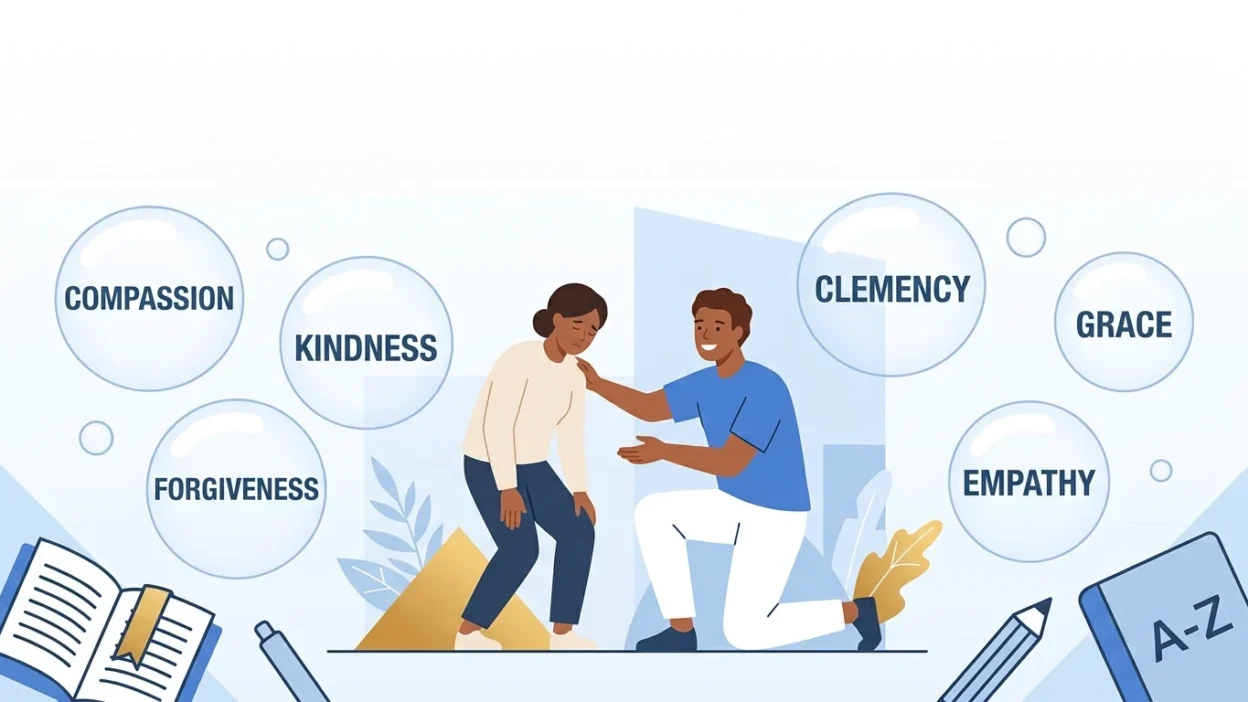
Mercy is one of the most meaningful words in the English language. It represents kindness, compassion, forgiveness, and the willingness to treat someone gently instead of harshly.
Whether you are writing an essay, creating content, speaking in public, or simply expanding your English vocabulary, learning mercy synonyms can help you communicate your ideas more clearly and naturally.
Students, ESL learners, writers, and content creators often look for different ways to express mercy without repeating the same word.
While many words share a similar meaning, each has its own tone and best usage. Understanding these differences allows you to choose the most appropriate word for every situation.
In this complete guide, you’ll discover the meaning of mercy, learn 30 useful mercy synonyms with simple explanations and examples, compare their meanings, and understand how to use each one confidently.
What Does “Mercy” Mean?
Meaning of Mercy
The word mercy means showing kindness, compassion, or forgiveness toward someone who could be punished or treated unfairly. It is the act of choosing kindness over harshness and understanding over judgment.
Tone of the Word
The word mercy usually has a compassionate, gentle, forgiving, caring, and humane tone.
Common Usage Context
Mercy is commonly used in:
- Everyday conversations
- Literature
- Religious writings
- Legal discussions
- Motivational speeches
- Emotional storytelling
Example Sentence:
The judge showed mercy by giving the young offender a second chance.
30 Mercy Synonyms
1. Compassion
Meaning: Deep concern for someone who is suffering.
Example: The nurse treated every patient with compassion.
Best Usage Context: Emotional writing and caring situations.
2. Kindness
Meaning: Being friendly, generous, and considerate.
Example: Her kindness made everyone feel welcome.
Best Usage Context: Everyday English.
3. Forgiveness
Meaning: Choosing to stop being angry after someone makes a mistake.
Example: He asked for forgiveness after apologizing.
Best Usage Context: Relationships and personal growth.
4. Clemency
Meaning: Mercy shown by a person in authority.
Example: The president granted clemency to the prisoner.
Best Usage Context: Legal and government writing.
5. Leniency
Meaning: Being less strict than expected.
Example: The teacher showed leniency during the first test.
Best Usage Context: Education and workplace settings.
6. Pity
Meaning: Feeling sorry for another person’s suffering.
Example: She looked at the injured bird with pity.
Best Usage Context: Emotional conversations.
7. Sympathy
Meaning: Sharing someone else’s sadness.
Example: We offered our sympathy after their loss.
Best Usage Context: Comforting others.
8. Empathy
Meaning: Understanding another person’s feelings.
Example: Good leaders always show empathy.
Best Usage Context: Leadership and relationships.
9. Charity
Meaning: Helping people who are in need.
Example: The charity supported homeless families.
Best Usage Context: Community service and donations.
10. Benevolence
Meaning: A desire to do good for others.
Example: His benevolence earned everyone’s respect.
Best Usage Context: Formal writing.
11. Humanity
Meaning: Compassionate treatment of people.
Example: The volunteers acted with great humanity.
Best Usage Context: Human rights discussions.
12. Grace
Meaning: Kindness freely offered.
Example: She accepted his apology with grace.
Best Usage Context: Religious and inspirational writing.
13. Tenderness
Meaning: Gentle care and affection.
Example: The mother spoke with tenderness.
Best Usage Context: Family and emotional writing.
14. Gentleness
Meaning: Calm and careful behavior.
Example: Handle the kitten with gentleness.
Best Usage Context: Everyday communication.
15. Consideration
Meaning: Thoughtfulness toward others.
Example: Thank you for your consideration.
Best Usage Context: Professional communication.
16. Generosity
Meaning: Willingness to share and give.
Example: Her generosity inspired everyone.
Best Usage Context: Charity and personal character.
17. Goodness
Meaning: Moral kindness and virtue.
Example: His goodness changed many lives.
Best Usage Context: Character descriptions.
18. Charity of Heart
Meaning: A forgiving and kind attitude.
Example: She treated everyone with charity of heart.
Best Usage Context: Literary writing.
19. Favor
Meaning: An act of special kindness.
Example: The king granted him a favor.
Best Usage Context: Historical and formal writing.
20. Relief
Meaning: Help that reduces pain or suffering.
Example: The medicine brought immediate relief.
Best Usage Context: Health and emergencies.
21. Helpfulness
Meaning: Being willing to assist others.
Example: Everyone appreciated her helpfulness.
Best Usage Context: Everyday conversations.
22. Understanding
Meaning: Accepting others with patience.
Example: Thank you for your understanding.
Best Usage Context: Work and relationships.
23. Tolerance
Meaning: Respecting differences peacefully.
Example: Tolerance creates stronger communities.
Best Usage Context: Social and educational topics.
24. Patience
Meaning: Staying calm during difficulties.
Example: Parenting requires patience every day.
Best Usage Context: Personal development.
25. Softheartedness
Meaning: Easily feeling sympathy for others.
Example: His softheartedness made him help everyone.
Best Usage Context: Informal writing.
26. Warmheartedness
Meaning: Genuine kindness and friendliness.
Example: Everyone loved her warmheartedness.
Best Usage Context: Personality descriptions.
27. Altruism
Meaning: Helping others without expecting rewards.
Example: Volunteering is an example of altruism.
Best Usage Context: Academic and professional writing.
28. Charity Work
Meaning: Volunteer work that helps people.
Example: They spent weekends doing charity work.
Best Usage Context: Community activities.
29. Humanity of Spirit
Meaning: A naturally compassionate character.
Example: His humanity of spirit inspired hope.
Best Usage Context: Inspirational writing.
30. Loving-Kindness
Meaning: Deep, caring compassion for others.
Example: She treated everyone with loving-kindness.
Best Usage Context: Spiritual and religious writing.
Comparison Guide
When to Use Different Mercy Synonyms
| Synonym | Best Used For | Tone |
|---|---|---|
| Compassion | Helping people | Caring |
| Kindness | Everyday conversation | Friendly |
| Forgiveness | Personal relationships | Emotional |
| Clemency | Legal writing | Formal |
| Leniency | Rules and discipline | Moderate |
| Sympathy | Comforting someone | Gentle |
| Empathy | Understanding emotions | Warm |
| Charity | Helping those in need | Generous |
| Benevolence | Formal writing | Professional |
| Grace | Religious writing | Elegant |
| Patience | Difficult situations | Calm |
| Tolerance | Social discussions | Respectful |
| Humanity | Human rights | Compassionate |
| Altruism | Academic writing | Formal |
| Generosity | Giving and donations | Positive |
How to Choose the Right Synonym
For Everyday Conversations
Choose words like kindness, compassion, helpfulness, gentleness, and understanding. They sound natural and are easy to understand.
For Emotional Writing
Use forgiveness, sympathy, empathy, tenderness, or warmheartedness to express deep emotions.
For Legal or Official Contexts
Words such as clemency and leniency are the best choices because they refer to reducing punishment or being less strict.
For Academic or Professional Writing
Use benevolence, altruism, humanity, and tolerance to create a more formal tone.
For Religious or Inspirational Writing
Words like grace, loving-kindness, charity, and mercy work well because they express compassion, forgiveness, and spiritual care.
Frequently Asked Questions
What is the closest synonym for mercy?
The closest synonyms include compassion, forgiveness, clemency, kindness, and grace, depending on the context.
Is mercy the same as forgiveness?
No. Mercy means showing kindness instead of punishment, while forgiveness means letting go of anger after someone has done something wrong.
Which mercy synonym is best for legal writing?
Clemency is the most appropriate synonym because it refers to reducing or pardoning punishment through legal authority.
Which mercy synonym is best for everyday English?
Kindness, compassion, and understanding are the most common and natural choices for daily conversations.
Why should I learn mercy synonyms?
Learning mercy synonyms helps you expand your vocabulary, avoid repeating the same word, improve your writing, and communicate with greater clarity and confidence.
Conclusion
Learning mercy synonyms helps you express kindness, compassion, forgiveness, and understanding more effectively. Although words like compassion, kindness, clemency, grace, and forgiveness are closely related to mercy, each one carries its own unique meaning and tone.
By understanding these differences, students, ESL learners, writers, and content creators can choose the right word for every situation. Expanding your vocabulary not only makes your writing more engaging but also helps you communicate your thoughts with confidence and precision.

Evelyn Mia is a passionate language writer and vocabulary enthusiast at Synomity.com, specializing in synonyms, word meanings, and language learning. She creates informative content that helps readers expand vocabulary and communicate more effectively.