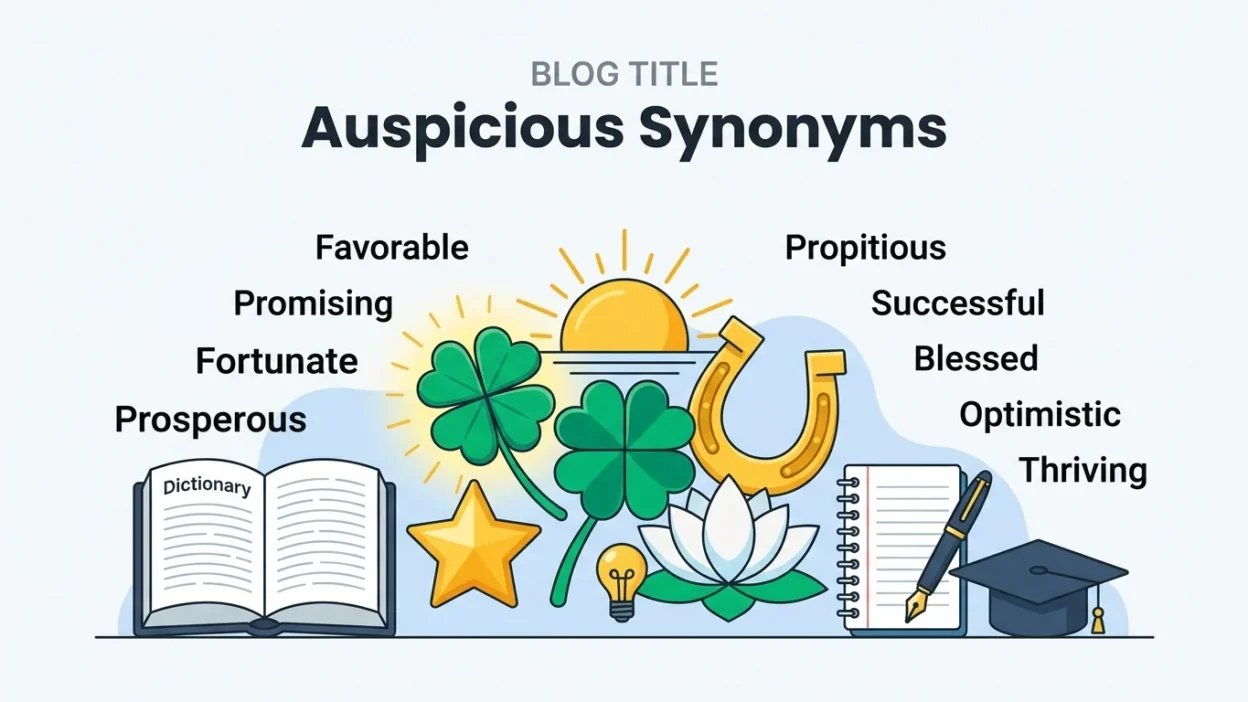
The word auspicious is often used to describe something that promises success, good fortune, or positive outcomes.
Whether you’re writing an essay, giving a speech, creating content, or improving your English vocabulary, knowing different auspicious synonyms helps you express positive ideas with greater variety and precision.
Students, ESL learners, writers, and content creators frequently search for alternatives to auspicious to avoid repetition and make their writing more engaging.
Some synonyms emphasize luck, while others highlight promise, success, or favorable conditions. Understanding these subtle differences allows you to choose the most suitable word for every situation.
In this guide, you’ll learn the meaning of auspicious, discover 30 useful synonyms, see beginner-friendly examples, compare their usage, and understand when to use each word naturally.
What Does “Auspicious” Mean?
Meaning of Auspicious
The word auspicious means showing signs of future success, good luck, or favorable results. It describes situations, events, or beginnings that suggest something positive is likely to happen.
Tone of the Word
The word auspicious usually has a:
- Positive tone
- Hopeful tone
- Formal tone
- Encouraging tone
- Optimistic tone
Common Usage Context
The word auspicious is commonly used in:
- Academic writing
- Literature
- Business discussions
- Religious and cultural traditions
- Formal speeches
- News articles
Example Sentence:
The company made an auspicious start with record-breaking sales.
30 Auspicious Synonyms
1. Favorable
Meaning: Producing good results.
Example: The weather was favorable for the event.
Best Usage Context: General writing.
2. Promising
Meaning: Likely to succeed.
Example: She showed promising talent.
Best Usage Context: Education and careers.
3. Fortunate
Meaning: Bringing good luck.
Example: We were fortunate to arrive safely.
Best Usage Context: Everyday English.
4. Lucky
Meaning: Having good fortune.
Example: He was lucky to win the prize.
Best Usage Context: Casual conversations.
5. Prosperous
Meaning: Successful and financially healthy.
Example: They built a prosperous business.
Best Usage Context: Business writing.
6. Successful
Meaning: Achieving desired results.
Example: The project was successful.
Best Usage Context: General communication.
7. Hopeful
Meaning: Feeling positive about the future.
Example: We remain hopeful about the outcome.
Best Usage Context: Motivational writing.
8. Encouraging
Meaning: Giving confidence or hope.
Example: The early results were encouraging.
Best Usage Context: Education and business.
9. Positive
Meaning: Good or beneficial.
Example: She received positive feedback.
Best Usage Context: Everyday communication.
10. Advantageous
Meaning: Providing benefits.
Example: The agreement was advantageous.
Best Usage Context: Professional writing.
11. Beneficial
Meaning: Helpful or useful.
Example: Exercise is beneficial for health.
Best Usage Context: Health and education.
12. Bright
Meaning: Showing signs of success.
Example: She has a bright future.
Best Usage Context: Personal achievements.
13. Golden
Meaning: Extremely valuable or fortunate.
Example: It was a golden opportunity.
Best Usage Context: Informal and motivational writing.
14. Encouragingly Positive
Meaning: Showing hopeful signs.
Example: Sales figures were encouragingly positive.
Best Usage Context: Reports and business.
15. Hope-Inspiring
Meaning: Creating confidence about success.
Example: The announcement was hope-inspiring.
Best Usage Context: Inspirational writing.
16. Lucky-Break
Meaning: An unexpected success.
Example: Winning the contest was a lucky break.
Best Usage Context: Informal English.
17. Fruitful
Meaning: Producing good results.
Example: The meeting was fruitful.
Best Usage Context: Business and education.
18. Productive
Meaning: Creating useful outcomes.
Example: We had a productive discussion.
Best Usage Context: Workplace communication.
19. Thriving
Meaning: Growing successfully.
Example: The small business is thriving.
Best Usage Context: Business and economy.
20. Flourishing
Meaning: Developing successfully.
Example: The garden is flourishing.
Best Usage Context: Nature and business.
21. Blessed
Meaning: Favored with good fortune.
Example: They felt blessed to have good health.
Best Usage Context: Religious and personal writing.
22. Fortuitous
Meaning: Happening by lucky chance.
Example: It was a fortuitous meeting.
Best Usage Context: Formal writing.
23. Opportune
Meaning: Happening at the perfect time.
Example: Her arrival was opportune.
Best Usage Context: Formal communication.
24. Timely
Meaning: Happening at the right moment.
Example: His timely advice helped everyone.
Best Usage Context: Everyday and business writing.
25. Encouragingly Good
Meaning: Better than expected.
Example: The test results were encouragingly good.
Best Usage Context: Reports.
26. Well-Favored
Meaning: Receiving positive support.
Example: The proposal was well-favored.
Best Usage Context: Formal writing.
27. Propitious
Meaning: Favorably indicating success.
Example: The signs were propitious.
Best Usage Context: Literary and formal English.
28. Blessedly Favorable
Meaning: Exceptionally fortunate.
Example: Conditions remained blessedly favorable.
Best Usage Context: Literary writing.
29. Optimistic
Meaning: Expecting good outcomes.
Example: Investors remained optimistic.
Best Usage Context: Business and personal writing.
30. Encouragingly Favorable
Meaning: Showing clear signs of success.
Example: Market conditions were encouragingly favorable.
Best Usage Context: Business reports.
Comparison Guide
When to Use Different Auspicious Synonyms
| Synonym | Best Used For | Tone |
|---|---|---|
| Favorable | General situations | Neutral |
| Promising | Future success | Positive |
| Fortunate | Good luck | Friendly |
| Lucky | Casual conversation | Informal |
| Prosperous | Business | Professional |
| Successful | Achievements | Positive |
| Encouraging | Early positive results | Hopeful |
| Beneficial | Helpful outcomes | Neutral |
| Fruitful | Meetings and discussions | Professional |
| Flourishing | Growth | Positive |
| Thriving | Business and life | Positive |
| Blessed | Religious writing | Spiritual |
| Opportune | Perfect timing | Formal |
| Propitious | Literary writing | Formal |
| Optimistic | Positive expectations | Encouraging |
How to Choose the Right Synonym
For Everyday English
Use lucky, fortunate, positive, successful, or bright because they are easy to understand and commonly used.
For Business and Professional Writing
Choose prosperous, fruitful, productive, advantageous, or promising to sound professional.
For Formal and Academic Writing
Use auspicious, propitious, opportune, fortuitous, or favorable to create a polished tone.
For Religious or Cultural Contexts
Words like blessed, auspicious, and fortunate are appropriate when discussing traditions, ceremonies, or spiritual beliefs.
For Motivational Writing
Choose hopeful, optimistic, encouraging, bright, or promising to inspire readers.
Frequently Asked Questions
What is the closest synonym for auspicious?
The closest synonyms are favorable, promising, propitious, fortunate, and opportune, depending on the context.
Does auspicious always mean lucky?
No. While it can suggest good luck, auspicious more often means showing signs that something is likely to succeed.
Which synonym is best for formal writing?
Propitious, opportune, favorable, and auspicious are excellent choices for formal and academic writing.
Which synonym is best for everyday conversation?
Lucky, fortunate, positive, and promising are the most natural options in everyday English.
Why should I learn auspicious synonyms?
Learning auspicious synonyms improves your vocabulary, strengthens your writing, helps avoid repetition, and allows you to express positive ideas more accurately.
Conclusion
Learning auspicious synonyms gives you more ways to describe success, good fortune, and positive beginnings. While words like favorable, promising, fortunate, prosperous, and propitious all share similar meanings, each has its own tone and ideal context.
By understanding these subtle differences, students, ESL learners, writers, and content creators can communicate more effectively and write with greater confidence. Expanding your vocabulary makes your writing more engaging, professional, and easier for readers to enjoy.

John Morrison is a dedicated content writer at Synomity.com, focused on synonyms, vocabulary development, and word meanings. He creates clear, educational resources that help readers improve language skills and communicate with confidence.