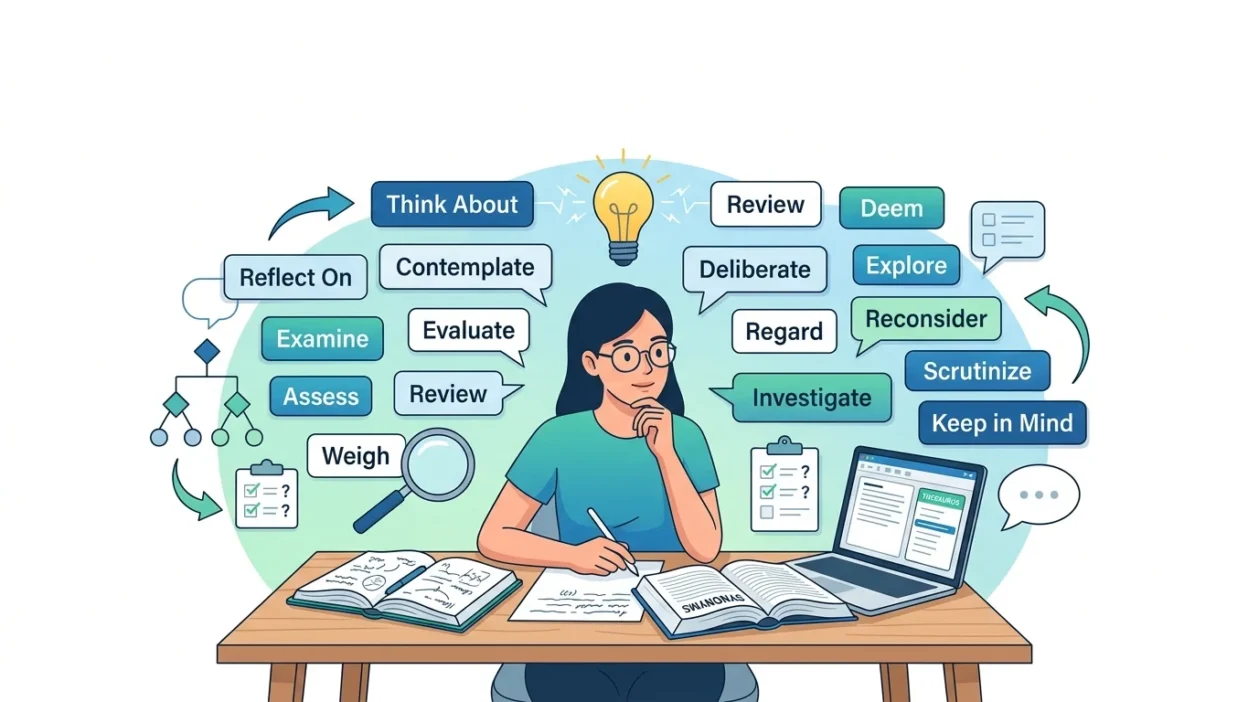
The word consider is one of the most useful verbs in English.
We use it when we think carefully about something, form an opinion, or take an idea into account before making a decision.
Whether you’re writing an essay, preparing a report, or having a conversation, knowing different consider synonyms can make your language more varied and precise.
While consider works well in many situations, it isn’t always the best choice. Depending on the context, words like think about, examine, evaluate, or contemplate may express your meaning more accurately.
Learning these alternatives helps students, ESL learners, writers, and content creators communicate with greater confidence.
This guide explains the meaning of consider, introduces 30 useful consider synonyms, and provides simple definitions, example sentences, and usage tips to help you choose the right word every time.
What Does “Consider” Mean?
Simple Meaning
Consider means to think carefully about something before making a decision or forming an opinion. It can also mean to regard someone or something in a particular way.
Tone and Usage Context
The word consider is commonly used in:
- Everyday conversations
- Academic writing
- Business communication
- Professional emails
- Essays and reports
- Decision-making discussions
Example:
“We should consider all the options before making a decision.”
Here, consider means to think carefully about something.
30 Best Consider Synonyms
1. Think About
Meaning: Reflect on something.
Example: Think about the advantages before deciding.
Best Usage Context: Everyday conversation.
2. Reflect On
Meaning: Think deeply about something.
Example: She reflected on her experiences.
Best Usage Context: Personal writing and self-improvement.
3. Contemplate
Meaning: Think carefully for a long time.
Example: He contemplated changing careers.
Best Usage Context: Formal and literary writing.
4. Ponder
Meaning: Think deeply or seriously.
Example: I pondered the question overnight.
Best Usage Context: Creative and academic writing.
5. Examine
Meaning: Study carefully.
Example: The scientist examined the results.
Best Usage Context: Academic and research writing.
6. Evaluate
Meaning: Judge the value or quality.
Example: We evaluated several proposals.
Best Usage Context: Business and education.
7. Assess
Meaning: Estimate or judge carefully.
Example: The teacher assessed the students’ progress.
Best Usage Context: Professional writing.
8. Review
Meaning: Look over carefully.
Example: Please review the document.
Best Usage Context: Business communication.
9. Analyze
Meaning: Study something in detail.
Example: Researchers analyzed the data.
Best Usage Context: Academic and scientific writing.
10. Inspect
Meaning: Examine closely.
Example: The engineer inspected the bridge.
Best Usage Context: Technical and workplace settings.
11. Observe
Meaning: Watch carefully.
Example: Scientists observed the experiment.
Best Usage Context: Research and education.
12. Study
Meaning: Learn or examine thoroughly.
Example: She studied the report before the meeting.
Best Usage Context: Academic settings.
13. Weigh
Meaning: Compare options before deciding.
Example: We weighed the pros and cons.
Best Usage Context: Decision-making.
14. Deliberate
Meaning: Discuss or think carefully.
Example: The committee deliberated for hours.
Best Usage Context: Formal meetings.
15. Judge
Meaning: Form an opinion.
Example: Don’t judge too quickly.
Best Usage Context: General writing.
16. Regard
Meaning: Think of someone or something in a certain way.
Example: Many regard her as an excellent leader.
Best Usage Context: Formal writing.
17. View
Meaning: Think about or see something.
Example: I view this as an opportunity.
Best Usage Context: Professional communication.
18. Deem
Meaning: Consider officially.
Example: The proposal was deemed acceptable.
Best Usage Context: Legal and formal writing.
19. Account For
Meaning: Take into consideration.
Example: Account for all possible risks.
Best Usage Context: Business planning.
20. Bear in Mind
Meaning: Remember while thinking.
Example: Bear in mind the deadline.
Best Usage Context: Everyday English.
21. Keep in Mind
Meaning: Remember when deciding.
Example: Keep in mind our budget.
Best Usage Context: Informal and professional writing.
22. Mull Over
Meaning: Think carefully for some time.
Example: I’ll mull over your suggestion.
Best Usage Context: Informal conversation.
23. Reconsider
Meaning: Think again.
Example: She reconsidered her decision.
Best Usage Context: Everyday and business English.
24. Reevaluate
Meaning: Assess again.
Example: The company reevaluated its strategy.
Best Usage Context: Professional writing.
25. Scrutinize
Meaning: Examine very carefully.
Example: The lawyer scrutinized the contract.
Best UsageContext: Legal and academic writing.
26. Investigate
Meaning: Look into thoroughly.
Example: Police investigated the incident.
Best Usage Context: Reports and journalism.
27. Explore
Meaning: Examine possibilities.
Example: Let’s explore new ideas.
Best Usage Context: Creative and business writing.
28. Question
Meaning: Think critically about something.
Example: Students questioned the conclusion.
Best Usage Context: Academic discussions.
29. Debate
Meaning: Discuss different viewpoints.
Example: They debated the issue for hours.
Best Usage Context: Formal discussions.
30. Calculate
Meaning: Think carefully using facts or numbers.
Example: Calculate the costs before investing.
Best Usage Context: Finance and planning.
When to Use Different Consider Synonyms
Quick Comparison Table
| Synonym | Best For | Tone |
|---|---|---|
| Think About | Everyday conversations | Neutral |
| Reflect On | Personal growth | Thoughtful |
| Contemplate | Deep thinking | Formal |
| Ponder | Creative writing | Literary |
| Examine | Research | Formal |
| Evaluate | Business decisions | Professional |
| Assess | Performance reviews | Professional |
| Analyze | Academic writing | Formal |
| Review | Documents | Neutral |
| Weigh | Decision-making | Neutral |
| Deliberate | Meetings | Formal |
| Regard | Opinions | Formal |
| Deem | Official decisions | Formal |
| Mull Over | Casual discussions | Informal |
| Reconsider | Changing decisions | Neutral |
| Explore | New ideas | Positive |
| Debate | Group discussions | Formal |
| Calculate | Planning | Technical |
How to Choose the Right Synonym
For Everyday Conversation
These words sound natural and friendly:
- Think About
- Keep in Mind
- Bear in Mind
- Mull Over
- Reconsider
For Academic Writing
Use these in essays, assignments, and research papers:
- Analyze
- Examine
- Evaluate
- Assess
- Investigate
- Study
For Business Communication
Professional alternatives include:
- Review
- Evaluate
- Assess
- Explore
- Account For
- Reevaluate
For Deep Thinking
Choose these when expressing careful reflection:
- Contemplate
- Ponder
- Reflect On
- Deliberate
- Weigh
For Formal Documents
These work well in reports and official writing:
- Deem
- Regard
- Analyze
- Assess
- Scrutinize
- Investigate
Common Mistakes When Using “Consider”
Don’t Overuse “Consider”
Using consider repeatedly can make your writing repetitive. Replace it with words like evaluate, review, or reflect on when appropriate.
Choose the Right Level of Formality
Mull over is suitable for casual conversations, while scrutinize and deem are better for formal or legal writing.
Match the Context
If you’re comparing choices, weigh fits better than consider.
If you’re studying information in detail, analyze or examine is often more accurate.
Tips for Expanding Your Vocabulary
Read Widely
Books, articles, and blogs expose you to different ways of expressing ideas.
Practice with Sentences
Write your own sentence using each synonym to understand its meaning.
Learn by Context
Notice how writers use these words in different situations instead of memorizing definitions alone.
Ask Yourself a Question
Before choosing a synonym, think:
- Am I making a decision?
- Am I studying something?
- Am I expressing an opinion?
- Am I reflecting deeply?
Your answer will help you select the most suitable word.
Conclusion
Learning consider synonyms helps you communicate more precisely and naturally. Although consider is a versatile word, alternatives like evaluate, reflect on, ponder, analyze, review, and assess can make your writing more engaging and appropriate for different contexts.
By understanding the meaning, tone, and best usage of each synonym, you’ll strengthen your vocabulary, improve your writing style, and express your thoughts with greater clarity in academic, professional, and everyday English.

John Morrison is a dedicated content writer at Synomity.com, focused on synonyms, vocabulary development, and word meanings. He creates clear, educational resources that help readers improve language skills and communicate with confidence.