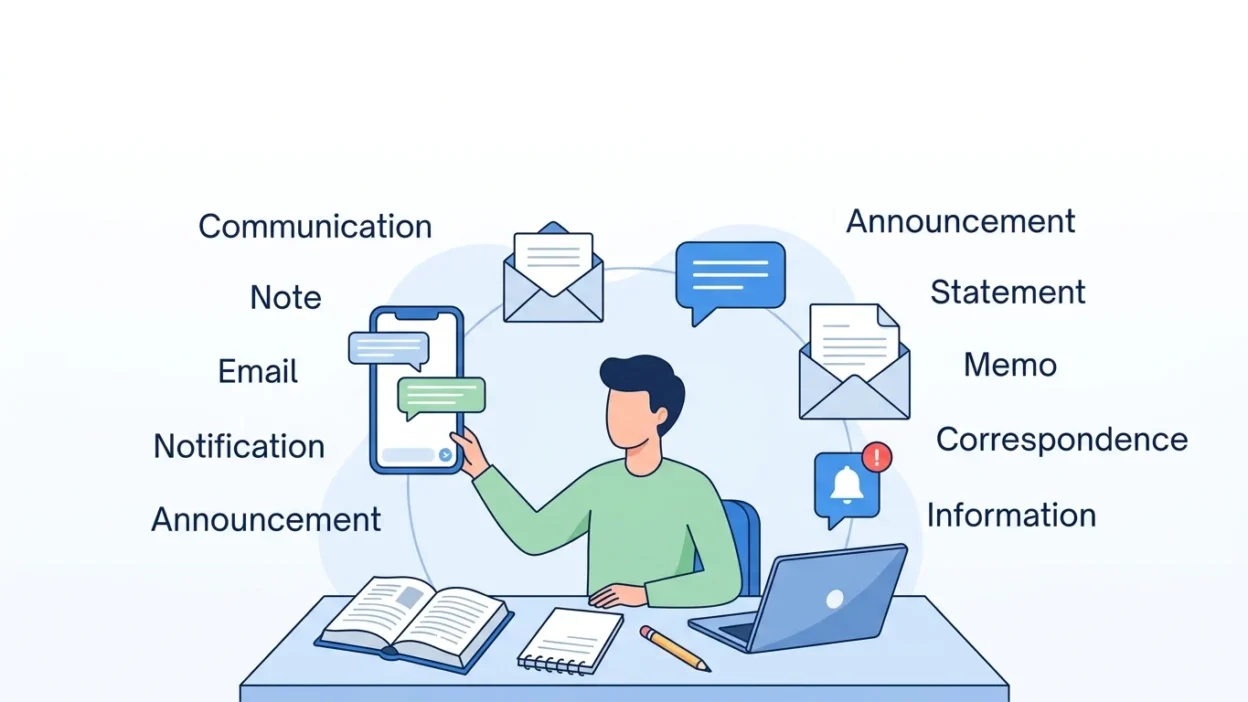
The word message is one of the most frequently used words in English. It can refer to spoken words, written communication, emails, text messages, announcements, or even a hidden meaning in a story or speech.
Because it appears so often in daily conversations and writing, learning different message synonyms can make your language more varied and engaging.
Students, ESL learners, writers, bloggers, and content creators often need alternatives to the word message to avoid repetition.
Some synonyms are formal, while others are better suited for casual conversations, business communication, or creative writing.
Knowing the differences helps you choose the right word for every situation.
In this guide, you’ll discover the meaning of message, explore 30 useful message synonyms, learn their meanings with simple examples, compare their usage, and understand when each word works best.
What Does “Message” Mean?
Meaning of Message
A message is information, an idea, or communication that is sent from one person or group to another. It may be spoken, written, digital, or symbolic.
Tone of the Word
The word message is generally:
- Neutral
- Informative
- Professional
- Friendly
- Versatile
Common Usage Context
The word message is commonly used in:
- Text messaging
- Emails
- Business communication
- Public announcements
- Speeches
- Literature
- Social media
- Personal conversations
Example Sentence:
She sent me a message to confirm our meeting.
30 Message Synonyms
1. Communication
Meaning: The exchange of information between people.
Example: Good communication builds strong relationships.
Best Usage Context: Business and education.
2. Note
Meaning: A short written message.
Example: She left a note on my desk.
Best Usage Context: Everyday writing.
3. Letter
Meaning: A written communication sent to someone.
Example: He received a letter from his friend.
Best Usage Context: Personal and formal communication.
4. Email
Meaning: A digital message sent over the internet.
Example: Please send the details by email.
Best Usage Context: Professional and personal communication.
5. Text
Meaning: A short message sent by phone.
Example: I’ll send you a text tonight.
Best Usage Context: Informal conversations.
6. Notification
Meaning: A message that provides information or an alert.
Example: I received a notification about the update.
Best Usage Context: Technology and apps.
7. Announcement
Meaning: A public statement or notice.
Example: The company made an important announcement.
Best Usage Context: Public speaking and news.
8. Statement
Meaning: A clear expression of facts or opinions.
Example: The manager released a statement.
Best Usage Context: Formal communication.
9. Notice
Meaning: An official piece of information.
Example: The school posted a notice on the board.
Best Usage Context: Schools and workplaces.
10. Memo
Meaning: A short internal business message.
Example: The office circulated a memo.
Best Usage Context: Workplace communication.
11. Dispatch
Meaning: An official report or message.
Example: The reporter sent a dispatch from the scene.
Best Usage Context: Journalism and military writing.
12. Report
Meaning: Detailed information about an event or situation.
Example: The report explained the findings.
Best Usage Context: Academic and professional writing.
13. Advice
Meaning: Helpful guidance given to someone.
Example: His advice changed my decision.
Best Usage Context: Personal communication.
14. Instruction
Meaning: Information explaining what to do.
Example: Read the instruction carefully.
Best Usage Context: Manuals and education.
15. Reminder
Meaning: A message that helps someone remember something.
Example: I received a reminder for my appointment.
Best Usage Context: Daily planning.
16. Alert
Meaning: An urgent warning or notification.
Example: The weather alert warned residents.
Best Usage Context: Safety and emergencies.
17. Signal
Meaning: A sign or message that communicates information.
Example: The green light is a signal to go.
Best Usage Context: Transportation and technology.
18. Word
Meaning: Information or news shared with others.
Example: We received word of his arrival.
Best Usage Context: Informal communication.
19. News
Meaning: New information about recent events.
Example: She shared exciting news today.
Best Usage Context: Media and conversations.
20. Information
Meaning: Facts or knowledge communicated to others.
Example: The website provides useful information.
Best Usage Context: General communication.
21. Bulletin
Meaning: A brief public announcement.
Example: The radio broadcast a weather bulletin.
Best Usage Context: News and public updates.
22. Brief
Meaning: A short summary or communication.
Example: The manager gave a brief before the meeting.
Best Usage Context: Business and military.
23. Directive
Meaning: An official instruction.
Example: Employees followed the new directive.
Best Usage Context: Government and organizations.
24. Correspondence
Meaning: Written communication between people.
Example: Their correspondence lasted for years.
Best Usage Context: Formal writing.
25. Memorandum
Meaning: A formal written message.
Example: The company issued a memorandum.
Best Usage Context: Business communication.
26. Proclamation
Meaning: An official public announcement.
Example: The king made a proclamation.
Best Usage Context: Government and history.
27. Warning
Meaning: A message about possible danger.
Example: The warning saved many lives.
Best Usage Context: Safety and emergencies.
28. Greeting
Meaning: A friendly message of welcome.
Example: She sent a birthday greeting.
Best Usage Context: Cards and celebrations.
29. Announcement Letter
Meaning: A written message informing others about something important.
Example: The company mailed an announcement letter.
Best Usage Context: Business and organizations.
30. Dispatch Notice
Meaning: A message confirming that something has been sent.
Example: The dispatch notice included the tracking number.
Best Usage Context: Shipping and logistics.
Comparison Guide
When to Use Different Message Synonyms
| Synonym | Best Used For | Tone |
|---|---|---|
| Communication | General conversations | Neutral |
| Note | Short written messages | Casual |
| Letter | Personal or formal writing | Professional |
| Digital communication | Professional | |
| Text | Mobile messaging | Informal |
| Notification | Apps and technology | Neutral |
| Announcement | Public information | Formal |
| Statement | Official communication | Professional |
| Memo | Internal office messages | Business |
| Reminder | Daily tasks | Friendly |
| Alert | Emergencies | Urgent |
| News | Recent events | Informative |
| Information | General facts | Neutral |
| Correspondence | Formal letters | Professional |
| Memorandum | Corporate communication | Formal |
How to Choose the Right Synonym
For Everyday Conversations
Choose words like note, text, word, news, or message. These are simple and natural.
For Professional Communication
Use email, memo, statement, memorandum, or correspondence when writing in business or academic settings.
For Technology and Digital Communication
The best options include notification, text, email, alert, and signal.
For Public Announcements
Choose announcement, bulletin, proclamation, or notice when addressing large groups.
For Instructions and Guidance
Use instruction, directive, advice, or reminder when helping others understand what to do.
Frequently Asked Questions
What is the closest synonym for message?
The closest synonyms include communication, note, notification, statement, and information, depending on the context.
Is a message the same as a notification?
Not exactly. A message is any communication, while a notification is a specific type of message that alerts or informs someone about an event.
Which synonym is best for business writing?
Words like email, memo, memorandum, statement, and correspondence are the best choices for professional communication.
Which synonym is best for texting?
Text, note, and message are the most natural choices for mobile conversations.
Why should I learn message synonyms?
Learning message synonyms improves your vocabulary, reduces repetition, strengthens your writing, and helps you communicate more effectively in different situations.
Conclusion
Learning message synonyms helps you communicate more clearly and professionally while making your writing more interesting. Although communication, note, email, announcement, notification, and statement all relate to the idea of a message, each word has its own purpose and tone.
By understanding these differences, students, ESL learners, writers, and content creators can choose the perfect word for emails, conversations, stories, business documents, and creative writing. A strong vocabulary leads to better communication and more engaging content.

Evelyn Mia is a passionate language writer and vocabulary enthusiast at Synomity.com, specializing in synonyms, word meanings, and language learning. She creates informative content that helps readers expand vocabulary and communicate more effectively.