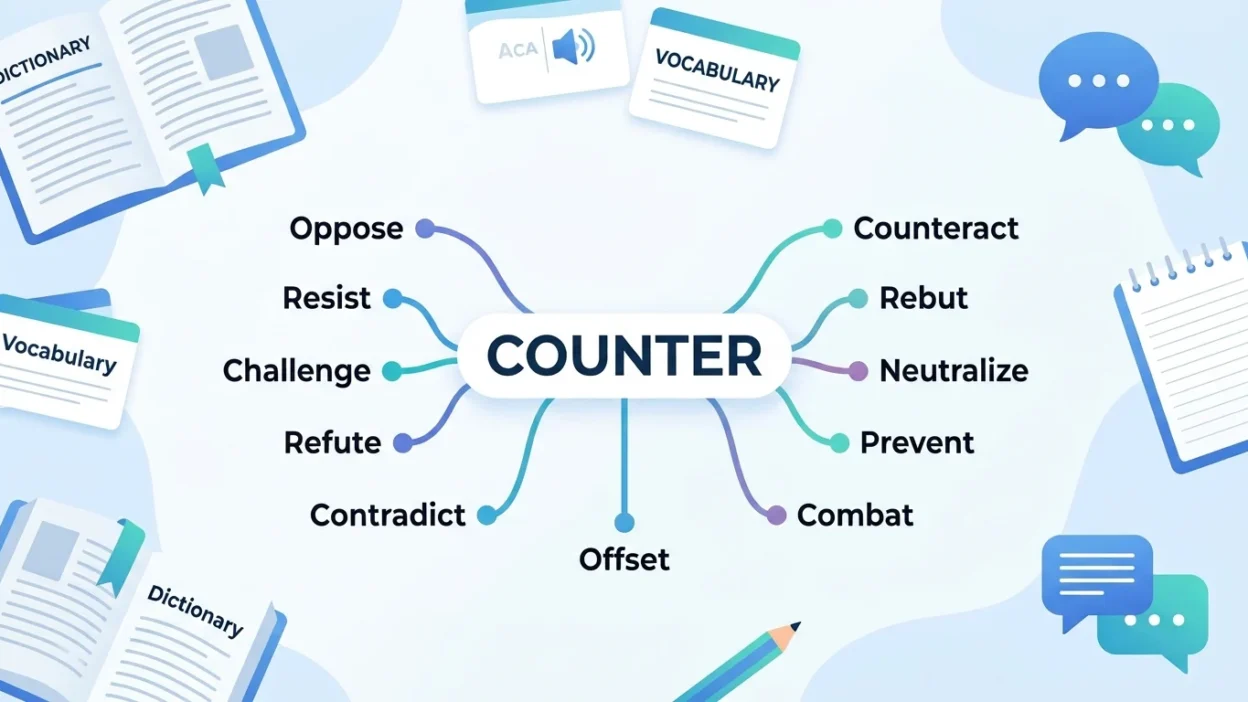
The English word counter is a versatile term with several meanings. It can describe the act of opposing an idea, responding to an argument, resisting an action, or balancing the effect of something.
Because it has multiple meanings, finding the right synonym depends on the context in which you are writing or speaking.
Learning counter synonyms helps students, ESL learners, writers, and content creators improve their vocabulary and avoid repeating the same word.
Using the right alternative makes your writing more engaging, natural, and precise. In this guide, you’ll learn the meaning of counter, discover 30 useful synonyms, understand when to use each one, and explore practical examples that make every word easy to remember.
What Does “Counter” Mean?
The word counter generally means to oppose, resist, respond to, or act against something. It can also mean to balance or reduce the effect of something. Depending on the situation, it may describe an argument, a reaction, or an action taken to prevent or overcome something else.
Example Sentences
- The lawyer tried to counter the witness’s statement.
- Regular exercise helps counter stress.
- The company launched a campaign to counter negative feedback.
Tone: Neutral to formal
Common Usage: Academic writing, business communication, debates, politics, journalism, and everyday English.
30 Counter Synonyms with Meanings, Examples, and Best Usage
1. Oppose
Meaning: To act against someone or something.
Example: Many residents oppose the new construction project.
Best Usage Context: Debates, politics, formal writing.
2. Resist
Meaning: To refuse to accept or give in.
Example: She resisted the temptation to quit.
Best Usage Context: Personal challenges, education.
3. Challenge
Meaning: To question or disagree with an idea.
Example: The professor challenged the traditional theory.
Best Usage Context: Academic and professional discussions.
4. Refute
Meaning: To prove that a statement is false.
Example: The scientist refuted the incorrect claim with evidence.
Best Usage Context: Research papers, legal writing.
5. Deny
Meaning: To state that something is not true.
Example: He denied all the accusations.
Best Usage Context: Legal and everyday conversations.
6. Contradict
Meaning: To express the opposite of another statement.
Example: Her report contradicts the earlier findings.
Best Usage Context: Reports, discussions.
7. Dispute
Meaning: To question the truth or accuracy of something.
Example: Experts disputed the survey results.
Best Usage Context: Academic and business writing.
8. Reject
Meaning: To refuse to accept something.
Example: The committee rejected the proposal.
Best Usage Context: Official decisions.
9. Defy
Meaning: To openly refuse to obey or accept.
Example: The workers defied unfair regulations.
Best Usage Context: Strong opposition.
10. Offset
Meaning: To balance or reduce the effect of something.
Example: Extra income helped offset rising expenses.
Best Usage Context: Finance, business.
11. Neutralize
Meaning: To remove or reduce an effect.
Example: The treatment neutralized the harmful substance.
Best Usage Context: Science and medicine.
12. Balance
Meaning: To make things equal or stable.
Example: Exercise helps balance physical and mental health.
Best Usage Context: Lifestyle, business.
13. Match
Meaning: To equal or correspond to something.
Example: Their offer matched ours.
Best Usage Context: Comparisons.
14. Equalize
Meaning: To make equal.
Example: The new policy equalized opportunities.
Best Usage Context: Sports, education.
15. Combat
Meaning: To fight against a problem.
Example: The campaign combats air pollution.
Best Usage Context: Public awareness, health.
16. Fight
Meaning: To struggle against something.
Example: Doctors fight diseases every day.
Best Usage Context: Everyday English.
17. Confront
Meaning: To face a problem directly.
Example: She confronted the issue with confidence.
Best Usage Context: Personal and professional writing.
18. Withstand
Meaning: To survive pressure or force.
Example: The bridge withstood the powerful storm.
Best Usage Context: Engineering, resilience.
19. Thwart
Meaning: To prevent a plan from succeeding.
Example: Police thwarted the robbery attempt.
Best Usage Context: News, formal writing.
20. Prevent
Meaning: To stop something from happening.
Example: Vaccination helps prevent illness.
Best Usage Context: Everyday English.
21. Stop
Meaning: To make something end.
Example: They stopped the spread of the fire.
Best Usage Context: Daily conversation.
22. Block
Meaning: To stop movement or progress.
Example: Fallen trees blocked the road.
Best Usage Context: Physical and figurative situations.
23. Hinder
Meaning: To make progress difficult.
Example: Heavy rain hindered construction work.
Best Usage Context: Formal writing.
24. Obstruct
Meaning: To block completely.
Example: Construction equipment obstructed traffic.
Best Usage Context: Official reports.
25. Counteract
Meaning: To reduce or cancel an effect.
Example: Fresh air can counteract unpleasant odors.
Best Usage Context: Science, health.
26. Rebut
Meaning: To answer an argument with evidence.
Example: The attorney rebutted every accusation.
Best Usage Context: Legal writing, debates.
27. Respond
Meaning: To react to something.
Example: She responded calmly to criticism.
Best Usage Context: Everyday communication.
28. Answer
Meaning: To reply or react.
Example: The company answered customer questions quickly.
Best Usage Context: General communication.
29. Retaliate
Meaning: To strike back after an attack.
Example: The country retaliated after the incident.
Best Usage Context: Military, conflict reporting.
30. Contest
Meaning: To challenge or argue against something officially.
Example: The candidate contested the election results.
Best Usage Context: Legal matters, politics.
Comparison Guide: When to Use Different Counter Synonyms
| Synonym | Best Used For | Tone |
|---|---|---|
| Oppose | Disagreeing with ideas | Neutral |
| Resist | Refusing pressure | Neutral |
| Challenge | Questioning opinions | Professional |
| Refute | Proving statements false | Formal |
| Contradict | Showing inconsistency | Neutral |
| Combat | Fighting problems | Strong |
| Offset | Balancing effects | Business |
| Neutralize | Removing harmful effects | Scientific |
| Counteract | Reducing negative impact | Formal |
| Rebut | Responding with evidence | Legal |
| Prevent | Stopping events | Everyday |
| Thwart | Blocking plans | Formal |
| Fight | General opposition | Casual |
| Withstand | Enduring pressure | Professional |
| Retaliate | Responding aggressively | Strong |
How to Choose the Right Counter Synonym
For Everyday Conversations
Choose words like fight, stop, prevent, respond, and answer. These are simple, common, and easy to understand.
For Academic Writing
Use challenge, refute, contradict, dispute, and rebut. These words are more formal and suitable for essays and research papers.
For Business Communication
Words such as offset, balance, counteract, respond, and prevent work well in reports, emails, and presentations.
For Strong Opposition
Choose oppose, resist, combat, defy, and retaliate when expressing powerful disagreement or action.
For Scientific and Technical Writing
Use neutralize, counteract, equalize, offset, and withstand because these words commonly appear in technical and scientific contexts.
Frequently Asked Questions
What is the best synonym for “counter”?
The best synonym depends on the context. Oppose, challenge, refute, counteract, and offset are among the most common alternatives.
Is “counter” the same as “oppose”?
Not always. Oppose means to disagree or act against something, while counter can also mean to respond, balance, or reduce an effect.
Which counter synonym is best for formal writing?
Formal writing often uses refute, rebut, contradict, dispute, and counteract.
Can “counter” mean “balance”?
Yes. In many contexts, counter means to offset or reduce the impact of another action or effect.
Which counter synonyms are easiest for ESL learners?
Beginner-friendly synonyms include oppose, fight, stop, prevent, respond, and balance because they are commonly used in everyday English.
Conclusion
Understanding counter synonyms allows you to express ideas with greater precision and variety. Since the word counter can mean to oppose, respond, resist, or balance, selecting the right synonym depends on your purpose and tone. Whether you are writing an essay, preparing a presentation, creating online content, or improving your English skills, using alternatives such as oppose, challenge, refute, combat, offset, and counteract will make your writing stronger and more engaging.
Expanding your vocabulary is one of the best ways to become a confident communicator. Practice these synonyms in different sentences and situations, and you’ll naturally develop clearer, more effective English.

Evelyn Mia is a passionate language writer and vocabulary enthusiast at Synomity.com, specializing in synonyms, word meanings, and language learning. She creates informative content that helps readers expand vocabulary and communicate more effectively.