The word try is one of the most common verbs in English.
It means making an effort to do something, testing something new, or attempting to achieve a goal.
Because it appears so often in everyday conversations, essays, emails, and creative writing, learning try synonyms can help you avoid repetition and make your language more natural.
Whether you’re a student, an ESL learner, a writer, or a content creator, using different words instead of try allows you to express different levels of effort, determination, or experimentation.
Some synonyms emphasize making an attempt, while others suggest testing, striving, or exploring new possibilities.
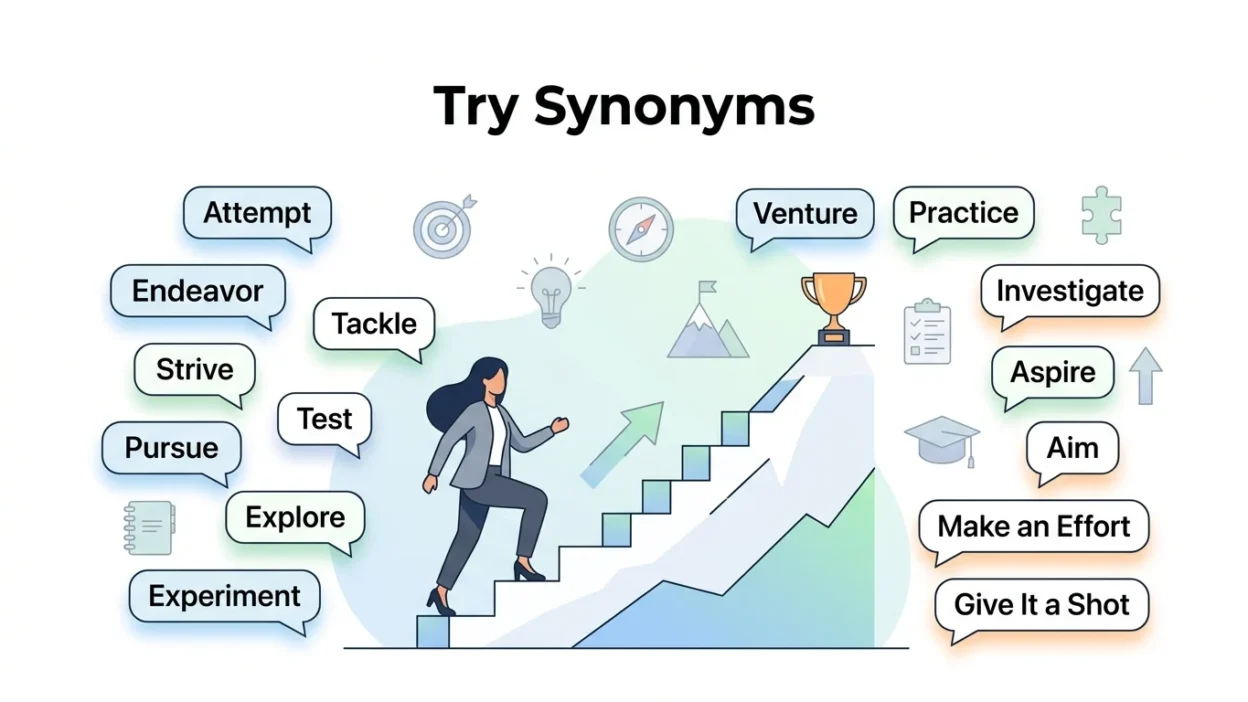
This guide explains the meaning of try, provides 30 useful try synonyms, and includes simple definitions, example sentences, usage notes, a comparison table, and practical tips for choosing the right word.
What Does “Try” Mean?
Simple Meaning
Try means to make an effort to do something, test something, or attempt to achieve a goal.
Tone and Usage Context
The word try has a neutral tone and is suitable for both formal and informal English. It is commonly used in conversations, education, business, sports, creative writing, and professional communication.
30 Try Synonyms with Meanings, Examples, and Usage
1. Attempt
Meaning: To make an effort to do something.
Example: She attempted to solve the difficult puzzle.
Best Usage Context: Formal and academic writing.
2. Endeavor
Meaning: To work hard toward a goal.
Example: The team endeavored to improve customer service.
Best Usage Context: Professional writing.
3. Strive
Meaning: To make great efforts to succeed.
Example: Students should strive for excellence.
Best Usage Context: Motivation and education.
4. Seek
Meaning: To try to find or obtain something.
Example: They seek better opportunities abroad.
Best Usage Context: Formal writing.
5. Pursue
Meaning: To continue working toward a goal.
Example: She pursued her dream of becoming a doctor.
Best Usage Context: Career and education.
6. Test
Meaning: To check how something works.
Example: Engineers tested the new software.
Best Usage Context: Science and technology.
7. Experiment
Meaning: To try something new to see what happens.
Example: He experimented with different recipes.
Best Usage Context: Science and creative projects.
8. Examine
Meaning: To inspect or study carefully.
Example: The doctor examined the patient.
Best Usage Context: Medical and academic fields.
9. Explore
Meaning: To investigate or discover something.
Example: We explored several solutions.
Best Usage Context: Learning and research.
10. Venture
Meaning: To do something risky or unfamiliar.
Example: She ventured into a new business.
Best Usage Context: Business and storytelling.
11. Give It a Go
Meaning: To make an informal attempt.
Example: Why not give it a go?
Best Usage Context: Everyday conversations.
12. Give It a Shot
Meaning: To attempt something.
Example: I’ll give it a shot this weekend.
Best Usage Context: Informal English.
13. Have a Go
Meaning: To try doing something.
Example: Let everyone have a go.
Best Usage Context: British English.
14. Have a Try
Meaning: To make an attempt.
Example: Have a try before asking for help.
Best Usage Context: Informal conversations.
15. Undertake
Meaning: To begin a task or responsibility.
Example: She undertook an important research project.
Best Usage Context: Formal writing.
16. Tackle
Meaning: To deal with a difficult task.
Example: We tackled the biggest problem first.
Best Usage Context: Work and education.
17. Aim
Meaning: To intend to achieve something.
Example: They aim to reduce pollution.
Best Usage Context: Goals and planning.
18. Aspire
Meaning: To strongly hope to achieve something.
Example: He aspires to become a scientist.
Best Usage Context: Career and ambitions.
19. Challenge Yourself
Meaning: To push yourself beyond your comfort zone.
Example: Challenge yourself every day.
Best Usage Context: Motivation.
20. Make an Effort
Meaning: To work hard toward something.
Example: She made an effort to improve her English.
Best Usage Context: Everyday communication.
21. Practice
Meaning: To do something repeatedly to improve.
Example: Practice speaking English daily.
Best Usage Context: Learning new skills.
22. Train
Meaning: To prepare through repeated practice.
Example: Athletes train every morning.
Best Usage Context: Sports and education.
23. Rehearse
Meaning: To practice before performing.
Example: The actors rehearsed their lines.
Best Usage Context: Performing arts.
24. Probe
Meaning: To investigate deeply.
Example: Scientists probed the mystery.
Best Usage Context: Research.
25. Investigate
Meaning: To examine carefully.
Example: Police investigated the incident.
Best Usage Context: Professional writing.
26. Sample
Meaning: To try a small amount.
Example: Customers sampled the new ice cream.
Best Usage Context: Food and products.
27. Taste
Meaning: To try food or drinks.
Example: Taste the soup before serving.
Best Usage Context: Cooking.
28. Experience
Meaning: To personally try or live through something.
Example: Visitors experienced local culture.
Best Usage Context: Travel and lifestyle.
29. Risk
Meaning: To try despite possible danger or failure.
Example: He risked everything for success.
Best Usage Context: Business and storytelling.
30. Do Your Best
Meaning: To make your greatest effort.
Example: Just do your best on the exam.
Best Usage Context: Encouragement and education.
Try Synonyms Comparison Guide
When to Use Different Try Synonyms
| Synonym | Best Used For | Tone |
|---|---|---|
| Attempt | Formal writing | Formal |
| Endeavor | Business and reports | Professional |
| Strive | Goals and motivation | Inspirational |
| Explore | Learning and research | Neutral |
| Experiment | Science and creativity | Neutral |
| Venture | Risk-taking | Creative |
| Test | Technology and science | Technical |
| Practice | Learning skills | Everyday |
| Tackle | Difficult tasks | Professional |
| Do Your Best | Encouragement | Friendly |
| Give It a Go | Casual conversations | Informal |
| Give It a Shot | Everyday speech | Informal |
How to Choose the Right Try Synonym
For Academic Writing
Use attempt, endeavor, undertake, investigate, explore, and examine when writing essays, reports, or research papers.
For Professional Communication
Choose tackle, pursue, aim, undertake, strive, and endeavor in workplace writing and business discussions.
For Everyday Conversations
Words like give it a go, give it a shot, have a go, have a try, and do your best sound friendly and natural.
For Learning and Self-Improvement
Use practice, train, challenge yourself, make an effort, and aspire when discussing personal development.
For Science and Research
Select test, experiment, probe, investigate, and examine when talking about research or technical work.
Common Mistakes When Using Try Synonyms
Using “Attempt” in Casual Conversations
While correct, attempt may sound too formal in everyday speech. Use give it a go or give it a shot instead.
Confusing “Practice” with “Try”
Practice means repeating an activity to improve, while try often refers to making an effort for the first time.
Mixing “Test” and “Experiment”
A test checks performance or quality, while an experiment explores new ideas or discovers results.
Using “Risk” as a Direct Replacement
Risk suggests possible danger or loss, while try does not always involve uncertainty or danger.
Frequently Asked Questions
What does try mean?
Try means making an effort to do something, test something, or attempt to achieve a goal.
What is the closest synonym for try?
Attempt is one of the closest synonyms because it also means making an effort to accomplish something.
Is “try” a formal or informal word?
It is a neutral word that works well in both formal and informal English.
Which synonym is best for academic writing?
Attempt, undertake, investigate, explore, and endeavor are excellent choices.
Which synonym is best for everyday conversations?
Give it a go, give it a shot, have a go, and do your best sound natural in casual speech.
Conclusion
Learning try synonyms helps you communicate more clearly and naturally in different situations. While try is a useful everyday word, alternatives like attempt, strive, endeavor, explore, practice, and tackle can better express your exact meaning. By understanding the differences between these synonyms and using them in the right context, you can improve your vocabulary, strengthen your writing, and speak English with greater confidence.

John Morrison is a dedicated content writer at Synomity.com, focused on synonyms, vocabulary development, and word meanings. He creates clear, educational resources that help readers improve language skills and communicate with confidence.