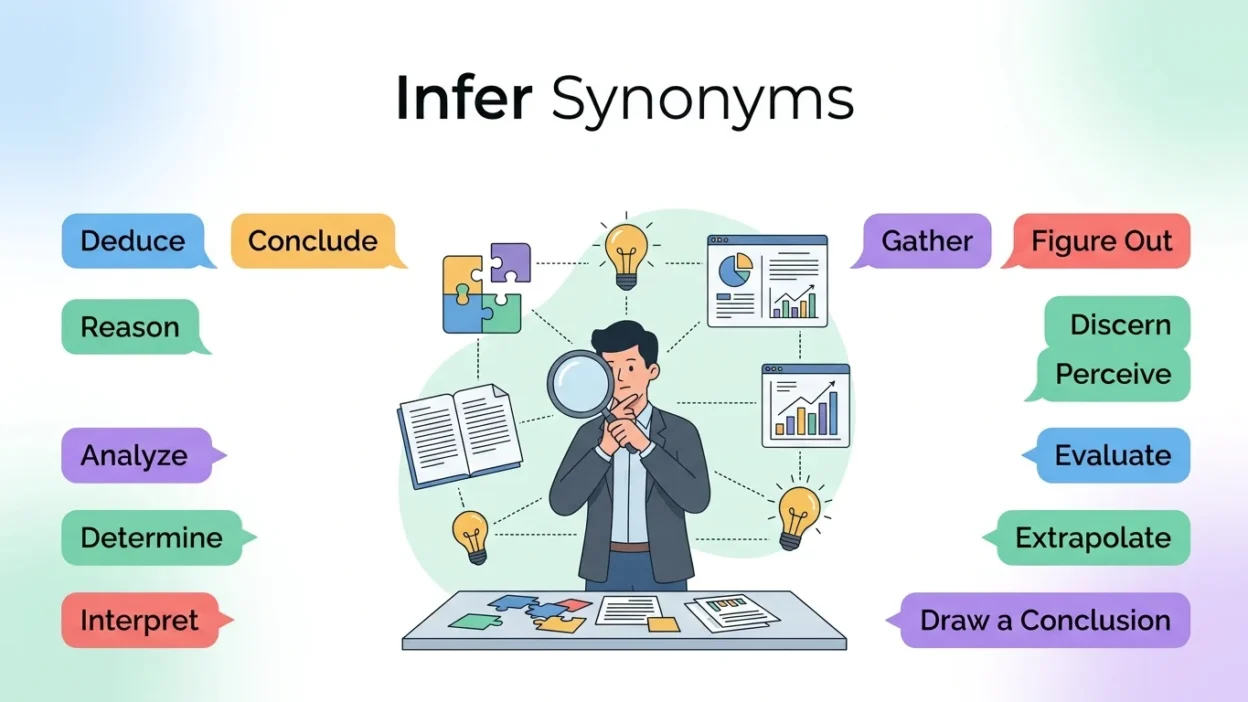
The word infer is commonly used in English to describe the process of reaching a conclusion based on evidence, facts, or reasoning rather than direct statements.
It is widely used in education, reading comprehension, research, science, business, and everyday conversations.
Learning infer synonyms helps you avoid repeating the same word while making your writing more accurate and engaging.
Whether you’re a student answering reading comprehension questions, an ESL learner building vocabulary, a writer improving sentence variety, or a content creator explaining ideas clearly, understanding infer synonyms can strengthen your communication.
Some alternatives focus on logical reasoning, while others emphasize guessing, concluding, or interpreting information.
This guide explains the meaning of infer, introduces 30 useful infer synonyms, and includes simple definitions, example sentences, usage notes, a comparison table, and practical tips for choosing the right synonym.
What Does “Infer” Mean?
Simple Meaning
Infer means to reach a conclusion based on evidence, facts, clues, or logical reasoning instead of direct information.
Tone and Usage Context
The word infer has a neutral to formal tone. It is commonly used in academic writing, reading comprehension, scientific research, journalism, legal discussions, and everyday English when drawing conclusions from available information.
30 Infer Synonyms with Meanings, Examples, and Usage
1. Conclude
Meaning: To reach a final decision or judgment.
Example: We concluded that the results were accurate.
Best Usage Context: Academic and formal writing.
2. Deduce
Meaning: To figure something out through logic.
Example: The detective deduced the suspect’s identity.
Best Usage Context: Investigation and reasoning.
3. Reason
Meaning: To think logically about something.
Example: She reasoned that the delay was caused by traffic.
Best Usage Context: General communication.
4. Gather
Meaning: To understand from available information.
Example: I gathered that the meeting had been canceled.
Best Usage Context: Everyday conversations.
5. Interpret
Meaning: To explain or understand the meaning.
Example: Readers may interpret the poem differently.
Best Usage Context: Literature and communication.
6. Understand
Meaning: To realize the meaning of something.
Example: I understand that the deadline has changed.
Best Usage Context: Everyday English.
7. Derive
Meaning: To obtain a conclusion from information.
Example: Scientists derived useful insights from the data.
Best Usage Context: Research and science.
8. Surmise
Meaning: To make an educated guess.
Example: She surmised that the train was delayed.
Best Usage Context: Formal writing.
9. Guess
Meaning: To make a conclusion without complete information.
Example: I guessed the answer correctly.
Best Usage Context: Informal conversations.
10. Assume
Meaning: To accept something as true without proof.
Example: Don’t assume everyone agrees.
Best Usage Context: General communication.
11. Presume
Meaning: To suppose something is true.
Example: We presumed the office was closed.
Best Usage Context: Formal English.
12. Read Between the Lines
Meaning: To understand an unstated meaning.
Example: You need to read between the lines.
Best Usage Context: Idiomatic English.
13. Discern
Meaning: To recognize or understand something.
Example: She discerned a pattern in the results.
Best Usage Context: Academic writing.
14. Detect
Meaning: To notice something hidden.
Example: Experts detected signs of improvement.
Best Usage Context: Science and investigation.
15. Recognize
Meaning: To identify something correctly.
Example: He recognized the importance of the issue.
Best Usage Context: General writing.
16. Identify
Meaning: To discover or determine.
Example: Researchers identified the main cause.
Best Usage Context: Education and research.
17. Perceive
Meaning: To become aware through observation.
Example: Many people perceived the change positively.
Best Usage Context: Formal writing.
18. Comprehend
Meaning: To fully understand.
Example: Students quickly comprehended the lesson.
Best Usage Context: Academic English.
19. Figure Out
Meaning: To understand after thinking.
Example: She finally figured out the solution.
Best Usage Context: Everyday conversations.
20. Work Out
Meaning: To solve through reasoning.
Example: We worked out the answer together.
Best Usage Context: Informal English.
21. Construe
Meaning: To interpret in a particular way.
Example: His words were construed as criticism.
Best Usage Context: Legal and formal writing.
22. Judge
Meaning: To form an opinion.
Example: It’s difficult to judge the situation.
Best Usage Context: General communication.
23. Estimate
Meaning: To make an approximate conclusion.
Example: Engineers estimated the repair cost.
Best Usage Context: Business and mathematics.
24. Extrapolate
Meaning: To predict using existing information.
Example: Scientists extrapolated future trends.
Best Usage Context: Research and statistics.
25. Analyze
Meaning: To examine carefully.
Example: Analysts analyzed the market data.
Best Usage Context: Academic and business writing.
26. Evaluate
Meaning: To assess carefully before deciding.
Example: Teachers evaluated the students’ work.
Best Usage Context: Education.
27. Decipher
Meaning: To understand something difficult.
Example: Researchers deciphered the ancient text.
Best Usage Context: History and language.
28. Ascertain
Meaning: To find out with certainty.
Example: Investigators ascertained the facts.
Best Usage Context: Formal reports.
29. Determine
Meaning: To establish after investigation.
Example: Experts determined the cause of the problem.
Best Usage Context: Professional writing.
30. Draw a Conclusion
Meaning: To form a final opinion based on evidence.
Example: Readers should draw a conclusion after reviewing the facts.
Best Usage Context: Reading comprehension and academic writing.
Infer Synonyms Comparison Guide
When to Use Different Infer Synonyms
| Synonym | Best Used For | Tone |
|---|---|---|
| Conclude | Academic writing | Formal |
| Deduce | Logic and investigation | Formal |
| Gather | Everyday conversations | Neutral |
| Interpret | Literature and communication | Academic |
| Guess | Informal speech | Casual |
| Assume | General discussions | Neutral |
| Analyze | Research and business | Professional |
| Determine | Reports and investigations | Formal |
| Figure Out | Everyday English | Informal |
| Draw a Conclusion | Reading comprehension | Academic |
| Ascertain | Official documents | Formal |
| Surmise | Literary writing | Formal |
How to Choose the Right Infer Synonym
For Academic Writing
Use conclude, deduce, determine, analyze, evaluate, and draw a conclusion in essays, reports, and research papers.
For Reading Comprehension
Choose infer, interpret, gather, understand, discern, and read between the lines when analyzing passages.
For Everyday Conversations
Words like figure out, guess, gather, work out, and understand sound natural and conversational.
For Research and Science
Use derive, determine, ascertain, analyze, extrapolate, and detect when discussing experiments or data.
For Legal and Professional Writing
Select construe, ascertain, determine, presume, evaluate, and judge for formal documents.
Common Mistakes When Using Infer Synonyms
Confusing “Infer” and “Imply”
Infer means the listener or reader reaches a conclusion, while imply means the speaker or writer suggests something indirectly.
Using “Guess” Instead of “Deduce”
A guess may have little evidence, while deduce requires logical reasoning.
Mixing “Assume” and “Infer”
An assumption may be made without evidence, but an inference is based on clues or facts.
Overusing “Figure Out” in Formal Writing
Although common in conversation, figure out may sound too informal in academic or professional documents.
Frequently Asked Questions
What does infer mean?
Infer means reaching a conclusion based on evidence, observations, or logical reasoning.
What is the closest synonym for infer?
Deduce is one of the closest synonyms because it also means reaching a conclusion through logical thinking.
Is infer a formal word?
Yes. It is widely used in academic, professional, and everyday English.
Which synonym is best for academic writing?
Conclude, deduce, determine, analyze, and draw a conclusion are excellent choices.
Which synonym is best for everyday conversations?
Figure out, guess, gather, and work out are commonly used in casual speech.
Conclusion
Learning infer synonyms helps you express reasoning and understanding more clearly in different situations. While infer is an excellent word for drawing conclusions from evidence, alternatives like deduce, conclude, interpret, determine, and analyze can better match specific contexts. By understanding the meanings and appropriate usage of these synonyms, you can improve your vocabulary, strengthen your writing, and communicate with greater confidence.

Evelyn Mia is a passionate language writer and vocabulary enthusiast at Synomity.com, specializing in synonyms, word meanings, and language learning. She creates informative content that helps readers expand vocabulary and communicate more effectively.