The words spring, sprang, and sprung are three forms of the same irregular English verb. They describe an action such as jumping, moving suddenly, appearing quickly, or developing rapidly.
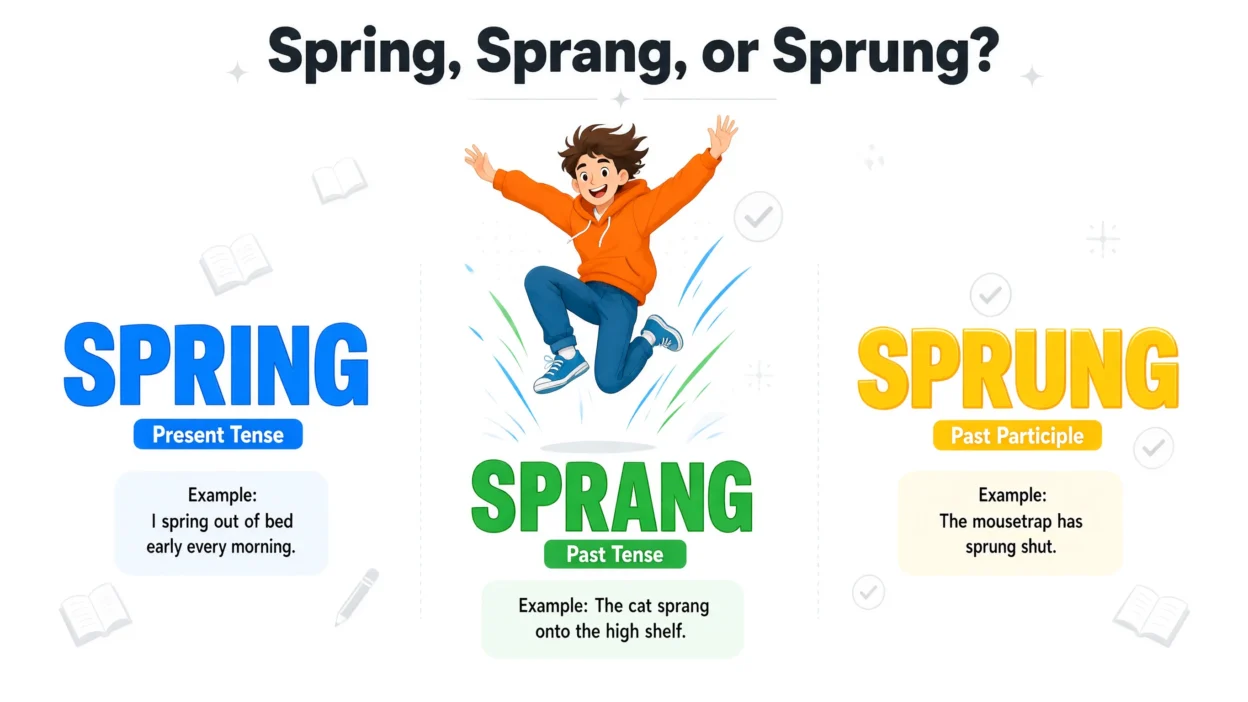
The main difference is their grammatical use: spring is the base form, sprang is the simple past tense, and sprung is the past participle. For example, you can say, “I spring into action,” “I sprang into action yesterday,” and “I have sprung into action.”
Learning when to use each form can be confusing, especially for English learners who are familiar with regular verbs that form the past tense by adding -ed. However, spring follows an irregular pattern, so its past forms must be learned separately. Understanding these three forms will help you write correct sentences, speak more naturally, and recognize the verb in books, conversations, and everyday English.
In this guide, you will learn the meaning of spring, sprang, and sprung, how they differ, when to use each form, and how to avoid common grammatical mistakes. You will also find practical examples, a comparison table, and a simple memory trick to help you remember the correct forms.
Quick Answer: Spring, Sprang, or Sprung?
Spring, sprang, and sprung are three forms of the verb “spring.” Spring is the base form and present-tense form, sprang is the simple past tense, and sprung is the past participle. Use sprang for a completed past action and sprung with helping verbs such as have, has, or had.
Why Do People Confuse Spring, Sprang, and Sprung?
People often confuse these words because they describe the same basic action but appear in different grammatical situations. Unlike regular verbs such as jump and jumped, the verb spring changes its spelling in the past tense and past participle.
Another reason for the confusion is that sprang and sprung can both refer to actions that happened before the present. The difference is how they function in a sentence.
Compare these examples:
- Spring: I spring out of bed every morning.
- Sprang: I sprang out of bed when the alarm rang.
- Sprung: I have sprung out of bed before sunrise many times.
The correct choice depends on the tense and sentence structure, not just on when the action happened.
First Word: What Does Spring Mean?
Spring is the base form of the verb. It can mean to jump, leap, move suddenly, appear unexpectedly, or develop quickly.
It is commonly used in the present tense, after modal verbs, and after to when forming an infinitive.
When to Use Spring
Use spring when:
- Describing a regular or repeated action.
- Talking about something that happens in the present.
- Giving an instruction.
- Using a modal verb such as can, will, or must.
- Using the infinitive form, to spring.
Examples:
- I spring out of bed as soon as my alarm rings.
- The cat can spring onto the table.
- Flowers spring from the ground in the warmer months.
- We need to spring into action immediately.
- The athlete is ready to spring over the hurdle.
The word spring also has other meanings. It can refer to the season between winter and summer, a coiled metal device, or a source of water. In this article, the focus is on its use as a verb.
Second Word: What Does Sprang Mean?
Sprang is the simple past tense of spring. Use it when describing an action that happened and was completed in the past.
It does not normally require did or have to express the simple past.
When to Use Sprang
Use sprang when:
- Describing a completed past action.
- Telling a story about something that happened suddenly.
- Reporting a past jump, movement, or unexpected appearance.
- Referring to a specific past event.
Examples:
- The rabbit sprang across the path.
- She sprang to her feet when she heard the news.
- The child sprang into his father’s arms.
- A new idea sprang into my mind.
- The dog sprang forward to catch the ball.
You can also use sprang in figurative expressions. For example, “A friendship sprang from their shared interests” means that their friendship developed from those interests.
Remember that sprang is the simple past form. In standard English, you would say “He sprang forward,” not “He springed forward.”
Third Word: What Does Sprung Mean?
Sprung is the past participle of spring. It is generally used with a helping verb, such as have, has, or had, to form perfect tenses.
It can also appear in passive constructions and in some adjective-like expressions.
When to Use Sprung
Use sprung when:
- Forming the present perfect tense with have or has.
- Forming the past perfect tense with had.
- Forming a passive construction with an appropriate form of be.
- Describing a resulting state, depending on the sentence.
Examples:
- The cat has sprung onto the counter.
- The children have sprung into action.
- The rabbit had sprung away before we noticed it.
- Several new businesses have sprung up in the area.
- The trap was sprung before anyone could react.
In the expression “new businesses have sprung up,” sprung up means that new businesses have appeared or developed.
Notice that sprung does not usually stand alone as the simple past tense in standard English. For example, write “She sprang over the fence,” but “She has sprung over the fence.”
Spring vs. Sprang vs. Sprung: Comparison Table
| Verb form | Grammatical use | Example |
| Spring | Base form and present tense | I spring into action. |
| Sprang | Simple past tense | I sprang into action yesterday. |
| Sprung | Past participle | I have sprung into action. |
The most important distinction is that sprang usually works as the main verb in a simple past sentence, while sprung generally needs a helping verb when used as a past participle.
When Should You Use Each Form?
Choosing the correct form becomes easier when you identify the grammatical structure of your sentence.
Use Spring for the Present or Base Form
Choose spring for present-tense actions, infinitives, instructions, and sentences with modal verbs.
- I spring out of bed at six.
- She wants to spring into action.
- You must spring over the gap carefully.
Use Sprang for a Completed Past Action
Choose sprang when the action occurred in the past and you are using the simple past tense.
- He sprang from his chair.
- The horse sprang over the fence.
- A solution sprang to mind during the meeting.
Use Sprung With Perfect Tenses
Choose sprung after have, has, or had when forming perfect tenses.
- I have sprung into action before.
- She has sprung to everyone’s attention.
- They had sprung into action before help arrived.
Use Sprung in Passive Constructions
The past participle can also be used in passive sentences.
- The trap was sprung accidentally.
- The mechanism had been sprung by the sudden pressure.
These examples show that the correct form depends on the grammatical structure rather than simply whether an action happened in the past.
12 Examples of Spring, Sprang, and Sprung in Sentences
The following examples show how the three verb forms work in everyday English.
Examples With Spring
- I spring out of bed when my alarm rings.
- The deer can spring over the fallen tree.
- We should spring into action before it is too late.
- The athlete trains daily to spring higher.
Examples With Sprang
- The deer sprang over the fallen tree.
- She sprang up when the teacher called her name.
- The children sprang toward the playground.
- An unexpected question sprang to mind.
Examples With Sprung
- The deer has sprung over the fallen tree before.
- She had sprung up before anyone could help her.
- New plants have sprung up after the rain.
- The trap was sprung by accident.
Each sentence uses the verb form that matches its grammatical purpose. Notice that the same basic action can be described with all three forms by changing the sentence structure.
Common Mistakes With Spring, Sprang, and Sprung
Even confident English speakers can make mistakes with irregular verbs. Here are some errors to watch for.
Mistake 1: Using Springed Instead of Sprang
Incorrect: The rabbit springed over the fence.
Correct: The rabbit sprang over the fence.
Springed is not the standard simple past form of spring.
Mistake 2: Using Sprang After Have
Incorrect: She has sprang into action.
Correct: She has sprung into action.
The present perfect tense requires the past participle, sprung.
Mistake 3: Using Sprung as the Simple Past
Incorrect: The cat sprung onto the table yesterday.
Correct: The cat sprang onto the table yesterday.
For standard written English, use sprang for the simple past tense.
Mistake 4: Forgetting the Helping Verb
Incorrect: They sprung into action already.
Correct: They have sprung into action already.
When sprung is used as a past participle, the sentence generally needs a suitable helping verb.
Mistake 5: Confusing Spring the Verb With Spring the Season
Incorrect: Springed flowers appeared in the garden.
Correct: Flowers sprang up in the garden.
Use the appropriate verb form to describe the action of appearing or growing. The season spring is a noun and has a different grammatical role.
Easy Memory Trick to Remember Spring, Sprang, and Sprung
A simple way to remember these forms is to learn them as a three-word sequence:
Spring → Sprang → Sprung
Associate each word with a time or grammatical function:
- Spring = now or the base form
- Sprang = past
- Sprung = used with a helping verb in perfect tenses
Try memorizing this sentence:
“I spring today, I sprang yesterday, and I have sprung before.”
You can also compare the pattern with other irregular verbs:
- Sing → Sang → Sung
- Ring → Rang → Rung
- Drink → Drank → Drunk
- Spring → Sprang → Sprung
These verbs share a similar vowel-changing pattern. Practicing them together can make their forms easier to recall.
American vs. British English: Is There a Difference?
There is no major difference between American and British English in the standard conjugation of spring. Both varieties use spring, sprang, and sprung as the traditional verb forms.
| Variety | Base form | Simple past | Past participle |
| American English | Spring | Sprang | Sprung |
| British English | Spring | Sprang | Sprung |
In both varieties, sprang is the standard simple past form, while sprung is the past participle. Some speakers may use different forms informally, but the traditional pattern is the safest choice for schoolwork, professional writing, and formal communication.
Similar Words: Other Irregular Verbs Like Spring
Learning similar irregular verbs can help you understand how English verb forms change.
| Base form | Simple past | Past participle |
| Sing | Sang | Sung |
| Ring | Rang | Rung |
| Drink | Drank | Drunk |
| Swim | Swam | Swum |
| Begin | Began | Begun |
| Shrink | Shrank | Shrunk |
| Spring | Sprang | Sprung |
Although these verbs follow similar patterns, their forms are not interchangeable. Each verb has its own meaning, and you must select the correct form for the sentence.
For example:
- She sang a beautiful song.
- He rang the bell.
- They have begun the project.
- The balloon shrank in the cold.
- The cat sprang onto the sofa.
Practicing these verbs in complete sentences is more effective than memorizing isolated words alone.
Final Verdict: Spring, Sprang, or Sprung?
The correct choice depends on how you use the verb in a sentence.
- Spring is the base form: “Birds spring into the air.”
- Sprang is the simple past: “The bird sprang into the air.”
- Sprung is the past participle: “The bird has sprung into the air.”
If you are describing a completed action in the simple past, choose sprang. If you are using a perfect tense with have, has, or had, choose sprung. When you need the base form or present tense, choose spring.
FAQs:
1. What is the past tense of spring?
The simple past tense of spring is sprang. For example, “The cat sprang onto the table.” Use sprang when describing an action that happened and was completed in the past.
2. Is it sprung or sprang?
Both words are correct, but they serve different grammatical purposes. Sprang is the simple past tense, while sprung is the past participle. Say “He sprang forward” and “He has sprung forward.”
3. Is springed a real word?
Springed is not the standard past-tense form of the verb spring. In standard English, use sprang for the simple past and sprung for the past participle.
4. What is the past participle of spring?
The past participle of spring is sprung. It is used in perfect tenses, such as “I have sprung into action” and “They had sprung into action before the alarm sounded.”
5. Can I say “I have sprang”?
In standard English, no. The correct form is “I have sprung.” The word following have in this construction should be the past participle, not the simple past form.
6. What is the difference between sprang and sprung in a sentence?
Sprang expresses the simple past, as in “The rabbit sprang away.” Sprung appears in constructions such as “The rabbit has sprung away.” The helping verb changes which form is grammatically appropriate.
7. Do American and British English use different forms?
No. Both American and British English generally use spring, sprang, and sprung. The same standard conjugation applies in both varieties.
Remember This
- Spring: Base form or present tense.
- Sprang: Simple past tense.
- Sprung: Past participle, usually used with a helping verb.
Remember the pattern spring → sprang → sprung, and pay attention to the other words in your sentence. If you see yesterday in a simple past sentence, sprang is often appropriate. If you see has, have, or had in a perfect-tense construction, sprung is usually the correct choice.
Conclusion
The difference between spring, sprang, and sprung becomes straightforward once you understand their grammatical roles. Spring is the base form, sprang is the simple past tense, and sprung is the past participle. Although all three forms express the same basic action, they cannot always be used interchangeably. Choosing the correct form helps make your English more accurate, natural, and easy to understand.
To remember the pattern, practice using all three forms in your own sentences. Say, “I spring into action,” “I sprang into action yesterday,” and “I have sprung into action before.” This simple exercise reinforces the difference between the present or base form, the simple past, and the past participle. With regular practice, you will be able to use these irregular verb forms confidently in both speaking and writing.