
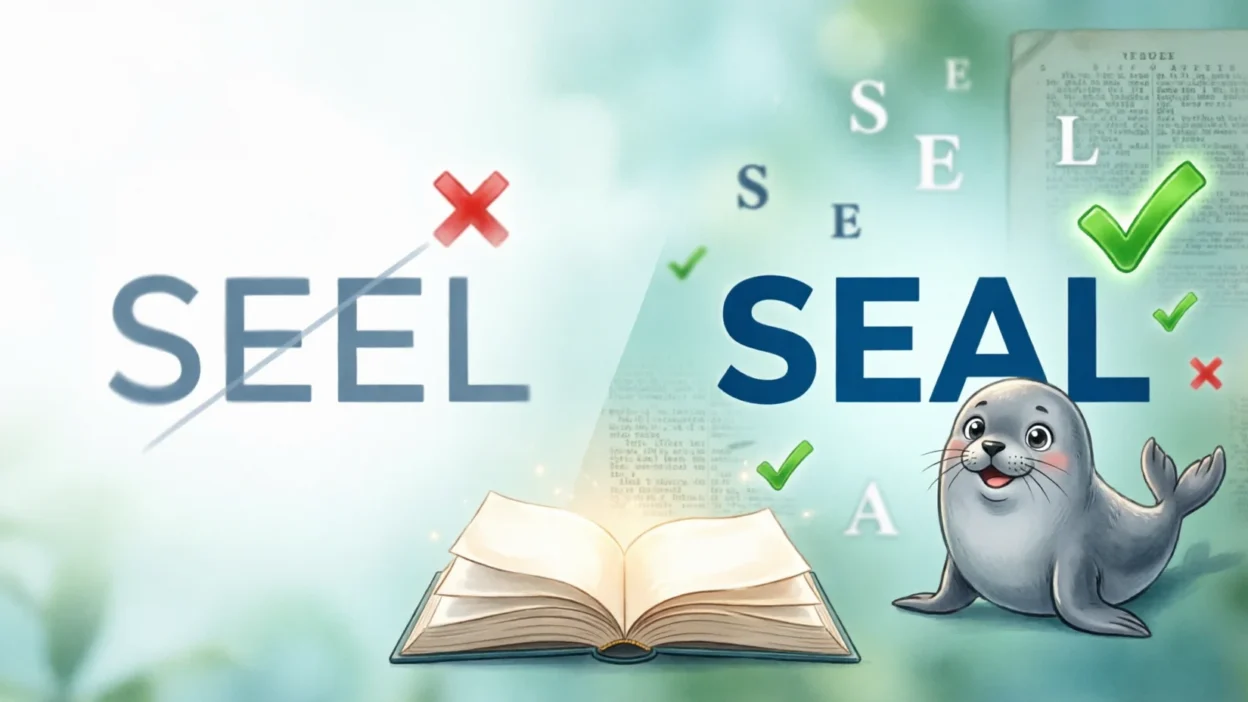
If you are confused about “seel or seal,” the correct choice depends on what you mean. Seal is a common English word with several meanings, including to close something securely, to confirm or finalize something, and a marine animal. Seel is a much rarer word and is generally not the spelling you want in everyday English.
This confusion often happens because seel and seal can sound similar in some pronunciations. However, their meanings and uses are very different. If you want to talk about closing an envelope, making something airtight, confirming an agreement, or referring to the animal that lives in the ocean, use seal. In this guide, you will learn the meanings, differences, examples, common mistakes, and an easy memory trick to remember the correct spelling.
Quick Answer
Seal is the correct and commonly used word for closing something securely, confirming something, or naming a marine animal. Seel is a rare word with specialized historical or technical uses. For everyday English writing, choose seal unless you specifically need the uncommon word “seel.”
Why Do People Confuse It?
People may confuse seel and seal because they can sound alike or very similar when spoken. English contains many words where pronunciation does not make the spelling obvious.
Another reason is that seal has several meanings, while seel is uncommon. When someone hears the word without seeing it written, they may guess the spelling incorrectly.
For normal communication, remember that seal is overwhelmingly the more useful spelling.
First Word: Seel
Seel is a rare English word. It is not normally used in everyday conversation or general writing.
Historically, seel has been used as a verb in specialized contexts. One older meaning relates to stitching or sewing a bird’s eyelids closed, particularly in historical falconry.
Because this word is uncommon, most learners do not need to use it in ordinary English.
Example:
- The historical text describes how falconers would seel a bird’s eyes.
If you are writing about ordinary actions such as closing, covering, or securing something, seel is usually not the word you need.
Second Word: Seal
Seal is a common English word with several important meanings.
As a verb, seal means to close something securely so that it cannot easily be opened or so that air, water, or other substances cannot enter or escape.
Examples:
- Please seal the envelope.
- The container is tightly sealed.
- They sealed the package with tape.
Seal can also mean to officially confirm or finalize something.
- The agreement sealed the deal.
- Her signature sealed the contract.
As a noun, a seal can also refer to a marine mammal.
- We saw a seal swimming near the shore.
Seel vs Seal: Comparison Table
| Word | Meaning | Commonness | Example |
|---|---|---|---|
| Seel | A rare historical/specialized verb | Very uncommon | The text describes how to seel a bird. |
| Seal | To close securely | Very common | Seal the box with tape. |
| Seal | To finalize or confirm | Common | The decision sealed the agreement. |
| Seal | A marine animal | Common | A seal was resting on the rocks. |
When Should You Use Each?
Use “seal” when you mean:
- Close something securely.
- Make something airtight or watertight.
- Confirm or finalize something.
- Officially mark or authenticate something.
- Refer to a marine mammal.
You are dealing with a specialized, historical, or literary context where seel has its specific meaning.
For everyday English, choosing seal will almost always be appropriate.
10+ Examples of “Seal”
Here are practical examples showing how seal works in different sentences:
- Please seal the envelope before mailing it.
- Make sure the lid is properly sealed.
- We need to seal the box with strong tape.
- The window was sealed to prevent cold air from entering.
- They used a special material to seal the pipe.
- The new agreement sealed the partnership.
- Her final decision sealed the deal.
- The bottle has a protective seal under the cap.
- A seal was swimming in the water.
- We watched the seals playing near the rocks.
- The package was tightly sealed.
- The official document carried the organization’s seal.
Common Mistakes
One common mistake is using seel when you actually mean seal.
Incorrect for everyday usage:
- Please seel the envelope.
- Seel the package tightly.
- I saw a seel at the beach.
Correct:
- Please seal the envelope.
- Seal the package tightly.
- I saw a seal at the beach.
Another mistake is assuming that similar pronunciation means the words have the same meaning. English spelling often requires you to remember the word’s meaning and context rather than relying only on sound.
Memory Trick: How to Remember Seal
A simple trick is:
Seal = Secure
Both seal and secure begin with the same sound, and sealing something often means securing it.
Think:
Seal → Secure → Close tightly
You can also remember the animal:
A seal swims in the sea.
This connection makes the spelling easier to remember.
American vs British English
There is no major American-versus-British spelling difference between seal and seel.
Both American English and British English use seal for the common meanings:
- to close securely
- to finalize something
- an official mark
- the marine animal
The rare word seel remains uncommon in both varieties.
So if you are writing for American or British readers, seal is normally the correct choice.
Similar Words
Several English words can be related to seal, depending on the context.
Close
To shut something.
- Please close the door.
Secure
To make something safe or firmly fixed.
- Secure the lid before moving the container.
Shut
To move something into a closed position.
- Shut the window.
Stamp
An official mark or impression.
- The document had an official stamp.
Sign
To put your name on a document.
- Please sign the agreement.
While these words can overlap with some meanings of seal, they are not always interchangeable.
Final Verdict
For normal English writing, seal is the word you should use. It can mean to close something securely, finalize an arrangement, refer to an official mark, or name a marine animal.
Seel is a rare and specialized word. Unless you are working with a historical or technical context where that specific term is intended, seal is the natural choice.
FAQs:
Is “seel” a correct English word?
Yes. Seel is a real but very uncommon English word with specialized and historical uses. It should not normally be substituted for seal in everyday writing.
Is it “seal the envelope” or “seel the envelope”?
The correct phrase is “seal the envelope.” Here, seal means to close the envelope securely.
Is a sea animal called a seel or seal?
The animal is called a seal. For example, “We saw a seal swimming in the ocean.”
What is the past tense of seal?
The past tense of seal is sealed.
Example:
“She sealed the package yesterday.”
Does “seal” have more than one meaning?
Yes. Seal can mean to close something, finalize something, place an official mark on something, or refer to a marine mammal.
Is “seel” common in modern English?
No. Seel is rare and mainly appears in specialized, historical, or literary contexts.
How do you remember seal vs seel?
Remember “Seal = Secure.” When you close or secure something, use seal. You can also remember that a seal is a marine animal.
Is “seal” the same in American and British English?
Yes. The common spelling seal is used in both American and British English.
Remember This
Seal is the normal word.
- Seal an envelope ✉️
- Seal a package 📦
- Seal a container 🫙
- Seal an agreement 🤝
- See a seal 🦭
Seel is a rare specialized word, so do not use it when you simply mean seal.
Conclusion
The difference between seel and seal is mainly about meaning and frequency. Seal is the everyday English word used for closing something securely, finalizing an agreement, referring to an official mark, or naming a marine animal. It is the spelling most students and general readers need.
Seel does exist, but it has specialized historical usage and is rarely needed in modern everyday English. When you are unsure which word to choose, ask yourself what you mean. If you mean “close securely,” “finalize,” or the ocean animal, choose seal.