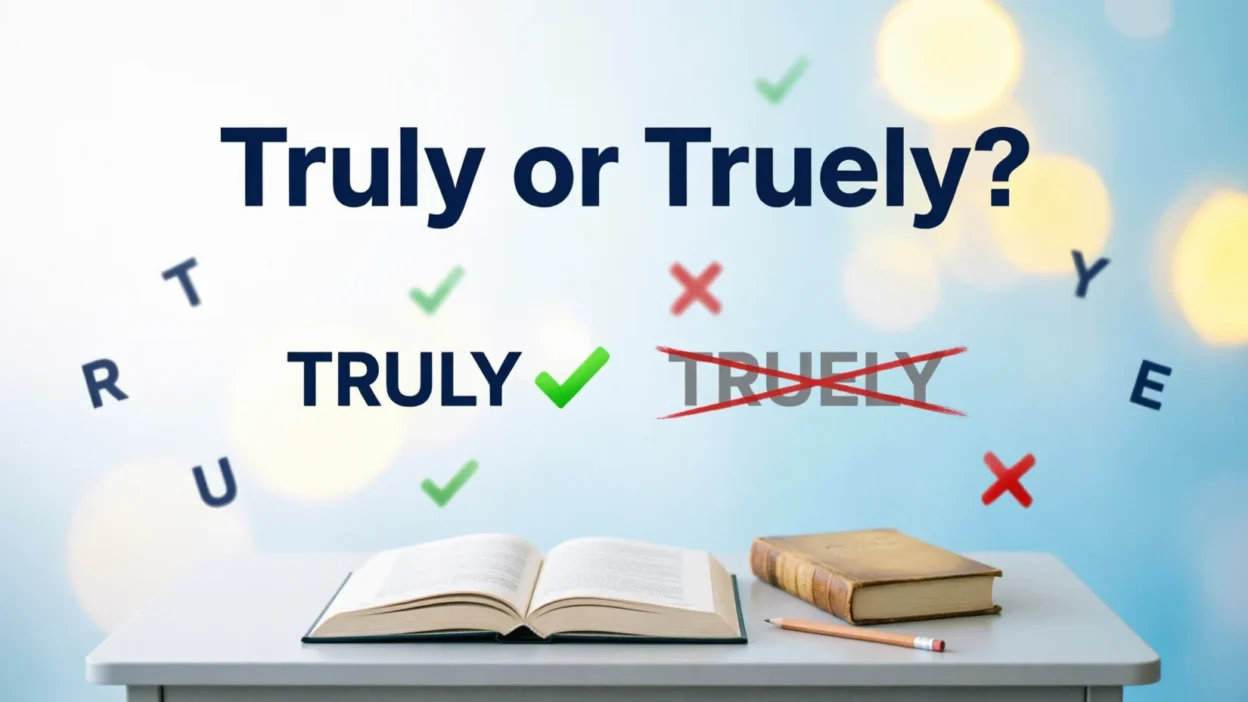
When you are unsure whether to write “truly” or “truely,” the correct spelling is truly. The word “truely” is a common spelling mistake and should not be used in standard English. Truly is an adverb that means “in a true, genuine, or sincere way.” For example: I truly appreciate your help.
The confusion happens because the adjective true becomes an adverb when we add -ly. Many people expect the spelling to become true + ly = truely, but English spelling rules remove the final e before adding -ly in this case. Learning this small rule can help you avoid the mistake in school assignments, emails, social media posts, and everyday writing.
Quick Answer
Truly is the correct spelling. Truely is incorrect in standard English. Use truly when you mean genuinely, really, or sincerely. For example, “I truly believe you.” The spelling changes from true to truly by dropping the final e before adding -ly.
Why Do People Confuse “Truly” and “Truely”?
The confusion comes from the word true. When people add -ly, they naturally assume the result should be truely.
However, English spelling does not always work by simply attaching a suffix. In truly, the final e in true is removed before -ly is added.
- True → truly ✅
- True → truely ❌
Because truly sounds similar to the incorrect spelling truely, the mistake is especially common among English learners and writers who are typing quickly.
First Word: Truly
Truly is the correct word.
It is an adverb and can mean:
- genuinely
- sincerely
- really
- honestly
- in a true way
Examples
- I truly appreciate your kindness.
- She truly cares about her family.
- He was truly surprised.
- I truly believe in you.
Second Word: Truely
Truely is not the standard spelling of the word.
Although people sometimes write it because they are following the pattern true + ly, dictionaries and standard English use truly.
So, if you are writing an essay, email, application, article, or social media caption, choose truly.
Truly vs Truely: Comparison Table
| Word | Correct? | Meaning | Example |
|---|---|---|---|
| Truly | ✅ Yes | Genuinely, sincerely, really | I truly understand. |
| Truely | ❌ No | Incorrect spelling | Avoid “truely” in standard English. |
When Should You Use “Truly”?
Use truly when you want to emphasize that something is genuine, sincere, real, or strongly felt.
For example:
- Truly grateful — genuinely grateful
- Truly amazing — genuinely amazing
- Truly sorry — sincerely sorry
- Truly beautiful — genuinely beautiful
- Truly important — genuinely important
You can use truly in both formal and informal writing.
Examples in everyday sentences
- I truly appreciate everything you have done.
- She is truly talented.
- He truly loves his family.
- I am truly sorry for my mistake.
- This is truly a beautiful place.
- We are truly grateful for your support.
- I truly enjoyed the movie.
- She truly believes in herself.
- You are truly special to me.
- He was truly surprised by the news.
- I truly hope everything goes well.
- They were truly happy with the result.
Common Mistakes With “Truly”
The biggest mistake is writing truely instead of truly.
Incorrect:
Correct:
Another common mistake is assuming every word ending in e keeps the e when -ly is added. English has several spelling patterns, so suffixes do not always behave identically.
Remember:
true → truly
not:
true → truely
Memory Trick for Truly
Here is a simple way to remember the spelling:
Think of it as:
TRUE − E + LY = TRULY
This makes it easier to remember that truly has only one e, not two.
American vs British English
There is no standard spelling difference between American and British English for this word.
Both use:
truly ✅
For example:
- American English: I truly appreciate your help.
- British English: I truly appreciate your help.
Truely is not the standard spelling in either variety.
Similar Words to “Truly”
Several words have a similar meaning to truly, depending on the context.
- Really — actually or genuinely
- Genuinely — sincerely or authentically
- Sincerely — honestly and genuinely
- Honestly — truthfully
- Actually — in fact
- Indeed — certainly or really
- Absolutely — completely or certainly
Example
I truly appreciate your help.
Similar:
- I really appreciate your help.
- I genuinely appreciate your help.
- I sincerely appreciate your help.
The exact meaning and tone can vary slightly, so these words are not always interchangeable.
Final Verdict: Truly or Truely?
Truly is correct. Truely is incorrect.
Use truly when you mean genuinely, sincerely, really, or honestly.
The spelling is:
True → Truly
The final e is dropped before -ly is added. This rule is especially useful for remembering why truly does not contain “ue” before the ly ending.
FAQs:
Is “truly” the correct spelling?
Yes. Truly is the correct standard English spelling. For example: I truly appreciate your support.
Is “truely” a word?
Truely is generally considered a misspelling of truly in standard English. Use truly instead.
Why is truly spelled without an e?
The word comes from true, but the final e is dropped before adding -ly, giving truly.
Is it “truly sorry” or “truely sorry”?
The correct phrase is “truly sorry.” For example: I am truly sorry for what happened.
Is truly used in American English?
Yes. Truly is the standard spelling in American English.
Is truly used in British English?
Yes. British English also uses truly. There is no standard British spelling “truely.”
What does truly mean?
Truly means genuinely, sincerely, really, or in a truthful way, depending on the sentence.
What is the easiest way to remember truly?
Remember: TRUE − E + LY = TRULY. The final e disappears before -ly.
Remember This
Truly = correct ✅
Truely = incorrect ❌
The easiest spelling rule is:
If you are ever unsure, remember that truly has only one “e.”
Conclusion
Choosing between truly and truely is simple once you remember the spelling change. Truly is the correct form, while truely is a common misspelling. Use truly to express something genuine, sincere, real, or strongly felt.
The key pattern to remember is true → truly. The final e is removed before -ly is added. If you are writing for school, work, social media, or everyday communication, truly is the spelling you should use.

Evelyn Mia is a passionate language writer and vocabulary enthusiast at Synomity.com, specializing in synonyms, word meanings, and language learning. She creates informative content that helps readers expand vocabulary and communicate more effectively.