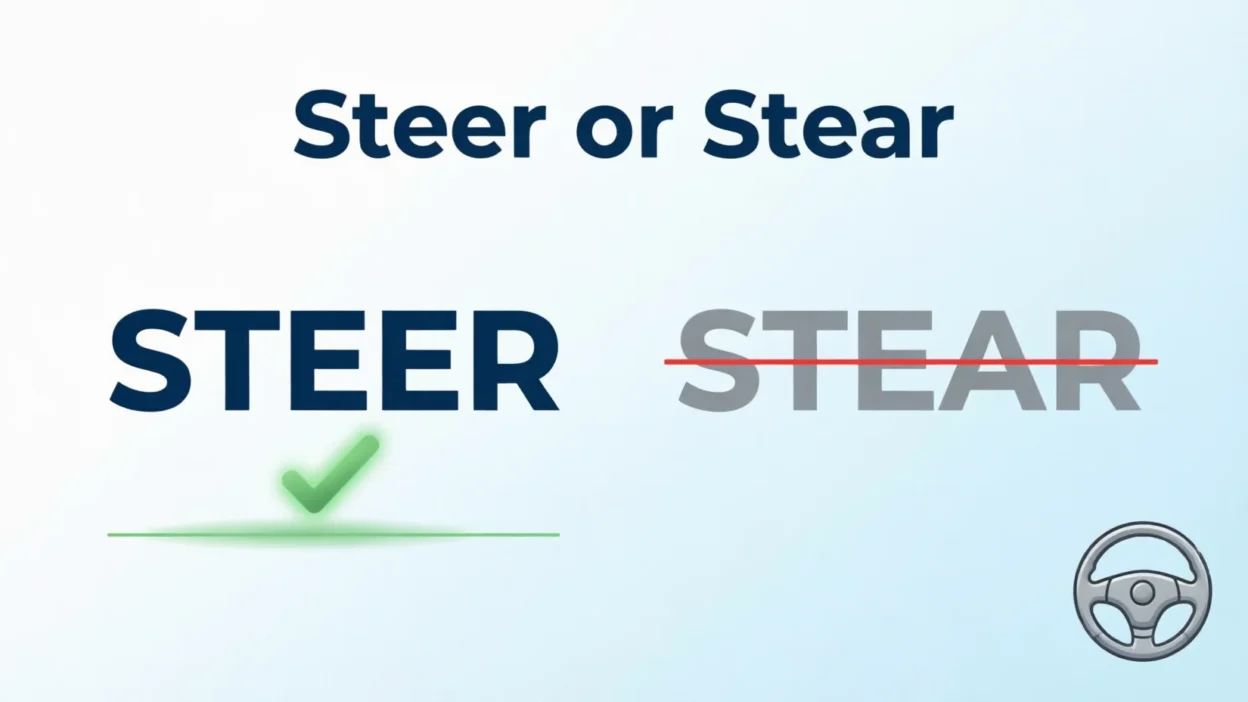
If you are wondering if the correct spelling is “steer” or “stear,” the correct standard English word is steer. It can be a verb meaning to control the direction of a vehicle, animal, or person, and it can also be a noun referring to a young male cattle animal. “Stear” is not a standard English word in normal modern usage.
These two spellings are easy to confuse because they sound very similar when spoken. However, they have different spelling patterns and only steer is normally used in everyday English.
Learning the meaning, pronunciation, and common examples of steer will help you avoid this spelling mistake in writing, schoolwork, emails, and conversations.
Quick Answer
Steer is the correct standard English spelling. It means to guide or control the direction of something, such as a car or boat. Stear is generally a misspelling of steer and should not be used in standard English writing.
Why Do People Confuse It?
People often confuse steer and stear because they can sound almost identical in pronunciation. When we hear a word rather than see it written, it can be difficult to know which vowel combination belongs in the spelling.
English contains many words where pronunciation does not perfectly reveal spelling. In this case, remembering the common spelling steer is the easiest solution.
For example:
- Correct: Steer the car carefully.
- Incorrect: Stear the car carefully.
The word steer is also related to several common expressions, including “steer clear of,” meaning to avoid something.
First Word: Steer
Steer is the standard English word.
As a verb, it means to guide or control the direction of something.
Examples:
- She learned how to steer a boat.
- Steer the car to the left.
- He tried to steer the conversation toward another topic.
- The driver carefully steered around the obstacle.
As a noun, steer can also mean a young male cattle animal, especially one raised for beef.
The pronunciation is usually similar to “stir” in many varieties of English.
Second Word: Stear
Stear is generally not a standard English spelling.
If you want to say that someone is guiding a car, boat, bicycle, conversation, or another moving thing, use steer.
For example:
- ❌ Please stear the boat toward the shore.
- ✅ Please steer the boat toward the shore.
If you see stear in informal writing, it is usually intended to be steer, although unusual names, specialized terms, or proper nouns can sometimes have their own spellings.
Steer vs Stear: Comparison Table
| Word | Standard English? | Meaning | Example |
|---|---|---|---|
| Steer | Yes | To guide or control direction | Steer the car carefully. |
| Steer | Yes | A young male cattle animal | The farmer raised a steer. |
| Stear | Generally no | Usually a misspelling of “steer” | ❌ Stear the boat. |
When Should You Use Each?
Use “Steer” When You Mean Guide or Control
Use steer when talking about controlling the direction of a vehicle, boat, animal, or other moving object.
Example:
“Can you steer the boat toward the dock?”
Use “Steer” for Directing a Conversation
The word can also be used figuratively when someone guides a conversation, discussion, or situation in a particular direction.
Example:
“She steered the discussion toward the main problem.”
Use “Steer Clear of” for Avoiding Something
The phrase steer clear of means to stay away from or avoid something.
Example:
“Steer clear of that wet floor.”
What About “Stear”?
In ordinary standard English, choose steer, not stear.
10+ Examples of “Steer”
Here are practical examples to make the difference easier to remember:
- Please steer the car slowly around the corner.
- He knows how to steer a bicycle safely.
- She learned to steer the boat by herself.
- The driver steered away from the fallen tree.
- Try to steer the conversation toward the main topic.
- The captain carefully steered the ship through the narrow channel.
- You need both hands to steer the vehicle properly.
- He steered his bike around the puddle.
- She tried to steer the meeting back to the original subject.
- Steer clear of the broken glass.
- The guide helped steer the group in the right direction.
- The young steer was standing near the fence.
Common Mistakes
The most common mistake is writing stear when you mean steer.
Mistake 1
❌ “Strear the car to the right.”
✅ “Steer the car to the right.”
Mistake 2
❌ “He knows how to stear a boat.”
✅ “He knows how to steer a boat.”
Mistake 3
❌ “We should stear clear of that road.”
✅ “We should steer clear of that road.”
Mistake 4
❌ “She steared the conversation away from politics.”
✅ “She steered the conversation away from politics.”
Remember that the past tense of steer is steered, not “stearred” or “steared” with a different base spelling.
Memory Trick
A simple way to remember steer is:
Steer = direction.
Think of the steering wheel in a car. Both steer and steering contain the same steer spelling.
You can remember:
Steer the wheel → steer the vehicle.
So whenever you are talking about guiding something, think of steering and spell the word steer.
American vs British English
There is no major American-versus-British spelling difference between steer and stear.
Both American and British English use steer as the standard spelling.
For example:
- American English: Steer the car carefully.
- British English: Steer the car carefully.
The word can have slightly different pronunciations depending on regional accent, but the standard spelling remains steer.
Similar Words
Several English words are related to steer or may be confused with it.
Steering
Steering is the present participle or gerund form of steer.
Example:
“Steering the boat requires concentration.”
Steered
Steered is the simple past and past participle form of steer.
Example:
“She steered the car into the parking space.”
Direction
A direction tells you where something should go.
Example:
“The sign gave us the right direction.”
Guide
Guide means to show or help someone or something move toward a particular place or result.
Example:
“The instructor guided the students through the exercise.”
Stir
Stir is a completely different word. It can mean mixing something or causing movement.
Example:
“Stir the soup before serving it.”
Although steer and stir can sound similar in some accents, their meanings and spellings are different.
Final Verdict
When choosing between steer and stear, use steer in standard English. Steer can mean to guide or control direction, and it can also refer to a young male cattle animal.
Stear is generally not the correct spelling for these meanings. If you are writing a sentence about driving, sailing, guiding, directing a conversation, or avoiding something, steer is the word you need.
FAQs:
Is “stear” a correct English word?
Generally, no. Stear is not the standard spelling used in ordinary modern English. In most situations, steer is the correct word.
Is it “steer” or “stear”?
The correct standard spelling is steer. For example, “Steer the car to the left” is correct.
What does “steer” mean?
Steer usually means to guide or control the direction of something, such as a car, bicycle, boat, or animal. It can also mean to guide a conversation or situation.
What is the past tense of “steer”?
The past tense is steered.
Example: “He steered the car into the driveway.”
Is “steer clear” correct?
Yes. Steer clear is a common English expression meaning to avoid or stay away from something.
Example: “Steer clear of the damaged area.”
Is “steer” used in British English?
Yes. Steer is standard in both British and American English.
What is the difference between “steer” and “stir”?
Steer means to guide or control direction, while stir commonly means to mix something or cause movement.
Example: “Steer the boat” versus “Stir the soup.”
Remember This
Steer is the standard spelling.
Think of a steering wheel → steer.
If you mean guiding a car, boat, bicycle, conversation, or situation, use steer. The spelling stear is generally incorrect in standard English.
Conclusion
The confusion between steer and stear mainly comes from their similar sound. However, spelling becomes much easier when you connect steer with familiar words such as steering and steering wheel. Whenever you are talking about controlling direction or guiding something, remember to use steer.
In standard English, stear is generally not the spelling you want. If you are a student, ESL learner, beginner, or simply checking a word before publishing something, choosing steer will keep your writing clear and correct.