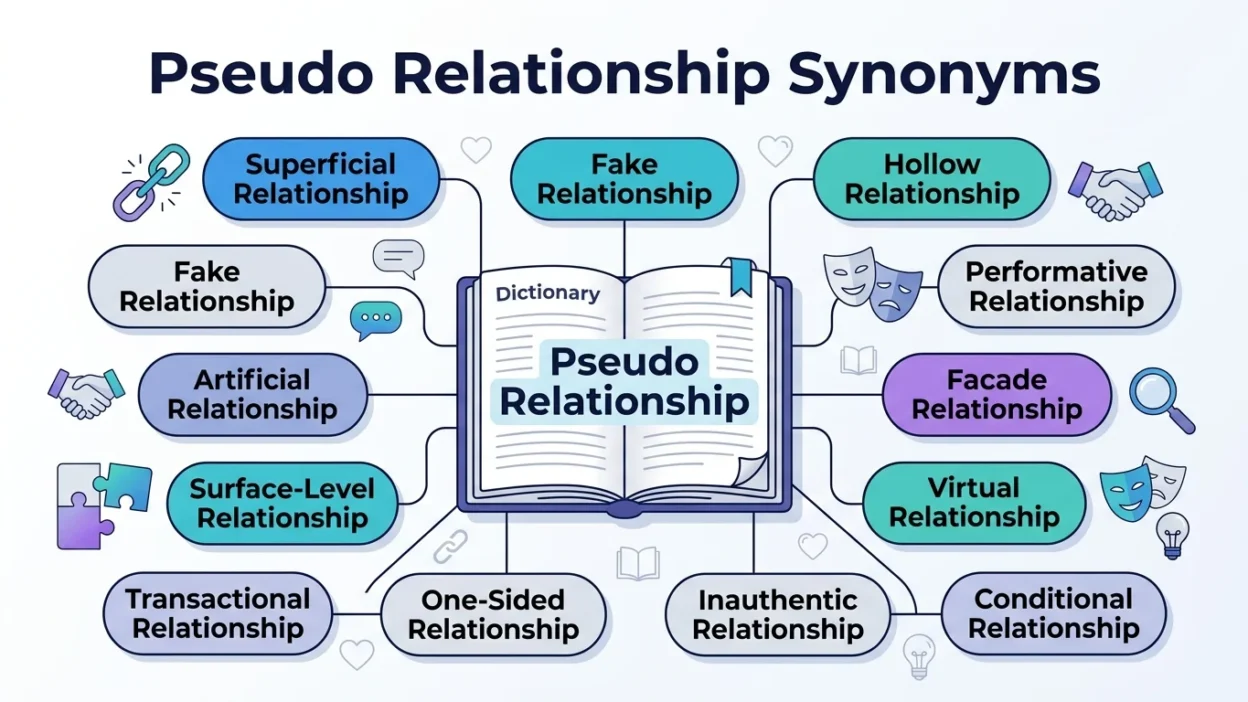
The phrase “pseudo relationship” describes a relationship that appears real on the surface but lacks the qualities of a genuine emotional, romantic, social, or personal connection.
It often refers to situations where people act like they are close, committed, or connected, but the relationship is based on appearances, convenience, misunderstanding, or limited interaction.
Learning pseudo relationship synonyms helps writers and English learners describe these situations with greater accuracy and variety.
Whether you’re writing fiction, academic essays, psychology content, social media posts, or blog articles, using different words instead of repeating “pseudo relationship” makes your writing clearer and more engaging. Different synonyms also carry different emotional tones, so choosing the right one helps communicate your intended meaning.
In this guide, you’ll discover the meaning of “pseudo relationship,” explore 30 useful synonyms and related expressions, learn when to use each one, and find tips for selecting the most appropriate alternative in different contexts.
What Does “Pseudo Relationship” Mean?
Simple Meaning
A pseudo relationship is a relationship that seems genuine but is not truly deep, honest, or emotionally connected. It may exist only for appearance, convenience, personal gain, or misunderstanding.
Tone
The phrase usually has a neutral to slightly negative tone because it suggests the relationship is not authentic.
Usage Context
Use “pseudo relationship” when describing friendships, romantic relationships, professional connections, or social interactions that appear real but lack sincerity or commitment.
Example:
Their online friendship looked close, but it was really a pseudo relationship built on limited interaction.
30 Pseudo Relationship Synonyms
1. Superficial Relationship
Meaning: A relationship based only on surface-level interaction.
Example: They had a superficial relationship at work.
Best Usage Context: General writing and psychology.
2. Fake Relationship
Meaning: A relationship that is not genuine.
Example: The couple admitted their fake relationship was only for publicity.
Best Usage Context: Everyday English.
3. False Relationship
Meaning: A relationship based on deception.
Example: Their false relationship eventually fell apart.
Best Usage Context: Formal and general writing.
4. Artificial Relationship
Meaning: A relationship created without natural emotions.
Example: Their conversations felt artificial.
Best Usage Context: Academic and professional writing.
5. Pretend Relationship
Meaning: A relationship where people only act connected.
Example: They maintained a pretend relationship for their families.
Best Usage Context: Casual writing.
6. Mock Relationship
Meaning: An imitation of a real relationship.
Example: The comedy featured a mock relationship between two characters.
Best Usage Context: Entertainment and fiction.
7. Sham Relationship
Meaning: A relationship created to deceive others.
Example: Authorities investigated the sham relationship.
Best UsageContext: Legal and official discussions.
8. Surface-Level Relationship
Meaning: A relationship lacking emotional depth.
Example: Most coworkers have surface-level relationships.
Best Usage Context: Self-help and psychology.
9. One-Sided Relationship
Meaning: Only one person invests emotionally.
Example: She realized it was a one-sided relationship.
Best Usage Context: Relationship advice.
10. Hollow Relationship
Meaning: Empty of genuine feelings.
Example: Their marriage became a hollow relationship.
Best Usage Context: Emotional writing.
11. Transactional Relationship
Meaning: Based mainly on mutual benefits.
Example: Their partnership remained transactional.
Best Usage Context: Business and psychology.
12. Conditional Relationship
Meaning: Exists only under certain conditions.
Example: It felt like a conditional relationship.
Best Usage Context: Personal development.
13. Convenient Relationship
Meaning: Maintained because it is useful.
Example: They stayed in a convenient relationship.
Best Usage Context: General writing.
14. Illusory Relationship
Meaning: Appears real but is actually false.
Example: Social media created an illusory relationship.
Best Usage Context: Academic writing.
15. Imagined Relationship
Meaning: Exists mainly in someone’s perception.
Example: He believed they were close, but it was an imagined relationship.
Best Usage Context: Psychology.
16. Symbolic Relationship
Meaning: Represents something more than actual closeness.
Example: Their symbolic relationship impressed the public.
Best Usage Context: Literature.
17. Nominal Relationship
Meaning: Exists in name only.
Example: They had only a nominal relationship.
Best Usage Context: Formal writing.
18. Empty Relationship
Meaning: Without emotional connection.
Example: Years later, it became an empty relationship.
Best Usage Context: Relationship articles.
19. Performative Relationship
Meaning: Maintained mainly for public appearance.
Example: Their performative relationship attracted attention online.
Best Usage Context: Social media discussions.
20. Cosmetic Relationship
Meaning: Looks good externally but lacks substance.
Example: Their cosmetic relationship fooled many people.
Best Usage Context: Opinion writing.
21. Simulated Relationship
Meaning: Artificially created.
Example: The virtual game included simulated relationships.
Best Usage Context: Technology and gaming.
22. Virtual Relationship
Meaning: Exists mainly online.
Example: Their virtual relationship lasted several years.
Best Usage Context: Digital communication.
23. Casual Connection
Meaning: A light relationship with little commitment.
Example: They shared only a casual connection.
Best Usage Context: Everyday English.
24. Weak Bond
Meaning: A relationship with little emotional strength.
Example: The team members had a weak bond.
Best Usage Context: General writing.
25. Fragile Relationship
Meaning: Easily damaged.
Example: Trust issues created a fragile relationship.
Best Usage Context: Relationship advice.
26. Distant Relationship
Meaning: Emotionally disconnected.
Example: They developed a distant relationship over time.
Best Usage Context: Family and friendship topics.
27. Unbalanced Relationship
Meaning: One person gives more than the other.
Example: It became an unbalanced relationship.
Best Usage Context: Counseling content.
28. Fictional Relationship
Meaning: Exists only in stories or imagination.
Example: The novel centered on a fictional relationship.
Best Usage Context: Literature.
29. Inauthentic Relationship
Meaning: Not sincere or genuine.
Example: She wanted to avoid inauthentic relationships.
Best Usage Context: Self-improvement writing.
30. Facade Relationship
Meaning: A relationship maintained only to create a false appearance.
Example: Their facade relationship ended after the truth emerged.
Best Usage Context: Fiction, psychology, and journalism.
Comparison Guide: When to Use Different Pseudo Relationship Synonyms
Formal and Academic Writing
| Synonym | Best Used For |
|---|---|
| Artificial Relationship | Academic papers |
| Illusory Relationship | Psychology |
| Nominal Relationship | Formal reports |
| Inauthentic Relationship | Research |
| Transactional Relationship | Sociology and business |
Everyday Conversation
| Synonym | Best Used For |
|---|---|
| Fake Relationship | Casual speech |
| Pretend Relationship | Informal writing |
| Surface-Level Relationship | Daily conversations |
| Casual Connection | General communication |
| One-Sided Relationship | Relationship advice |
Emotional or Creative Writing
| Synonym | Best Used For |
|---|---|
| Hollow Relationship | Fiction |
| Empty Relationship | Emotional articles |
| Fragile Relationship | Personal stories |
| Facade Relationship | Drama and novels |
| Distant Relationship | Family and friendship topics |
How to Choose the Right Synonym
For Academic Writing
Use artificial relationship, illusory relationship, transactional relationship, nominal relationship, and inauthentic relationship because they sound professional and precise.
For Everyday English
Choose fake relationship, pretend relationship, surface-level relationship, or casual connection. These are easy to understand and commonly used.
For Relationship Advice
Words like one-sided relationship, fragile relationship, empty relationship, and distant relationship clearly describe emotional situations.
For Fiction and Storytelling
Use facade relationship, hollow relationship, performative relationship, imagined relationship, and fictional relationship to create vivid descriptions.
For Social Media or Modern Discussions
Expressions such as performative relationship, virtual relationship, and transactional relationship fit today’s online communication and digital culture.
Common Mistakes to Avoid
Assuming Every Weak Relationship Is a Pseudo Relationship
A relationship can be weak or distant without being fake. Use pseudo relationship only when the connection appears genuine but lacks authenticity.
Using Formal Terms in Casual Speech
Words like illusory or nominal may sound too technical in everyday conversations. Simpler alternatives are often better.
Ignoring Context
Choose a synonym that matches your audience. Academic readers expect formal language, while blog readers often prefer simpler expressions.
Tips to Improve Your Vocabulary
Read Relationship and Psychology Articles
These often use a variety of words to describe different kinds of human connections.
Learn Synonyms Through Examples
Reading complete sentences helps you understand subtle differences between similar expressions.
Practice Rewriting Sentences
Replace pseudo relationship with different alternatives to see how the tone changes.
Match the Purpose
Always consider whether your writing is formal, conversational, academic, or creative before choosing a synonym.
Conclusion
Learning pseudo relationship synonyms helps you describe relationships with greater precision and variety. While pseudo relationship refers to a connection that appears genuine but lacks authenticity, alternatives such as superficial relationship, fake relationship, transactional relationship, performative relationship, and facade relationship can better express specific situations and emotional nuances.
By understanding the meanings, examples, and best usage contexts of these alternatives, you’ll improve your vocabulary and communicate more effectively in essays, blogs, stories, professional writing, and everyday English.

John Morrison is a dedicated content writer at Synomity.com, focused on synonyms, vocabulary development, and word meanings. He creates clear, educational resources that help readers improve language skills and communicate with confidence.