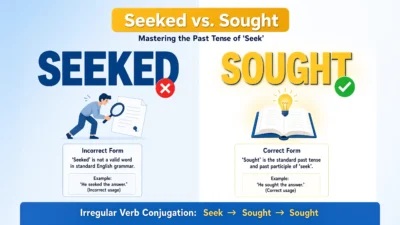
When talking about the past, should you use cost or costed? The answer depends on how you use the verb. The past tense of cost is usually cost, especially when talking about the price of something. For example, “The jacket cost $50 last year” is correct. However, costed is also a real word and is used in specific situations, particularly when calculating or estimating the cost of a project, product, or plan.
The verb cost can confuse English learners because it does not always follow the regular rule of adding -ed to form the past tense. Unlike verbs such as walk and talk, it often keeps the same form in the present and past.
Understanding when to use cost and costed will help you write more accurately, speak naturally, and avoid common grammar mistakes. In this guide, you will learn the past tense of cost, the difference between cost and costed, the correct verb forms, and practical examples that make the rules easy to remember.
Quick Answer: What Is the Past Tense of Cost?
The past tense of cost is usually cost. For example, “The phone cost $300.” The past participle is also usually cost, as in “The phone has cost me a lot.” However, costed is correct when it means calculating or estimating expenses, as in “The company costed the project.”
Why Do People Confuse Cost and Costed?
People often confuse these forms because most regular English verbs take -ed in the past tense. For example, help becomes helped, and clean becomes cleaned. However, cost generally remains unchanged when it refers to the price or amount of money required for something.
Another reason for the confusion is that costed has a legitimate grammatical use. In business, accounting, manufacturing, and project planning, it describes the process of calculating or estimating costs. Therefore, neither form is always wrong; the correct choice depends on the intended meaning.
First Word: Cost
Cost is an irregular verb that usually has the same form in the present tense, simple past tense, and past participle when it refers to the price or expense of something.
Meaning of Cost
As a verb, cost means to require a particular amount of money or to cause someone to lose something valuable.
Examples:
- This book costs $15.
- The meal cost $40 last night.
- The repairs have cost us hundreds of dollars.
- His mistake cost the team an important victory.
Forms of the Verb Cost
| Verb form | Correct form | Example |
| Base form | Cost | These shoes cost $60. |
| Simple past | Cost | The shoes cost $60 yesterday. |
| Past participle | Cost | The shoes have cost me $60. |
| Present participle | Costing | The shoes are costing more than expected. |
| Third-person singular | Costs | This service costs $10 a month. |
Remember: When cost describes the price of something, its simple past and past participle generally remain cost.
Second Word: Costed
Costed is the past tense and past participle of cost when the verb means to calculate, estimate, or determine the expenses involved in something.
Meaning of Costed
In business and professional settings, costed often refers to working out the expected or actual expenses of a plan, project, product, or activity.
Examples:
- The team costed the project before submitting the proposal.
- The company has costed the new product.
- We costed several options before choosing a supplier.
- The proposed changes were carefully costed.
In these examples, costed does not simply mean that something had a price. It means someone calculated or assessed the expenses.
Is Costed Grammatically Correct?
Yes. Costed is grammatically correct when used in the sense of calculating or estimating costs. However, when describing how much something was priced at or required in money, cost is generally the standard form.
For example:
- Correct: “The laptop cost $800.”
- Correct: “The accountant costed the new project.”
- Usually incorrect for the intended price meaning: “The laptop costed $800.”
The key is to identify whether you are describing a price or the process of calculating expenses.
Cost vs. Costed: Comparison Table
The main difference between cost and costed is their meaning in context.
| Feature | Cost | Costed |
| Main use | Describes a price or expense | Describes calculating expenses |
| Simple past | Cost | Costed |
| Past participle | Cost | Costed |
| Example | The trip cost $500. | We costed the trip. |
| Common context | Shopping, travel, bills | Business, budgeting, planning |
| Standard for stating a price | Yes | Generally no |
Easy rule: Use cost to say how much something required. Use costed to describe calculating how much something would require.
When Should You Use Each Word?
When to Use Cost
Use cost when describing the price of an item, the expense of an activity, or the loss caused by an action.
Examples:
- The watch cost $100.
- Our vacation cost more than expected.
- The repairs cost a lot of money.
- His carelessness cost him his job.
In each sentence, cost describes an expense or consequence rather than the process of calculating one.
When to Use Costed
Use costed when someone works out or estimates the expenses involved in a project, service, product, or proposal.
Examples:
- The engineers costed the construction project.
- The company costed the new product line.
- We costed the proposal before approving it.
- The contractor has costed the renovation.
This usage is particularly common in professional and financial contexts.
12 Examples of Cost in the Past Tense
Here are practical examples showing how cost works in everyday English.
- The dress cost $75. — The dress had a price of $75.
- My new phone cost a fortune. — The phone was very expensive.
- The tickets cost less last year. — The tickets were cheaper in the past.
- Our dinner cost $40. — The dinner required $40.
- The repair cost more than expected. — The repair was more expensive than planned.
- The trip cost us thousands of dollars. — We spent thousands on the trip.
- The mistake cost him his promotion. — He lost the opportunity because of the mistake.
- The project cost the company a lot of money. — The project required substantial spending.
- The house cost less than we expected. — The house was cheaper than anticipated.
- The delay cost us valuable time. — The delay caused us to lose time.
- The repairs have cost us a great deal. — The expenses have accumulated.
- The decision cost the team its chance to win. — The team lost its opportunity because of the decision.
Notice that cost stays unchanged in the simple past, even when the sentence refers to a completed event.
Common Mistakes with Cost and Costed
English learners often make these mistakes when forming the past tense of cost.
Mistake 1: Adding -ed When Describing a Price
Incorrect: The bag costed $50.
Correct: The bag cost $50.
Why? When cost means having a particular price, the simple past form is normally cost.
Mistake 2: Using Cost Instead of Costed for Calculating Expenses
Less appropriate: The finance team cost the project before approval.
Better: The finance team costed the project before approval.
Why? In this context, the team calculated the expected expenses, so costed communicates the intended meaning clearly.
Mistake 3: Changing the Past Participle
Incorrect: The repairs have costed $500.
Correct: The repairs have cost $500.
Why? The sentence describes the amount of money spent, not the calculation of a budget.
Mistake 4: Assuming Costed Is Always Wrong
Incorrect rule: Costed is never a correct English word.
Correct rule: Costed is correct when it means calculated or estimated the costs.
Mistake 5: Confusing Past Tense and Past Participle
For the price-related meaning, both the simple past and past participle are cost.
- Simple past: The meal cost $30.
- Present perfect: The meal has cost $30.
For the calculation-related meaning, costed can serve as both forms.
- Simple past: We costed the proposal.
- Present perfect: We have costed the proposal.
Memory Trick: How to Remember Cost vs. Costed
Use this simple trick:
Price = Cost. Calculation = Costed.
- If something had a price, use cost: “The bicycle cost $200.”
- If someone calculated expenses, use costed: “The team costed the bicycle project.”
Think of cost as the amount required and costed as the work involved in calculating that amount.
With this simple distinction, you can choose the right form in most situations.
American vs. British English
The distinction between cost and costed is primarily about meaning, not a major difference between American and British spelling.
| Usage | American English | British English |
| The item had a price | It cost $50. | It cost £50. |
| The project expenses were calculated | We costed the project. | We costed the project. |
| Past participle for a price | It has cost $50. | It has cost £50. |
Both varieties generally use cost when stating a price in the past. Both also use costed in contexts involving cost calculation.
The currency symbols in the examples reflect typical usage, not a grammatical requirement.
Similar Words to Cost and Costed
Understanding related words can help you choose the right expression.
| Word | Meaning | Example |
| Spend | Use money to pay for something | I spent $50 on shoes. |
| Pay | Give money in exchange for something | I paid $50 for the shoes. |
| Price | Set or state a selling price | The store priced the item at $50. |
| Estimate | Make an approximate calculation | We estimated the project would cost $5,000. |
| Calculate | Work out a figure mathematically | She calculated the total expense. |
| Budget | Plan how money will be used | We budgeted $500 for the trip. |
| Costing | The process of calculating costs | The costing took two days. |
These words are related, but they are not interchangeable in every sentence. For example, spent describes money used, while cost can describe the price of something or a loss caused by an event.
Final Verdict: Is It Cost or Costed?
The correct past tense depends on what you mean.
- Cost is the usual past tense when describing the price of something: “The computer cost $900.”
- Costed is correct when describing the calculation or estimation of expenses: “The accountant costed the project.”
- Cost is also the usual past participle when referring to a price: “The computer has cost $900.”
If you are unsure, ask yourself whether the sentence describes a price or the process of calculating one. That simple question will usually help you select the correct form.
FAQs:
1. What is the past tense of cost?
The past tense of cost is usually cost when describing a price or expense. For example, “The shoes cost $80 yesterday.” When the verb means calculating expenses, its past tense can be costed.
2. Is costed a real word?
Yes, costed is a correct English word. It is used when someone calculates or estimates the expenses of a project, product, or plan. For example, “The team costed the project before presenting it.”
3. Is it cost or costed in the past tense?
Use cost when stating how much something was worth or required. Use costed when describing the calculation of expenses. For example, “The car cost $10,000” and “The company costed the car manufacturing project.”
4. What is the past participle of cost?
The past participle is usually cost when referring to a price. For example, “The repairs have cost us $500.” When the verb means calculating expenses, costed can be used as the past participle.
5. Is “It costed me $100” grammatically correct?
It is generally not the standard choice if you mean that something required $100. The natural sentence is “It cost me $100.” Use costed when you mean that someone calculated or estimated expenses.
6. What is the difference between cost and costing?
Cost can refer to a price or an expense, and it can function as a verb. Costing refers to the process of calculating costs or serves as the -ing form of the verb. For example, “The costing process took a week.”
7. Does cost change in the present, past, and perfect tenses?
When describing a price, cost has the same form in the base form, simple past, and past participle. For example: “It costs $20,” “It cost $20,” and “It has cost $20.” In the calculation-related sense, costed is also used.
Remember This
- Present: The book costs $20.
- Past: The book cost $20.
- Past participle: The book has cost $20.
- Calculated expenses in the past: We costed the book production project.
The most important rule is that cost usually remains unchanged when you talk about a price. Costed is appropriate when you talk about working out expenses.
Conclusion
The past tense of cost is generally cost, not costed, when describing the price of something or the expense caused by an event. For example, “The meal cost $25” and “The delay cost us an hour” are both correct. The same form is commonly used as the past participle, as in “The meal has cost $25.”
However, costed is also correct English when it means calculating or estimating expenses. You might say, “The company costed the project before approving the budget.” Remember the simple distinction: use cost for a price and costed for calculating costs.
With this rule and the examples in this guide, you can use both forms confidently in everyday writing, schoolwork, and professional communication.