
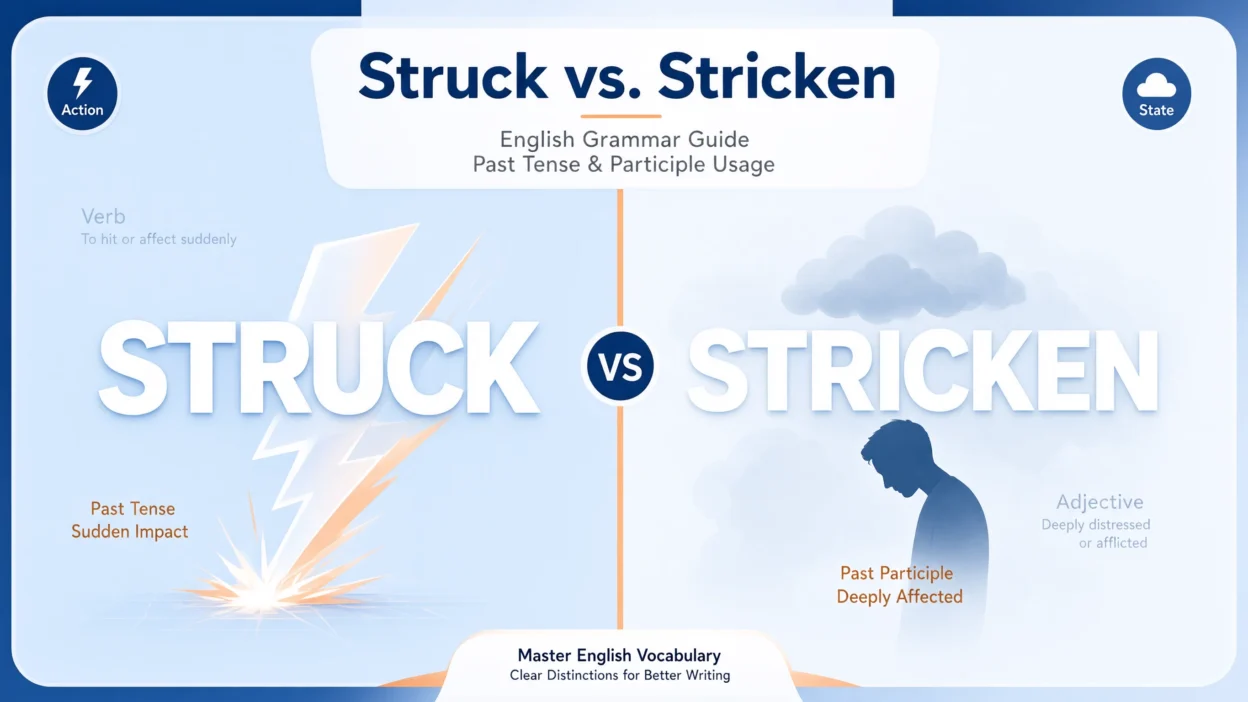
The words struck and stricken are both forms of the verb strike, but they are not always interchangeable. If you are unsure if to write “struck by lightning” or “stricken by fear,” understanding their meanings and grammatical uses will help you choose the correct word. Both forms are correct English, but they appear in different contexts.
In general, struck is the simple past tense and past participle of strike. It commonly describes hitting something, making an impact, or suddenly noticing or affecting something. Stricken is also a past participle, but it is often used to describe someone affected by a serious illness, strong emotion, disaster, or difficult situation.
For example, you might say, “The ball struck the window,” but “The family was stricken with grief.” Learning these patterns will make your writing clearer and help you avoid common mistakes in everyday conversations, school assignments, and professional communication.
Quick Answer: Struck vs. Stricken
Struck is the simple past tense and past participle of strike, used for hitting, impacts, and many other actions. Stricken is a past participle commonly used to describe being deeply affected by illness, fear, grief, or disaster. For example, “He struck the table” and “She was stricken with panic” are both correct.
Why Do People Confuse Struck and Stricken?
People confuse these words because they come from the same irregular verb, strike. Unlike regular verbs, which usually form the past tense by adding -ed, strike has different forms:
- Base form: strike
- Simple past tense: struck
- Past participle: struck or stricken
The confusion arises because both struck and stricken can function as past participles. However, their usage depends on the meaning of the sentence and the expression being used.
For example:
- Correct: The car struck a tree.
- Correct: The town was stricken by disease.
- Correct: Lightning has struck the building.
- Correct: He was stricken with grief.
The key is to understand the context rather than assume that one form is always correct and the other is wrong.
1. What Does Struck Mean?
Struck is the simple past tense and one of the past participles of the verb strike. It can describe hitting something, causing an impact, reaching an agreement, or suddenly experiencing a thought or feeling.
Common Uses of Struck
- Physical impact: The hammer struck the nail.
- Lightning or other sudden events: Lightning struck the tree.
- Sudden realization: An idea struck me during the meeting.
- Emotional impact: Her kindness struck me as unusual.
- Agreements: The two companies struck a deal.
- Industrial action: The workers struck for better wages.
Examples of Struck in Sentences
- The clock struck twelve at midnight.
- A falling branch struck the roof.
- I was struck by how beautiful the sunset was.
- The players struck the ball with great force.
- The two sides struck an agreement after several hours of discussion.
In these examples, struck describes an action, impact, or sudden experience. It is often the natural choice when you are describing what happened in the past.
2. What Does Stricken Mean?
Stricken is a past participle of strike that often describes someone or something seriously affected by a condition, emotion, tragedy, or disaster. It is especially common in formal writing, literature, news reports, and established expressions.
Common Uses of Stricken
- Illness: The region was stricken with a deadly disease.
- Grief: He was stricken with sorrow after the loss.
- Fear or panic: She stood there, stricken with fear.
- Disasters: The storm-stricken community needed assistance.
- Guilt: He looked stricken with guilt.
- Poverty: The organization provides food to poverty-stricken families.
Examples of Stricken in Sentences
- The stricken patient received immediate medical attention.
- She was stricken with grief after hearing the news.
- The earthquake-stricken region received emergency supplies.
- He appeared stricken with fear when the lights went out.
- The disease-stricken village needed additional medical support.
In these sentences, stricken emphasizes the condition or suffering experienced by a person or place. It often conveys a sense of seriousness or emotional intensity.
3. Struck vs. Stricken: Comparison Table
| Feature | Struck | Stricken |
| Base verb | Strike | Strike |
| Grammatical form | Simple past and past participle | Past participle |
| Main use | Hitting, impacts, actions, sudden thoughts | Serious conditions, emotions, disasters |
| Tone | Neutral and versatile | Often serious or dramatic |
| Common expressions | Struck a match, struck a deal | Grief-stricken, stricken with fear |
| Example | Lightning struck the house. | The town was stricken by disease. |
| Can it be a past participle? | Yes | Yes |
| Is it always interchangeable with the other? | No | No |
Remember: Both words are correct forms of strike. The right choice depends on the sentence’s meaning, grammatical structure, and established usage.
4. When Should You Use Struck or Stricken?
Choose the word that fits the action or condition you want to describe.
Use Struck When Describing an Action or Impact
Use struck when someone or something hits another object, when a clock indicates a time, or when an idea or feeling suddenly occurs.
Examples:
- The boxer struck his opponent.
- Lightning struck the telephone pole.
- A brilliant idea struck her while she was reading.
- The company struck a deal with its supplier.
Use Stricken When Describing Suffering or a Serious Condition
Use stricken when someone is deeply affected by illness, fear, grief, guilt, or another difficult circumstance.
Examples:
- The grief-stricken father sat quietly.
- The community was stricken by a severe drought.
- She was stricken with panic.
- The poverty-stricken family needed help.
What About Expressions Such as “Struck by Illness”?
Struck can also describe the onset of illness or misfortune. For instance, “He was struck by a sudden illness” is perfectly natural English.
Likewise, stricken can describe someone affected by a sudden event. The distinction is not absolute: struck emphasizes the event or impact, while stricken often emphasizes the resulting condition.
5. More Than 10 Examples of Struck vs. Stricken
Here are 15 examples showing how each word works in natural English.
| No. | Struck or stricken example | Why it works |
| 1 | The ball struck the wall. | A physical impact |
| 2 | Lightning struck the tallest tree. | A sudden natural event |
| 3 | The clock struck six. | Indicating the hour |
| 4 | An idea struck me suddenly. | A sudden thought |
| 5 | They struck a business deal. | Reaching an agreement |
| 6 | The workers struck for higher wages. | Taking industrial action |
| 7 | He was struck by her honesty. | Being deeply impressed |
| 8 | She was stricken with grief. | Experiencing intense sorrow |
| 9 | The disease-stricken area needed doctors. | A place affected by disease |
| 10 | He looked stricken with fear. | Experiencing intense fear |
| 11 | The flood-stricken village needed food. | A community affected by flooding |
| 12 | The guilt-stricken man apologized. | Being deeply affected by guilt |
| 13 | The drought-stricken farms lost their crops. | Farms suffering from drought |
| 14 | She stood there, stricken with shock. | Experiencing a powerful reaction |
| 15 | The storm struck the coast overnight. | A storm hitting a location |
These examples show that struck often describes an event or action, while stricken frequently describes a resulting state of suffering or distress.
6. Common Mistakes When Using Struck and Stricken
Even fluent English speakers can hesitate over these words because both forms are grammatically valid. The following mistakes are easy to avoid.
Mistake 1: Assuming Stricken Is Always Wrong
Incorrect assumption: “Struck is the only correct past participle of strike.”
Correct understanding: Both struck and stricken are accepted past participles, although their uses differ.
- Correct: The building was struck by lightning.
- Correct: The community was stricken by famine.
Mistake 2: Using Stricken for Every Physical Impact
Awkward: The hammer stricken the nail.
Correct: The hammer struck the nail.
Stricken is not the simple past tense. When describing an action that happened in the past, use struck.
Mistake 3: Forgetting the Verb Form
Incorrect: She stricken him with a stick.
Correct: She struck him with a stick.
The simple past tense is struck, not stricken.
Mistake 4: Ignoring Established Expressions
Some expressions strongly favor one form.
- Stricken with grief is a common expression.
- Struck by lightning is a common expression.
- Grief-stricken is the standard compound adjective.
- Struck a deal is the usual expression for reaching an agreement.
Although other constructions may sometimes be grammatical, these established combinations sound more natural.
Mistake 5: Thinking Stricken Always Means Physically Injured
Stricken can describe emotional distress, guilt, fear, and poverty, as well as illness or disaster.
For example, “She was stricken with guilt” describes an emotional state, not a physical injury.
7. Easy Memory Trick: Struck vs. Stricken
Use this simple memory trick to remember the difference:
- Struck = action or impact. Think of a hammer striking a nail.
- Stricken = affected or suffering. Think of a person stricken with grief.
Try remembering these two sentences:
“The tree was struck by lightning.”
“The family was stricken with sorrow.”
The first emphasizes the event that happened to the tree. The second emphasizes the family’s emotional condition.
This is a helpful guideline rather than an unbreakable rule, because struck can also describe emotional effects, and stricken can refer to the effects of physical events.
8. Struck vs. Stricken in American and British English
There is no major difference between American and British English in the basic distinction between struck and stricken. Both varieties recognize these forms and use them in similar ways.
| Context | American English | British English |
| Physical impact | The car struck a wall. | The car struck a wall. |
| Emotional distress | He was stricken with grief. | He was stricken with grief. |
| Natural disaster | The town was stricken by flooding. | The town was stricken by flooding. |
| Sudden illness | She was struck by illness. | She was struck by illness. |
Differences may arise from individual writing styles, regional preferences, or the surrounding expression, but neither variety requires a different past tense for strike.
Tip: When writing for either American or British readers, focus on the meaning and grammatical role of the word rather than the variety of English.
9. Similar Words Related to Struck and Stricken
Several words have related meanings, but they are not always suitable replacements.
| Word | Meaning | Example |
| Hit | To make contact with force | The ball hit the window. |
| Smashed | Hit or broken with great force | The rock smashed the glass. |
| Affected | Influenced or changed by something | The storm affected the village. |
| Afflicted | Made to suffer from a problem or condition | He was afflicted with a serious illness. |
| Overwhelmed | Strongly affected by emotion or circumstances | She was overwhelmed with sadness. |
| Shocked | Surprised or emotionally disturbed | We were shocked by the news. |
| Grief-stricken | Deeply affected by grief | The grief-stricken family gathered together. |
| Stunned | Temporarily unable to react because of surprise | He was stunned by the announcement. |
These alternatives can help you express your meaning more precisely. However, words such as hit, affected, and overwhelmed do not always preserve the exact meaning of struck or stricken.
FAQs:
1. Is struck or stricken correct?
Both are correct. Struck is the simple past tense and a past participle of strike. Stricken is another past participle, commonly used to describe serious emotional distress, illness, or disaster.
2. Is stricken the past tense of strike?
No. The simple past tense is struck. Stricken is a past participle, as in “She was stricken with grief.”
3. Should I write struck by lightning or stricken by lightning?
Struck by lightning is the usual expression when describing a lightning strike. For example, “The tree was struck by lightning.” Stricken is more commonly associated with a resulting condition or serious affliction.
4. Is it stricken with grief or struck with grief?
“Stricken with grief” is the more established and natural expression. “Struck with grief” may be understandable in some contexts, but stricken with grief is generally the better choice.
5. Can I say “I was struck by fear”?
Yes. “I was struck by fear” is grammatically correct and natural. It emphasizes the sudden onset of fear. “I was stricken with fear” is also correct and can emphasize the intensity of the emotional state.
6. Is grief-stricken correct?
Yes. Grief-stricken is a standard compound adjective describing someone deeply affected by grief or sorrow.
Example: “The grief-stricken family received support from their friends.”
7. What are the three forms of the verb strike?
The principal forms are:
- Base form: strike
- Simple past tense: struck
- Past participle: struck or stricken
Examples: “I strike the ball,” “I struck the ball yesterday,” and “The ball has struck the wall.”
Remember This
- Strike is the base form of the verb.
- Struck is the simple past tense and a past participle.
- Stricken is an alternative past participle, often used for suffering, illness, and strong emotions.
- Use “struck the window” for an impact and “stricken with grief” for an emotional condition.
- Learn common expressions because the most natural choice depends on context.
Conclusion
Understanding struck vs. stricken becomes much easier when you focus on what the sentence describes. Struck is the simple past tense of strike and is widely used for physical impacts, sudden events, thoughts, and agreements. Stricken is a past participle that often emphasizes a condition of suffering, distress, or serious affliction.
Both forms are correct, but they serve different purposes in everyday English. Remember “lightning struck the tree” and “the family was stricken with grief” as two useful examples. With practice, you will recognize which form sounds natural and use it confidently in conversations, essays, and professional writing.

John Morrison is a dedicated content writer at Synomity.com, focused on synonyms, vocabulary development, and word meanings. He creates clear, educational resources that help readers improve language skills and communicate with confidence.