Choosing between stinged and stung can be confusing, especially if you are learning English irregular verbs. Both words may seem reasonable because regular verbs usually form their past tense by adding -ed. However, the verb sting follows a different pattern.
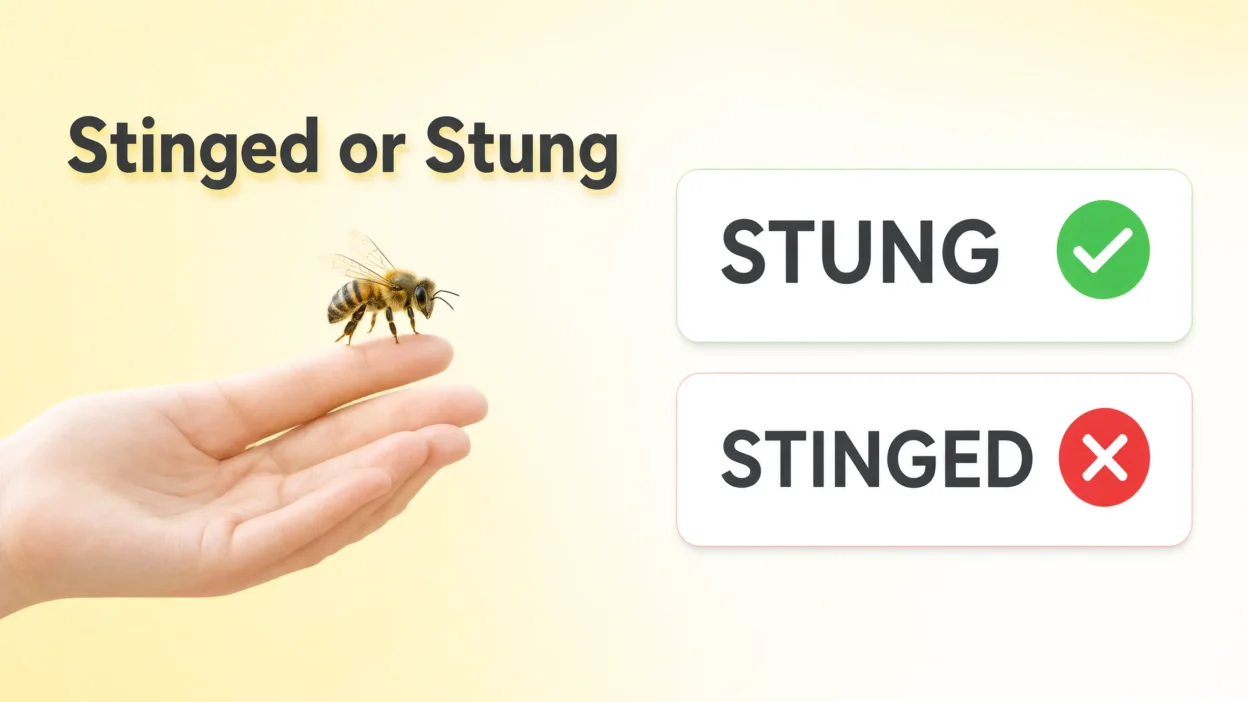
Stung is the correct standard past tense and past participle of sting. Stinged is generally considered incorrect in standard English when referring to the past action of stinging. For example, you should write, “A bee stung me yesterday,” rather than “A bee stinged me yesterday.”
Understanding the difference helps you write more accurately, speak naturally, and avoid common grammar mistakes. If you are describing a bee sting, an insect bite, a painful comment, or an emotional experience, knowing when to use sting and stung makes your sentences clearer. This guide explains both words, provides practical examples, and shows you an easy way to remember the correct form.
Quick Answer: Stinged or Stung?
Stung is the correct past tense and past participle of sting. Use sting for the present or base form and stung for completed actions and perfect tenses. Stinged is not the standard form used in ordinary English. For example: “The wasp stung my hand.”
Why Do People Confuse Stinged and Stung?
People often confuse these words because many English verbs form their past tense by adding -ed.
For example:
- Walk → walked
- Jump → jumped
- Help → helped
- Sting → stung
Unlike regular verbs, sting is an irregular verb. Its spelling changes in the past tense instead of following the usual -ed pattern.
Learners may naturally create stinged by applying a familiar grammar rule. Although this is understandable, the standard form is stung.
What Does Sting Mean?
Sting is a verb that means to cause a sharp, burning, or painful sensation, often with a pointed body part, such as a bee’s or wasp’s stinger.
It can also describe emotional pain caused by criticism, rejection, or hurtful words.
Examples:
- Bees sometimes sting when they feel threatened.
- My eyes sting when I cut onions.
- His harsh criticism can sting.
- A mosquito bite may sting for a while.
The word can function as a noun, too. For example, “The bee’s sting was painful.”
What Does Stung Mean?
Stung is the simple past tense and past participle of sting. It describes an action that happened in the past or appears in a perfect-tense construction.
Examples:
- A bee stung my arm yesterday.
- The wasp stung him twice.
- I have been stung by a bee before.
- Her rude comment stung me deeply.
The word can describe both physical pain and emotional hurt.
Stinged vs. Stung: Comparison Table
| Feature | Stinged | Stung |
| Standard English form | Generally incorrect for the past of sting | Correct |
| Base verb | Sting | Sting |
| Simple past tense | Nonstandard | Stung |
| Past participle | Nonstandard | Stung |
| Example | The bee stinged me. | The bee stung me. |
| Recommended usage | Avoid in ordinary English | Use in standard English |
Remember: When describing a past action, choose stung, not stinged.
When Should You Use Sting and Stung?
Use the form that matches the tense and structure of your sentence.
Use Sting for the Present or Base Form
Use sting with the base form of the verb, including after to, after modal verbs, and with plural subjects in the simple present.
Examples:
- Bees sting when they feel threatened.
- Be careful, or the wasp might sting you.
- I do not want to sting anyone.
- Some plants sting when you touch them.
With he, she, or it in the simple present, use stings.
Example: “This insect stings when disturbed.”
Use Stung for the Simple Past
Use stung when the action happened in the past.
Examples:
- A bee stung me this morning.
- The insect stung my leg.
- His words stung her feelings.
- I got stung while gardening.
Use Stung as the Past Participle
Use stung with auxiliary verbs such as have, has, or had. It also appears in passive constructions.
Examples:
- I have been stung before.
- She has stung her finger on a thorn.
- He had been stung by a wasp.
- We were stung by mosquitoes all night.
The sentence “She has stung her finger on a thorn” is grammatically possible, although “She has pricked her finger on a thorn” may sound more natural in that context.
12 Examples of Sting and Stung in Sentences
Here are practical examples showing how to use the verb correctly.
- A bee stung my hand while I was gardening.
- The wasp stung him on the neck.
- Mosquitoes sometimes sting me when I sit outside.
- Be careful because that insect may sting you.
- My eyes sting when I chop onions.
- Her sarcastic remark stung more than she expected.
- I have never been stung by a wasp.
- The child cried after a bee stung his foot.
- His criticism stung because I knew he was right.
- Some jellyfish can sting swimmers in the water.
- She had been stung by a bee before the picnic ended.
- The memory of his rejection still stings.
These examples demonstrate that sting and its related forms can describe physical sensations as well as emotional experiences.
Common Mistakes With Stinged and Stung
Avoid these frequent errors when speaking or writing English.
Mistake 1: Using Stinged for the Past
Incorrect: The bee stinged my finger.
Correct: The bee stung my finger.
Explanation: Sting is irregular, so its simple past is stung.
Mistake 2: Using Sting Instead of Stung
Incorrect: Yesterday, a wasp sting me.
Correct: Yesterday, a wasp stung me.
Explanation: A completed past action requires the past-tense form.
Mistake 3: Using Stinged After Have or Has
Incorrect: I have stinged my hand.
Correct: I have been stung on my hand.
Explanation: The past participle of sting is stung. The passive construction is appropriate when something else caused the sting.
Mistake 4: Forgetting the Present-Tense Form
Incorrect: This bee stung people every summer.
Correct: This bee stings people every summer.
Explanation: Use stings for a habitual action by a singular subject in the simple present.
What Is an Easy Way to Remember Stung?
Use this simple memory trick:
Sing, sang, sung — sting, stung, stung.
Although sing and sting are different verbs, the similar sound pattern can help you remember the irregular form.
Remember the three principal forms:
- Sting: Base form
- Stung: Simple past
- Stung: Past participle
Think of this sentence: “Yesterday, a bee stung me, and I have been stung before.”
Both past-tense uses rely on stung, never stinged in standard English.
Stinged vs. Stung in American and British English
There is no meaningful standard American-versus-British spelling difference here.
Both American English and British English use stung as the simple past tense and past participle of sting.
Examples in both varieties:
- American English: The bee stung my arm.
- British English: The bee stung my arm.
The spelling and grammar remain the same. You do not need to choose between different regional forms.
Similar Words and Irregular Verb Forms
Learning related irregular verbs can help you recognize why sting does not follow the usual -ed rule.
| Base form | Simple past | Past participle |
| Sting | Stung | Stung |
| Sing | Sang | Sung |
| Ring | Rang | Rung |
| Swing | Swung | Swung |
| Cling | Clung | Clung |
| Fling | Flung | Flung |
| Bring | Brought | Brought |
| Bite | Bit | Bitten |
| Shake | Shook | Shaken |
| Write | Wrote | Written |
Notice that some verbs change their vowels, while others change more substantially. Learning each verb’s forms helps you avoid creating nonstandard forms such as stinged.
Final Verdict: Stinged or Stung?
Stung is the correct choice in standard English. Use it as both the simple past tense and the past participle of sting.
- Present: I sting.
- Simple past: I stung.
- Past participle: I have stung.
When describing an insect’s action, you can say, “A bee stung me.” When describing an experience, you can say, “I have been stung before.”
Avoid stinged in standard writing, school assignments, professional communication, and everyday conversation.
FAQs:
1. Is stinged a real word?
Stinged may appear as a nonstandard form or as an error made by English learners, but it is not the standard past tense of sting. Use stung in ordinary English.
2. Is stung the past tense of sting?
Yes. Stung is the simple past tense of sting. For example: “A bee stung my leg yesterday.”
3. Is stung also the past participle of sting?
Yes. The past participle is also stung. Use it in sentences such as “I have been stung before” or “The wasp had stung him.”
4. Should I say “I got stinged” or “I got stung”?
Say “I got stung.” This is the standard expression when an insect or another creature stings you.
5. What are the three forms of sting?
The three principal forms are sting, stung, stung. The base form is sting, the simple past is stung, and the past participle is also stung.
6. Do Americans and British people use different forms?
No. Both American and British English use stung. There is no standard regional difference between the two forms.
7. Can stung describe emotional pain?
Yes. Stung can describe emotional hurt caused by criticism, rejection, or an unpleasant remark. For example: “Her words stung more than she realized.”
Remember This
- Sting = base form or present-tense form, depending on the sentence.
- Stings = simple present with he, she, or it.
- Stung = simple past tense.
- Stung = past participle.
- Stinged = avoid this form in standard English.
The easiest rule is to remember that the correct verb forms are sting, stung, stung.
Conclusion
The difference between stinged and stung is simple once you understand irregular verbs. Although adding -ed is common in English, sting follows a different pattern. Its simple past tense and past participle are both stung. Therefore, “A bee stung me” is correct, while “A bee stinged me” is not standard English.
To improve your grammar, practise using sting, stings, and stung in different sentences. Remember the pattern, read examples aloud, and pay attention to how the verb changes with tense. With regular practice, you will naturally choose stung when talking about past experiences, physical pain, or emotional hurt.

Lucas Smith is a skilled language writer at Synomity.com, passionate about synonyms, vocabulary enrichment, and word meanings. He develops engaging content that helps readers strengthen communication skills and expand their understanding of language.