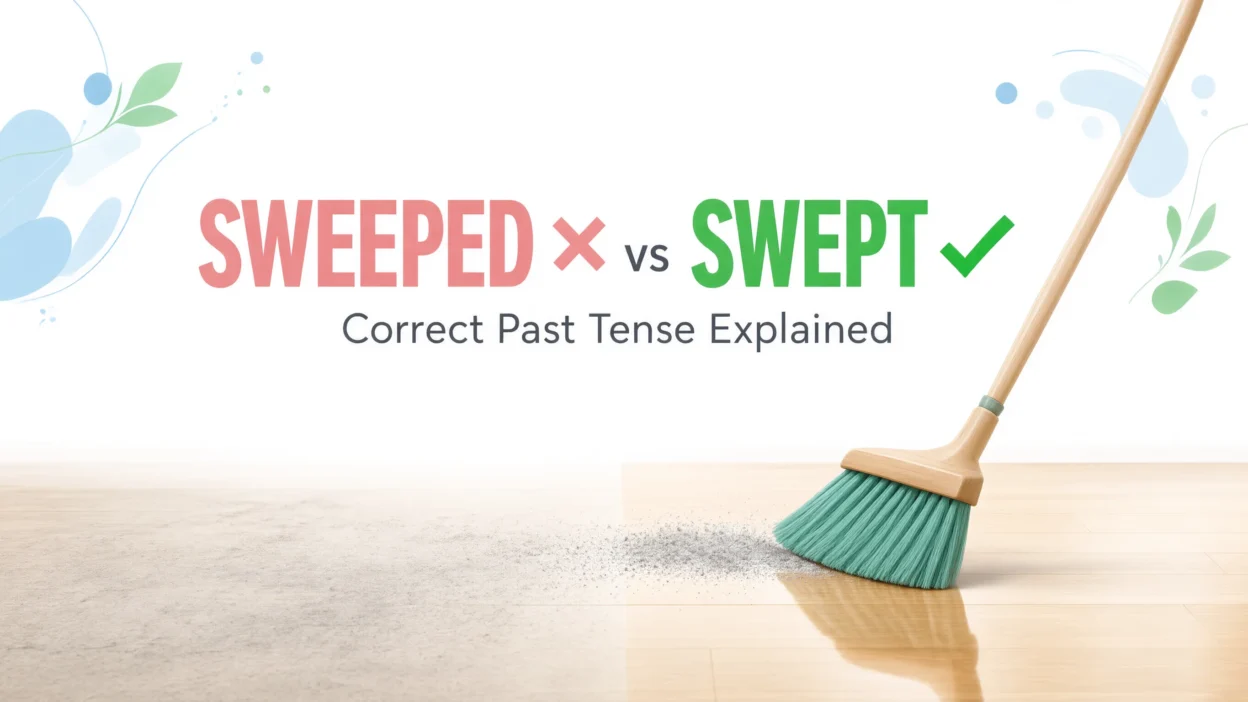
The correct past tense of sweep is “swept,” not “sweeped.” If you want to describe cleaning a floor, removing dirt with a broom, or moving something across a surface, use swept. For example, “She swept the kitchen floor yesterday” is correct, while “She sweeped the kitchen floor yesterday” is incorrect in standard English.
English has many irregular verbs that do not form their past tense by simply adding -ed. The verb sweep is one of them. Learning its correct forms will help you write more accurately, speak naturally, and avoid common grammar mistakes.
If you are a student, an English learner, or someone improving everyday writing, understanding the difference between sweeped and swept is straightforward once you learn the basic rule.
In this guide, you will discover the meaning of both words, how to use swept in sentences, common mistakes to avoid, and how the verb changes across different tenses.
Quick Answer: Sweeped or Swept?
Swept is the correct simple past tense and past participle of sweep. Sweeped is not accepted in standard modern English. Use swept when describing an action that happened in the past, such as “He swept the porch this morning.” The verb forms are sweep, swept, and swept.
Why Do People Confuse Sweeped and Swept?
People often confuse these words because many English verbs form their past tense by adding -ed. For example, clean becomes cleaned, and jump becomes jumped.
However, English also contains irregular verbs that change their spelling instead of following this pattern. The verb sweep belongs to this group.
Its past tense changes from sweep to swept, just as sleep becomes slept and keep becomes kept.
The confusion is understandable, but remembering the irregular form makes it easy to choose the correct word.
What Does Sweep Mean?
Sweep is a verb that commonly means to clean a surface using a broom or brush. It can also describe moving something smoothly across an area or affecting a large number of people or places.
Examples:
- Please sweep the floor before dinner.
- The wind swept the leaves across the garden.
- The team swept the competition.
The word can describe both literal actions and figurative events.
What Does Swept Mean?
Swept is the simple past tense and past participle of sweep. It describes an action that has already happened or is used with an auxiliary verb to form a perfect tense or passive construction.
Examples:
- I swept the living room yesterday.
- She has swept the entire house.
- The fallen leaves were swept away by the wind.
In each example, swept is the correct form of the verb.
Sweeped vs. Swept: Comparison Table
| Feature | Sweeped | Swept |
| Word status | Nonstandard form | Correct standard form |
| Base verb | Sweep | Sweep |
| Simple past tense | Incorrect in standard English | Correct |
| Past participle | Incorrect in standard English | Correct |
| Example | She sweeped the floor. | She swept the floor. |
| Recommended usage | Avoid in standard writing | Use in speaking and writing |
Remember: When writing in standard English, always choose swept instead of sweeped.
When Should You Use Sweep and Swept?
Choosing the correct form depends on when the action happens and how the sentence is structured.
1. Use Sweep for the Present Tense
Use sweep for the base form, habits, routines, instructions, and actions that happen in the present.
Examples:
- I sweep the floor every morning.
- They sweep the classroom after school.
- Please sweep the steps.
For third-person singular subjects, use sweeps: “He sweeps the porch every evening.”
2. Use Swept for the Past Tense
Use swept when an action happened and finished in the past.
Examples:
- I swept the garage yesterday.
- She swept the kitchen after breakfast.
- They swept the hallway last night.
3. Use Swept as the Past Participle
Use swept with helping verbs such as has, have, and had to form perfect tenses.
Examples:
- I have swept the floor.
- He has swept the entire room.
- We had swept the yard before the rain started.
The same form can also appear in passive constructions: “The floor was swept this morning.”
12 Examples of Swept in Sentences
Here are 12 practical examples to help you understand how to use swept correctly.
- She swept the kitchen floor before cooking dinner.
- I swept the dust from beneath the table.
- He swept the leaves off the front porch.
- They swept the classroom after the lesson.
- My mother swept the hallway early in the morning.
- The cleaner swept the office before the employees arrived.
- We swept the garage over the weekend.
- The wind swept the dry leaves across the road.
- The strong current swept the boat downstream.
- Our team swept the series by winning every game.
- A feeling of relief swept over her.
- The broken glass was carefully swept into a dustpan.
These examples show that swept can refer to cleaning, movement, emotions, and complete victories.
Common Mistakes with Sweeped and Swept
Even though the rule is simple, learners sometimes make mistakes when using this verb.
Mistake 1: Using Sweeped Instead of Swept
Incorrect: He sweeped the floor yesterday.
Correct: He swept the floor yesterday.
Explanation: Sweep is an irregular verb, so its past tense is swept.
Mistake 2: Using Sweep Instead of Swept in the Past
Incorrect: She sweep the room last night.
Correct: She swept the room last night.
Explanation: The phrase last night indicates a completed past action.
Mistake 3: Using Sweeped After Has or Have
Incorrect: I have sweeped the kitchen.
Correct: I have swept the kitchen.
Explanation: The past participle of sweep is also swept.
Mistake 4: Confusing Swept With Sweeping
Incorrect: He is swept the floor right now.
Correct: He is sweeping the floor right now.
Explanation: Use sweeping with forms of be to describe an ongoing action.
What Is an Easy Memory Trick for Swept?
A simple way to remember the correct past tense is to connect sweep with sleep.
- Sweep → Swept
- Sleep → Slept
- Keep → Kept
- Weep → Wept
Notice the similar spelling patterns. Instead of adding -ed, these verbs change their endings.
Memory tip: If you would say “I slept well,” remember that you would also say “I swept the floor.” Both are irregular past-tense forms.
American vs. British English: Sweeped or Swept
There is no standard American-versus-British spelling difference for this verb. Both American English and British English use swept as the standard past tense and past participle of sweep.
| English variety | Correct form | Example |
| American English | Swept | She swept the porch. |
| British English | Swept | She swept the pavement. |
Although vocabulary and spelling sometimes differ between the two varieties, the verb forms remain the same.
Similar Words to Sweep and Swept
Learning other irregular verbs can help you recognize patterns and avoid similar mistakes.
| Present tense | Past tense | Past participle |
| Sweep | Swept | Swept |
| Sleep | Slept | Slept |
| Keep | Kept | Kept |
| Weep | Wept | Wept |
| Feel | Felt | Felt |
| Leave | Left | Left |
| Build | Built | Built |
| Deal | Dealt | Dealt |
| Mean | Meant | Meant |
| Send | Sent | Sent |
These verbs do not all follow precisely the same spelling rule, but they illustrate why English learners need to memorize common irregular forms.
Final Verdict: Sweeped or Swept?
Swept is correct; sweeped is nonstandard and should be avoided in standard English.
Use sweep for the base or present form, swept for the simple past tense, and swept as the past participle.
For example:
- Present: I sweep the floor every day.
- Past: I swept the floor yesterday.
- Present perfect: I have swept the floor already.
Whether you are writing an assignment, sending a message, or speaking in everyday conversation, swept is the form you should use.
FAQs:
1. Is sweeped a real word?
Sweeped may appear as a nonstandard form in learner writing or informal contexts, but it is not the accepted past tense of sweep in standard English. The correct form is swept.
2. Is swept the past tense of sweep?
Yes. Swept is the simple past tense of sweep. For example, “He swept the kitchen yesterday.”
3. Is swept also the past participle of sweep?
Yes. Both the simple past tense and the past participle are swept. For example, “She swept the floor” and “She has swept the floor” are both correct.
4. What are the three forms of sweep?
The three principal forms are:
- Base form: Sweep
- Simple past tense: Swept
- Past participle: Swept
5. Why is swept correct instead of sweeped?
Sweep is an irregular verb. Irregular verbs do not always form their past tense by adding -ed. Its established standard past-tense form is swept.
6. Is it “I have swept” or “I have sweeped”?
“I have swept” is correct. The verb have is followed by the past participle, which is swept.
7. What is the past tense of sweeping?
The past tense of the base verb sweep is swept. Sweeping is the -ing form, as in “I am sweeping the floor.” To describe a completed action, say “I swept the floor.”
Remember This
- Sweep = base form and present-tense verb.
- Sweeps = present tense with he, she, or it.
- Swept = simple past tense.
- Swept = past participle.
- Sweeped = avoid in standard English.
The easiest rule to remember is that sweep becomes swept, not sweeped.
Conclusion
When choosing between sweeped and swept, always use swept in standard English. It is the correct past tense and past participle of sweep. Although many regular verbs take -ed in the past tense, irregular verbs follow their own patterns. Learning these forms helps you write clear, grammatically correct sentences.
Keep practicing with simple examples such as “I swept the floor,” “She has swept the room,” and “The wind swept the leaves away.” With regular practice, the correct form will become natural. Whenever you need to describe a completed sweeping action, remember one simple rule: sweep in the present, swept in the past.

Lucas Smith is a skilled language writer at Synomity.com, passionate about synonyms, vocabulary enrichment, and word meanings. He develops engaging content that helps readers strengthen communication skills and expand their understanding of language.