
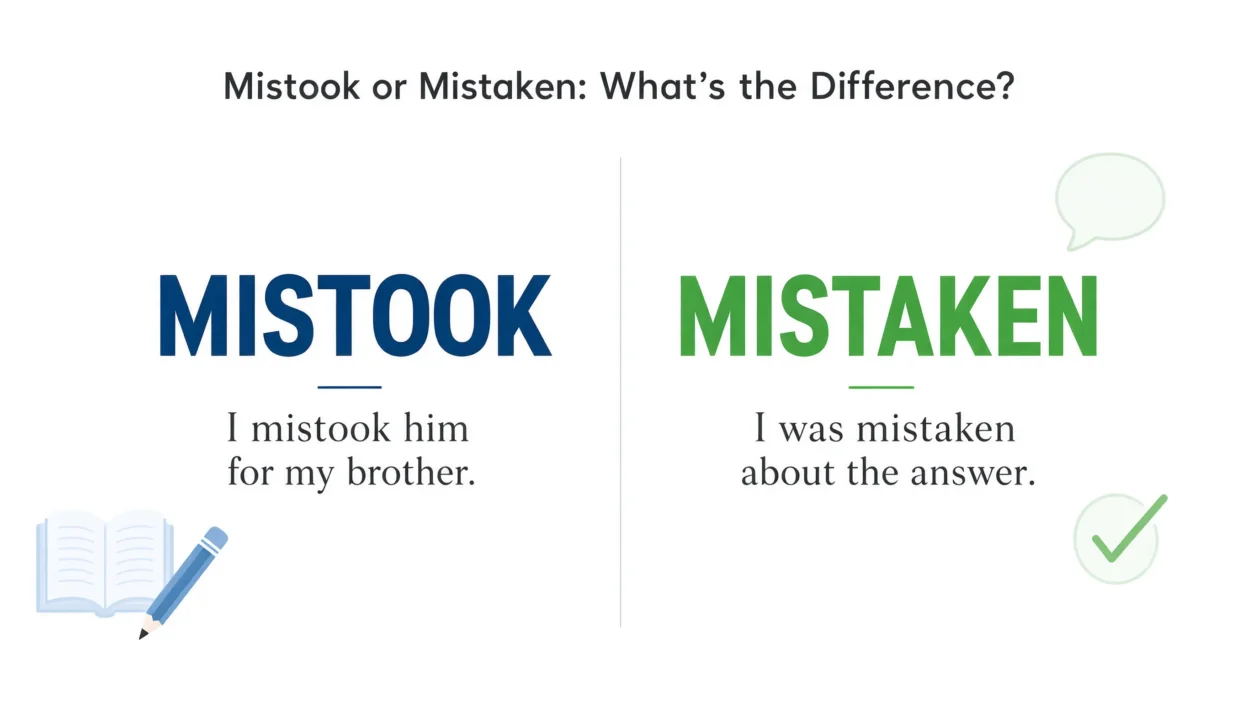
The words mistook and mistaken are both forms of the verb mistake, but they are used differently in English. Mistook is the simple past tense, while mistaken is the past participle. Understanding the difference helps you choose the correct word when speaking, writing, or describing a misunderstanding.
Many English learners confuse these forms because they refer to the same action and do not follow the usual pattern of adding -ed to form the past tense. However, each word has a specific grammatical role. For example, you can say, “I mistook him for his brother,” but you should say, “I have mistaken him for his brother” when using the present perfect tense.
In this guide, you will learn the meanings of mistook and mistaken, how to use each word correctly, and which grammar rules to remember. You will also find practical examples, common mistakes, a comparison table, and answers to frequently asked questions.
Quick Answer
Mistook is the simple past tense of mistake, used for an action that happened in the past. Mistaken is the past participle, used with helping verbs such as have, has, and had. For example, “I mistook her for Anna” is correct, as is “I have mistaken her for Anna.”
Why Do People Confuse Mistook and Mistaken?
People often confuse these words because both come from the verb mistake and describe identifying, understanding, or judging something incorrectly.
The confusion also occurs because English has irregular verbs with different past-tense and past-participle forms. Unlike regular verbs such as walk (walked, walked), mistake changes to mistook and mistaken.
Remember that the correct form depends on the sentence structure, not just on whether an event happened in the past.
What Does Mistook Mean?
Mistook is the simple past tense of mistake. It describes an incorrect belief, identification, or judgment that occurred in the past.
You generally use mistook when talking about a completed action without a helping verb such as have or had.
Examples of Mistook
- I mistook the stranger for my teacher.
- She mistook my silence for anger.
- He mistook the address and went to the wrong house.
- They mistook the warning for a joke.
- We mistook the blue bag for our own.
In each example, mistook describes something that happened in the past.
What Does Mistaken Mean?
Mistaken is the past participle of mistake. It is commonly used with have, has, or had to form perfect tenses. It can also function as an adjective meaning incorrect or wrong.
Examples of Mistaken
- I have mistaken him for someone else.
- She has mistaken my kindness for weakness.
- They had mistaken the road before checking the map.
- You are mistaken about the meeting time.
- His mistaken assumption caused confusion.
Notice that mistaken can appear in different grammatical structures. In “I have mistaken him,” it forms a perfect tense. In “You are mistaken,” it describes someone’s incorrect belief.
Mistook vs. Mistaken: Comparison Table
| Feature | Mistook | Mistaken |
| Base verb | Mistake | Mistake |
| Grammatical form | Simple past tense | Past participle |
| Common use | Completed past action | Perfect tenses or adjective |
| Helping verb required? | Usually no | Yes, for perfect tenses |
| Example | I mistook him for John. | I have mistaken him for John. |
| Adjective use | No, not normally | Yes: You are mistaken. |
When Should You Use Mistook or Mistaken?
Choose the correct form by looking at the verb structure and the meaning of your sentence.
Use Mistook for a Past Action
Use mistook when describing something that happened in the past.
Examples:
- I mistook your bag for mine.
- He mistook her question for a complaint.
- We mistook the time and arrived early.
Use Mistaken with Have, Has, or Had
Use mistaken with a perfect-tense helping verb.
Examples:
- I have mistaken the date.
- She has mistaken his intentions.
- They had mistaken the instructions.
Use Mistaken as an Adjective
Use mistaken when describing a person, belief, opinion, or assumption that is incorrect.
Examples:
- You are mistaken about the price.
- That is a mistaken belief.
- He was mistaken in his judgment.
12 Examples of Mistook vs. Mistaken in Sentences
These examples show how the two forms work in everyday English.
- Mistook: I mistook the woman for my aunt.
- Mistaken: I have mistaken that woman for my aunt before.
- Mistook: She mistook his smile for approval.
- Mistaken: She had mistaken his smile for approval.
- Mistook: He mistook the classroom number and entered the wrong room.
- Mistaken: He has mistaken the classroom number again.
- Mistook: We mistook the sound for thunder.
- Mistaken: We had mistaken the sound for thunder.
- Mistook: They mistook my suggestion for criticism.
- Mistaken: They were mistaken about my intentions.
- Mistook: I mistook the stranger for a colleague.
- Mistaken: I may have mistaken the stranger for a colleague.
The key difference is grammatical: mistook stands as the simple past-tense verb, while mistaken usually appears with a helping verb or works as an adjective.
Common Mistakes to Avoid
Even experienced English speakers sometimes use irregular verb forms incorrectly. Here are some mistakes to watch for.
1. Using Mistaken Without a Helping Verb
Incorrect: I mistaken him for my brother yesterday.
Correct: I mistook him for my brother yesterday.
Use mistook for a simple past-tense statement.
2. Using Mistook After Have
Incorrect: I have mistook the address.
Correct: I have mistaken the address.
After have, has, or had, use the past participle mistaken.
3. Confusing Mistaken with Mistake
Incorrect: She has mistake my name.
Correct: She has mistaken my name.
The past participle is mistaken, not mistake.
4. Forgetting the Adjective Use of Mistaken
Incorrect: You are mistook about the answer.
Correct: You are mistaken about the answer.
When describing an incorrect belief or opinion, use mistaken.
Memory Trick: How to Remember Mistook vs. Mistaken
Use this simple memory trick:
- Mistook = Past action. “I mistook the bag for mine.”
- Mistaken = Have, has, had, or being wrong. “I have mistaken the bag for mine.” “You are mistaken.”
You can also remember the three forms of the verb together:
Mistake → Mistook → Mistaken
- Present: I sometimes mistake the twins for each other.
- Past: I mistook the twins for each other yesterday.
- Past participle: I have mistaken the twins for each other before.
Practicing these three forms in complete sentences makes it easier to use them naturally.
Mistook vs. Mistaken in American and British English
There is no major difference between American and British English in the grammatical use of mistook and mistaken. Both varieties use mistook as the simple past tense and mistaken as the past participle.
| Variety | Simple past | Past participle |
| American English | Mistook | Mistaken |
| British English | Mistook | Mistaken |
Examples in both varieties:
- I mistook him for his brother.
- I have mistaken him for his brother.
Spelling and pronunciation conventions can differ between American and British English, but these verb forms remain the same.
Similar Words and Related Verb Forms
Learning related forms can help you understand irregular verbs and avoid similar mistakes.
| Verb form | Example | Usage |
| Mistake | I sometimes mistake their names. | Base or present form |
| Mistakes | She mistakes one twin for the other. | Present tense with he, she, or it |
| Mistook | I mistook him for a friend. | Simple past tense |
| Mistaken | I have mistaken him for a friend. | Past participle |
| Misunderstood | I misunderstood the instructions. | Past tense and past participle of misunderstand |
| Misjudged | I misjudged the situation. | Past tense and past participle of misjudge |
Although mistook and misunderstood can describe similar situations, they are not always interchangeable. Mistake often involves confusing one thing or person with another, while misunderstand focuses on interpreting something incorrectly.
Final Verdict: Mistook or Mistaken?
The correct choice depends on how the word functions in your sentence.
- Use mistook for a simple past action: “I mistook him for my cousin.”
- Use mistaken with have, has, or had: “I have mistaken him for my cousin.”
- Use mistaken as an adjective: “You are mistaken.”
Neither word is inherently more correct than the other. Both are correct when used in the appropriate grammatical context.
FAQs:
1. Is mistook or mistaken correct?
Both are correct. Mistook is the simple past tense of mistake, while mistaken is its past participle and can also be an adjective. Choose the form that fits your sentence.
2. Is mistook the past tense of mistake?
Yes. Mistook is the simple past tense of mistake. For example, “I mistook the stranger for my neighbor.”
3. Is mistaken the past participle of mistake?
Yes. Mistaken is the past participle of mistake. It is used in perfect tenses, such as “She has mistaken my meaning,” and in passive-like or descriptive constructions such as “You are mistaken.”
4. Can I say “I have mistook”?
No. In standard English, the correct form is “I have mistaken.” The present perfect tense requires the past participle, not the simple past tense.
5. Is “You are mistaken” grammatically correct?
Yes. “You are mistaken” is correct because mistaken functions as an adjective describing an incorrect belief, understanding, or opinion.
6. What are the three forms of the verb mistake?
The three principal forms are mistake, mistook, mistaken. They correspond to the base form, simple past tense, and past participle, respectively.
7. Is mistook used differently in British and American English?
No significant grammatical difference exists. Both American and British English use mistook as the simple past tense and mistaken as the past participle.
Remember This
- Mistake: Base form — “I sometimes mistake the twins.”
- Mistook: Simple past — “I mistook one twin for the other.”
- Mistaken: Past participle — “I have mistaken one twin for the other.”
- Mistaken: Adjective — “You are mistaken.”
The most important rule is to use mistook for a simple past action and mistaken after have, has, or had, or when describing something incorrect.
Conclusion
Understanding the difference between mistook and mistaken is easier when you remember their grammatical roles. Mistook describes an action that happened in the past, while mistaken is the past participle used in perfect tenses and can also describe an incorrect belief or judgment. Both words are essential parts of standard English.
To improve your English, practice using the forms in everyday sentences. Say, “I mistook the time,” “I have mistaken the time,” and “I was mistaken about the time.” These examples demonstrate how the same verb changes form depending on the sentence. With a little practice, you will be able to choose between mistook and mistaken confidently in conversation, schoolwork, and professional writing.


