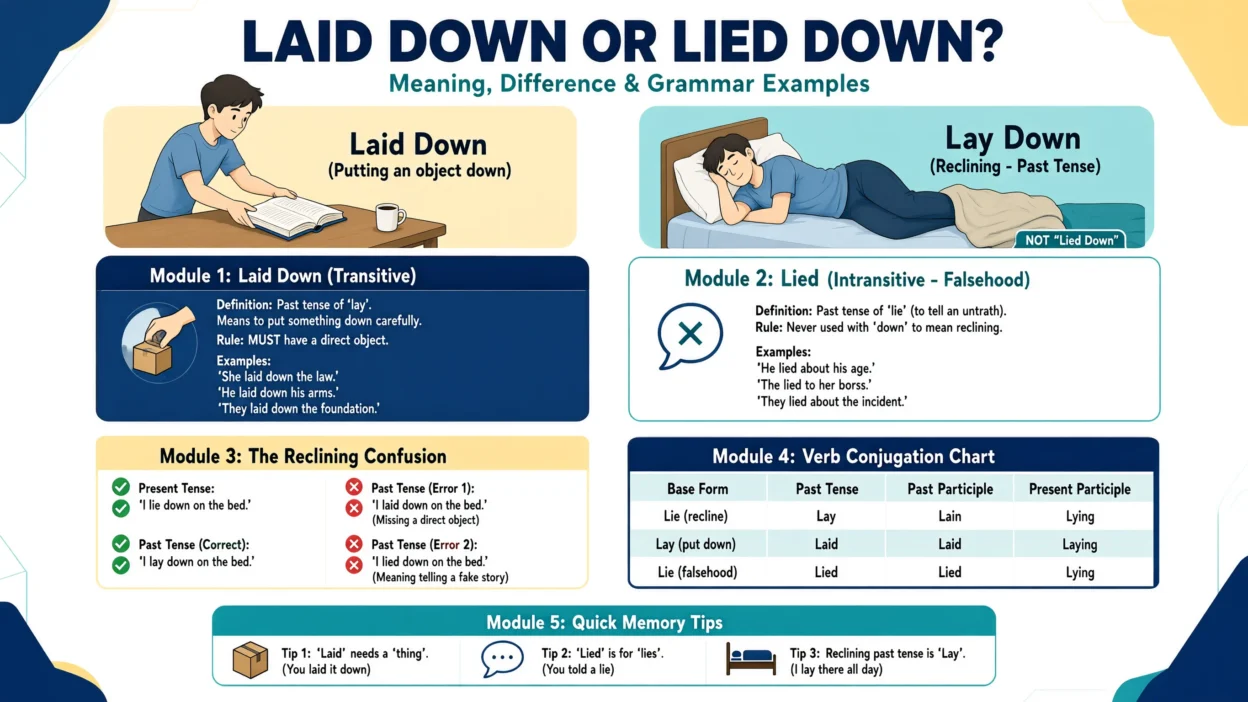
Have you ever wondered if to write “laid down” or “lied down”? These phrases sound similar, but they follow different grammar rules. Understanding the difference will help you choose the correct expression when talking about resting, placing something somewhere, or describing an action that happened in the past.
“Laid down” is the past tense of lay down, which means to put something or someone in a resting position. “Lied down” is the past tense of lie down, which means to recline or rest your own body. For example, “She laid down the book” is correct because she placed an object somewhere, while “She lay down on the bed” is correct in standard English because she rested her body.
Notice that the correct past-tense form of lie down is actually lay down, not lied down. The word lied usually means that someone told an untruth. Once you understand these verb forms, you can avoid a common English grammar mistake.
Quick Answer
“Laid down” is the past tense of lay down, meaning to place something somewhere. “Lay down” is the past tense of lie down, meaning to recline or rest. “Lied down” is generally incorrect when describing resting; lied is the past tense of lie meaning to tell an untruth.
Why Do People Confuse Laid Down and Lied Down?
People often confuse these expressions because the verbs lie and lay have similar meanings in certain contexts and their past-tense forms are irregular.
The confusion comes from three related verb forms:
- Lie → Lay → Lain: To recline or rest.
- Lay → Laid → Laid: To put something down.
- Lie → Lied → Lied: To tell an untruth.
The main challenge is remembering that lie and lay are different verbs, even though they can both describe actions involving a resting position.
First Word: Laid Down
Laid down is the simple past form of lay down. It means to place something or someone in a horizontal or resting position.
Use this expression when the subject puts an object somewhere.
Examples:
- She laid down her phone on the table.
- He laid down the rules before the meeting.
- I laid down my bag beside the door.
- The mother laid down her sleeping baby carefully.
The phrase can also have figurative meanings. For example, “The company laid down new guidelines” means the company established new rules.
Is “Laid Down” Always Correct?
No. Although laid down is correct when referring to placing something, it is not the standard simple past form for describing your own body resting.
Incorrect: I laid down on the sofa.
Correct: I lay down on the sofa.
In the correct sentence, lay is the past tense of lie, meaning to recline.
Second Word: Lied Down
Lied down is generally not correct when you mean that someone reclined or rested. The confusion arises because lied is a real past-tense word, but it belongs to a different verb.
The verb lie, meaning to tell an untruth, follows this pattern:
Lie → Lied → Lied
Examples:
- He lied about his age.
- She lied to her parents.
- They lied about what happened.
If you want to describe someone resting, use lay down for the simple past, not lied down.
For example:
Incorrect: She lied down after lunch.
Correct: She lay down after lunch.
What About “I Have Lain Down”?
When using the present perfect tense, the correct form of lie down is have or has lain down.
Examples:
- I have lain down for a few minutes.
- She has lain down to rest.
- They have lain down on the grass.
Although lain may sound unusual to some speakers, it is the standard past participle of lie when it means to recline.
Laid Down vs. Lied Down: Comparison Table
| Feature | Laid down | Lied down |
| Standard meaning | Placed something down | Usually an incorrect form for resting |
| Base verb intended | Lay | Often mistakenly intended as lie |
| Correct past form for resting | Not normally used for this meaning | Lay down |
| Correct past form for placing | Laid down | Not applicable |
| Example | He laid down the book. | Incorrect: He lied down. |
| Correct resting sentence | She lay down. | She lay down. |
| Related past participle | Laid | Lain for reclining; lied for telling an untruth |
Important: If you mean resting, neither laid down nor lied down is the standard simple past form. The correct phrase is lay down.
When to Use Each Expression
Choosing the correct expression depends on what the subject is doing.
Use “Laid Down” When Placing Something
Choose laid down when someone puts an object or another person into a position.
Examples:
- I laid down the newspaper.
- The nurse laid the patient down gently.
- The manager laid down clear expectations.
A useful question is: What did the person put down? If the sentence answers that question, laid down may be correct.
Use “Lay Down” When Resting
Choose lay down when someone reclined in the past without directly placing an object somewhere.
Examples:
- I lay down after work.
- He lay down on the bed.
- The dog lay down beside its owner.
A useful question is: Did the person simply recline? If yes, use lay down for the simple past.
Use “Lied” When Someone Told an Untruth
Choose lied when the sentence is about dishonesty.
Examples:
- He lied to his teacher.
- I lied about being late.
- They lied during the interview.
Remember that lied does not mean reclined.
12 Examples of Laid Down and Lay Down in Sentences
The following examples show how these expressions work in everyday English.
1. Correct: I laid down my keys on the counter. Meaning: I placed my keys on the counter.
2. Correct: She laid down the baby in the crib. Meaning: She placed the baby in the crib.
3. Correct: He laid down the law at the meeting. Meaning: He firmly established rules.
4. Correct: They laid down their weapons. Meaning: They put their weapons down.
5. Correct: I lay down for an hour yesterday. Meaning: I reclined to rest.
6. Correct: She lay down on the couch after dinner. Meaning: She rested her body on the couch.
7. Correct: The dog lay down near the fireplace. Meaning: The dog reclined near the fireplace.
8. Correct: We lay down under a tree to watch the clouds. Meaning: We reclined beneath a tree.
9. Correct: He has lain down for a short rest. Meaning: He has reclined.
10. Correct: I have laid down the documents on your desk. Meaning: I have placed the documents on the desk.
11. Correct: She lied about where she had been. Meaning: She told an untruth.
12. Incorrect: He lied down because he was tired. Correct: He lay down because he was tired.
These examples demonstrate why identifying the intended meaning is more useful than choosing a word based on how it sounds.
Common Mistakes to Avoid
English learners and native speakers alike sometimes mix up these verbs. Here are the most frequent errors.
Mistake 1: Saying “I Laid Down”
Incorrect: I laid down because I felt tired.
Correct: I lay down because I felt tired.
Use lay down when describing your own past action of reclining.
Mistake 2: Saying “She Lied Down”
Incorrect: She lied down after lunch.
Correct: She lay down after lunch.
The word lied refers to telling an untruth, not resting.
Mistake 3: Confusing “Lay” and “Laid”
Incorrect: Yesterday, I lay the book on the table.
Correct: Yesterday, I laid the book on the table.
When you put an object somewhere, use laid in the simple past.
Mistake 4: Using “Lain” as the Simple Past
Incorrect: Yesterday, he lain down.
Correct: Yesterday, he lay down.
Lain is the past participle, used with helping verbs such as has, have, and had.
Mistake 5: Forgetting the Object Rule
Compare these sentences:
- I lay down on the bed. — I reclined.
- I laid the blanket on the bed. — I placed the blanket.
The first verb does not need a direct object. The second verb normally takes an object.
Memory Trick: How to Remember the Difference
Use this simple trick to remember the correct forms:
- Lay = Place: You lay something down.
- Lie = Recline: You lie down yourself.
- Laid = Placed: You laid something down yesterday.
- Lay = Reclined: You lay down yesterday.
- Lied = Told an untruth: You lied about something.
- Lain = Have reclined: You have lain down.
Think of the sentence, “Yesterday, I lay down, but I laid down my book.”
This one example captures the key distinction: you lay your body down, but you laid your book down.
American vs. British English
The basic grammatical distinction between lay, lie, laid, lied, and lain is the same in standard American and British English.
| Meaning | American English | British English |
| Recline in the present | I lie down. | I lie down. |
| Recline in the past | I lay down. | I lay down. |
| Place something in the past | I laid down the book. | I laid down the book. |
| Tell an untruth in the past | I lied. | I lied. |
| Past participle of reclining | I have lain down. | I have lain down. |
In everyday conversation, some speakers use laid down when they mean lay down. You may also hear lied down, but these forms are not the standard choices for describing rest.
For formal writing, school assignments, professional communication, and edited English, follow the standard verb patterns.
Similar Words and Expressions
Understanding related verbs makes the distinction easier to remember.
Lie vs. Lay
- Lie: To recline. Example: I lie down when I feel tired.
- Lay: To place something. Example: I lay the book on the desk.
Lay vs. Laid
- Lay: Present tense of the verb meaning to place. Example: I lay the keys on the table every evening.
- Laid: Past tense of that verb. Example: I laid the keys on the table yesterday.
Lie vs. Lied
- Lie: To tell an untruth in the present. Example: He lies about his age.
- Lied: To tell an untruth in the past. Example: He lied about his age yesterday.
Lay vs. Lain
- Lay: Simple past of lie meaning to recline. Example: She lay on the grass.
- Lain: Past participle of lie meaning to recline. Example: She has lain on the grass.
Sit vs. Set
These verbs follow a similar distinction:
- Sit: To rest in a seated position. Example: I sat near the window.
- Set: To put something in a particular position. Example: I set the cup on the table.
The comparison is helpful because it shows how English distinguishes between assuming a position and placing something.
Final Verdict: Laid Down or Lied Down?
If you are talking about resting, the correct simple past phrase is lay down, not laid down or lied down.
Use laid down when someone placed something somewhere, established rules, or put something into a position. Use lied when someone told an untruth. For reclining, use lie down in the present, lay down in the past, and lain down with a suitable helping verb.
The simplest way to decide is to ask whether the subject placed something or reclined. If the subject placed an object, laid down is usually correct. If the subject reclined, lay down is correct.
FAQs:
1. Is it “laid down” or “lied down”?
When describing resting in the past, the correct expression is lay down. Use laid down when placing something and lied when referring to telling an untruth.
2. Is “I laid down” grammatically correct?
It can be correct when the sentence includes an understood or stated object in a suitable context, but for simply describing your own rest, use “I lay down.” For example, “I laid down my bag” is correct.
3. Is “She lied down” ever correct?
Not in standard English when the intended meaning is that she reclined. The correct sentence is “She lay down.” You can use lied when she told an untruth, as in “She lied about her whereabouts.”
4. What is the past tense of “lie down”?
The simple past tense of lie down, meaning to recline, is lay down. For example, “I lay down after lunch yesterday.”
5. What is the past participle of “lie down”?
The past participle is lain down. Use it with a helping verb: “I have lain down for a while” or “She had lain down before the phone rang.”
6. Why do people say “laid down” instead of “lay down”?
People often confuse lie and lay because their meanings overlap in everyday contexts and their past-tense forms are irregular. In casual speech, some speakers use laid down for reclining, but lay down is the standard form.
7. Is “lay down” present or past tense?
It can be either, depending on the verb and context. As the present tense of lay, it means to place something down, as in “I lay down the book.” As the past tense of lie, it means to recline, as in “Yesterday, I lay down.”
Remember This
- Lie down: Recline now.
- Lay down: Place something now, or recline in the past, depending on context.
- Laid down: Placed something in the past.
- Lied: Told an untruth in the past.
- Lain down: Reclined, used with a helping verb.
The most important distinction is that “I lay down yesterday” is correct when you mean you rested.
Conclusion
The difference between laid down and lied down becomes much easier once you understand the verbs lie and lay. If you rested yesterday, say “I lay down.” If you placed a book, phone, or bag somewhere, say “I laid down the book,” “I laid down my phone,” or “I laid down my bag.” If you told someone something untrue, use lied.
Remember the three main patterns: lie–lay–lain for reclining, lay–laid–laid for placing something, and lie–lied–lied for telling an untruth. Practicing these forms in everyday sentences will help you write more accurately and speak with greater confidence.