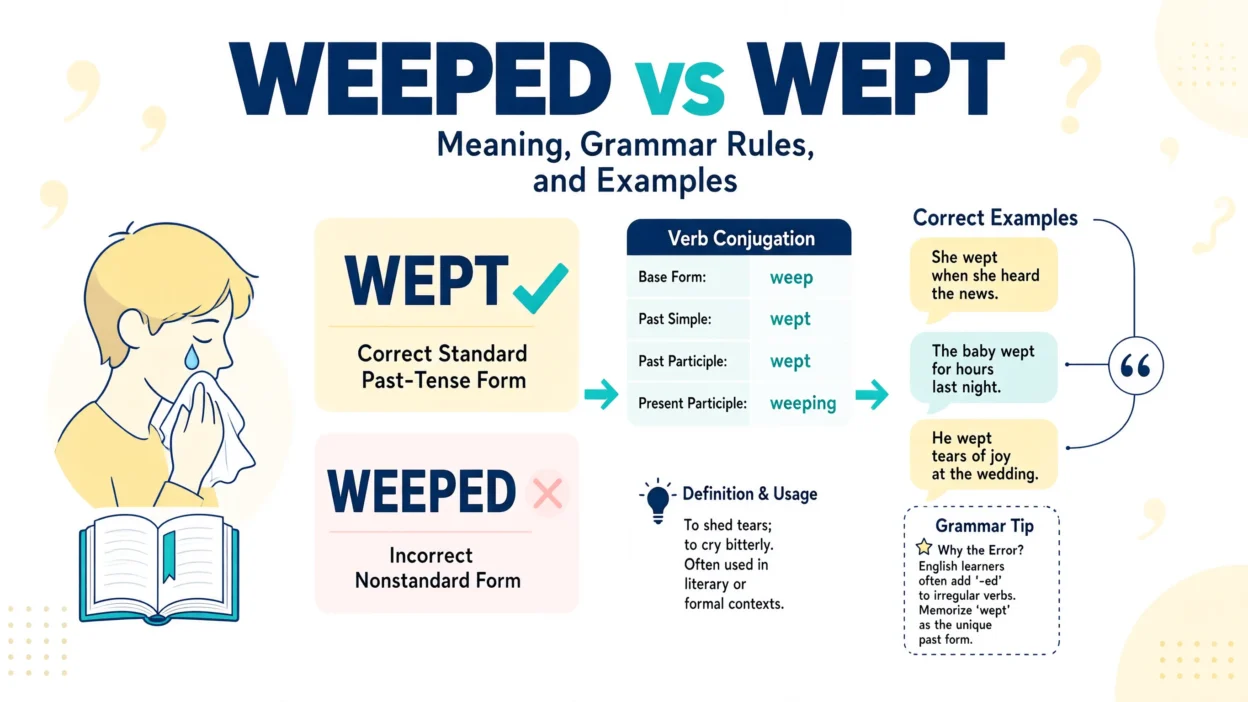
The correct past tense of weep is wept. The word weeped is sometimes formed by applying the regular past-tense rule of adding “-ed,” but it is not the standard form used in modern English. For example, you should write, “She wept when she heard the sad news,” rather than “She weeped when she heard the sad news.”
The verb weep means to cry, shed tears, or express deep sadness. It is an irregular verb, which means its past tense does not follow the usual pattern of adding “-ed” to the base form. Instead, weep changes to wept, just as sleep changes to slept and keep changes to kept.
Learning this pattern can help you use the word correctly in conversations, school assignments, stories, and formal writing. In this guide, you will learn the difference between weeped and wept, see practical examples, and discover an easy way to remember the correct spelling.
Quick Answer: Weeped or Wept?
Wept is the correct standard past tense and past participle of weep. It means cried or shed tears. Weeped is a nonstandard form and should generally be avoided in modern English writing. For example, “The child wept after losing his toy” is correct.
Why Do People Confuse Weeped and Wept?
People often confuse these words because most regular English verbs form their past tense by adding “-ed.” For example, walk becomes walked, and laugh becomes laughed.
However, English also contains irregular verbs that change their form in different ways. Weep belongs to this group, so its standard past tense is wept, not weeped.
The confusion is understandable, especially for English learners who are still learning irregular verb forms.
First Word: Weeped
Weeped is a nonstandard past-tense form of weep. It may appear in learner writing or informal usage, but it is not the accepted standard form for general modern English.
- Word: Weeped
- Part of speech: Verb form
- Intended meaning: Cried or shed tears
- Standard usage: Generally incorrect in edited English
Example of nonstandard usage: “The little girl weeped after the accident.”
Correct version: “The little girl wept after the accident.”
Although adding “-ed” is a common way to form the past tense, it does not work with every English verb. When using weep, remember to use wept in standard writing.
Second Word: Wept
Wept is the standard simple past tense and past participle of weep. It describes crying or shedding tears because of sadness, pain, joy, or another strong emotion.
- Base form: Weep
- Simple past tense: Wept
- Past participle: Wept
- Present participle: Weeping
Examples:
- She wept after hearing the heartbreaking news.
- The man has wept many times over his loss.
- The audience was weeping during the emotional scene.
The word wept often appears in literature, news stories, personal accounts, and everyday English. It can sound more formal or literary than cried, depending on the context.
Weeped vs. Wept: Comparison Table
| Feature | Weeped | Wept |
| Standard form | No | Yes |
| Base verb | Weep | Weep |
| Simple past tense | Nonstandard | Correct |
| Past participle | Nonstandard | Correct |
| Meaning | Intended to mean cried | Cried or shed tears |
| Formal writing | Avoid | Use |
| Example | She weeped. | She wept. |
The main difference: Wept is the correct standard form. Use it whenever you need the past tense or past participle of weep.
When Should You Use Weeped or Wept?
When to Use Wept
Use wept in standard English whenever you describe someone crying in the past or use the past participle with an auxiliary verb.
Examples:
- Simple past: He wept when he said goodbye.
- Present perfect: She has wept over the loss.
- Past perfect: They had wept before the ceremony ended.
- Passive or participial construction: The character was left weeping.
In everyday conversation, you can also use cried when it sounds more natural.
When to Use Weeped
In ordinary modern English, you should generally avoid weeped. If you want to express that someone cried in the past, use wept instead.
If you encounter weeped in a learner’s text or an informal passage, understand that the writer probably intends the past tense of weep. In edited schoolwork, professional writing, and formal communication, choose wept.
12 Examples of Wept in Sentences
These examples show how to use wept correctly in different situations.
- The little boy wept when he lost his favorite toy.
- She wept quietly after reading the letter.
- The family wept when they said their final goodbyes.
- He wept tears of joy at his daughter’s wedding.
- The audience wept during the emotional film.
- The soldier wept when he returned home.
- The child wept because he missed his mother.
- She has wept many times since the difficult news arrived.
- They had wept together before finding the strength to move forward.
- The old man wept as he remembered his childhood.
- I nearly wept when I heard the beautiful song.
- The character wept at the end of the novel.
Notice that wept works whether the emotion is sadness, relief, happiness, or nostalgia.
Common Mistakes With Weeped and Wept
Avoid these frequent errors when writing or speaking English.
Mistake 1: Adding “-ed” to weep
- Incorrect: She weeped all night.
- Correct: She wept all night.
Mistake 2: Using weeped after “has” or “have”
- Incorrect: He has weeped over the incident.
- Correct: He has wept over the incident.
Mistake 3: Using weep instead of wept for a completed past action
- Incorrect: They weep when they heard the news yesterday.
- Correct: They wept when they heard the news yesterday.
Mistake 4: Confusing wept with weeping
- Correct: She wept yesterday.
- Correct: She was weeping when I arrived.
Wept expresses the past action, while weeping is the “-ing” form used in continuous constructions and other grammatical contexts.
Memory Trick: How to Remember Wept
An easy way to remember the correct past tense is to connect weep with two similar irregular verbs:
- Weep → Wept
- Sleep → Slept
- Keep → Kept
All three verbs change their spelling in a similar way.
Memory tip: If you can remember “I slept well” and “I kept my promise,” you can remember “I wept when I heard the news.”
You can also repeat this simple pattern aloud: Weep today, wept yesterday.
American vs. British English: Weeped or Wept?
There is no meaningful difference between standard American and British English for this verb. Both varieties use wept as the standard simple past tense and past participle of weep.
| Variety | Correct form | Example |
| American English | Wept | He wept after the ceremony. |
| British English | Wept | He wept after the ceremony. |
Unlike spelling pairs such as color/colour and organize/organise, this verb does not have separate standard American and British past-tense forms.
Whether you are writing for an American or British audience, use wept.
Similar Words to Weep and Wept
Understanding related words can help you express emotions more naturally.
| Word | Meaning | Example |
| Cry | Shed tears or express emotion | The baby cried loudly. |
| Sob | Cry with broken breaths | She sobbed after the farewell. |
| Wail | Cry out loudly in grief or pain | The child wailed in distress. |
| Whimper | Cry or complain in a soft voice | The puppy whimpered. |
| Mourn | Feel or express grief over a loss | They mourned their friend. |
| Weeping | The act of shedding tears | He was weeping quietly. |
| Wept | Past tense of weep | She wept with relief. |
Although these words are related, they are not exact synonyms in every situation. Sob suggests a particular way of crying, while mourn describes expressing grief or experiencing sorrow after a loss.
Final Verdict: Weeped or Wept?
Wept is correct; weeped is nonstandard in modern English.
Use wept when describing someone who cried in the past or when forming a perfect tense with has, have, or had.
Remember these forms:
- Present: Weep
- Past: Wept
- Past participle: Wept
- Present participle: Weeping
For example, “She wept when she heard the news” is the correct sentence. Whether you are writing an essay, a story, an email, or a social media post, wept is the standard choice.
FAQs:
1. Is weeped a real word?
Weeped can be encountered as a nonstandard formation of the past tense of weep, but it is not the accepted standard form. Use wept in ordinary modern English.
2. Is wept the past tense of weep?
Yes. Wept is the standard simple past tense of weep. For example, “The child wept when his mother left.”
3. Is it weeped or wept in British English?
The correct standard form in British English is wept. British English does not use a different standard past tense for this verb.
4. Is it weeped or wept in American English?
American English also uses wept. For example, “He wept after hearing the sad news” is correct in American English.
5. What is the past participle of weep?
The past participle is wept. It is used with auxiliary verbs in sentences such as “She has wept before” and “They had wept together.”
6. What is the difference between wept and cried?
Both can describe shedding tears. Wept is the past tense of weep and may sound more literary or emotionally expressive. Cried is the past tense of cry and is common in everyday conversation.
7. What are the three forms of the verb weep?
The three principal forms are weep – wept – wept. The first is the base form, the second is the simple past tense, and the third is the past participle.
Remember This
- Weep is the present or base form.
- Wept is the correct past tense.
- Wept is also the correct past participle.
- Weeping is the “-ing” form.
- Weeped is nonstandard and should generally be avoided.
The easiest rule to remember is: Weep today, wept yesterday.
Conclusion
The choice between weeped and wept is simple once you understand irregular verbs. Although many English verbs form their past tense by adding “-ed,” weep follows a different pattern. Its standard past tense and past participle are both wept. Using the correct form helps make your writing clear, natural, and grammatically accurate.
Whenever you describe someone shedding tears in the past, choose wept. Remember the similar patterns sleep–slept and keep–kept to help you recall the spelling. With a little practice, you will be able to use weep, wept, and weeping confidently in everyday conversations, academic assignments, and creative writing.

Lucas Smith is a skilled language writer at Synomity.com, passionate about synonyms, vocabulary enrichment, and word meanings. He develops engaging content that helps readers strengthen communication skills and expand their understanding of language.