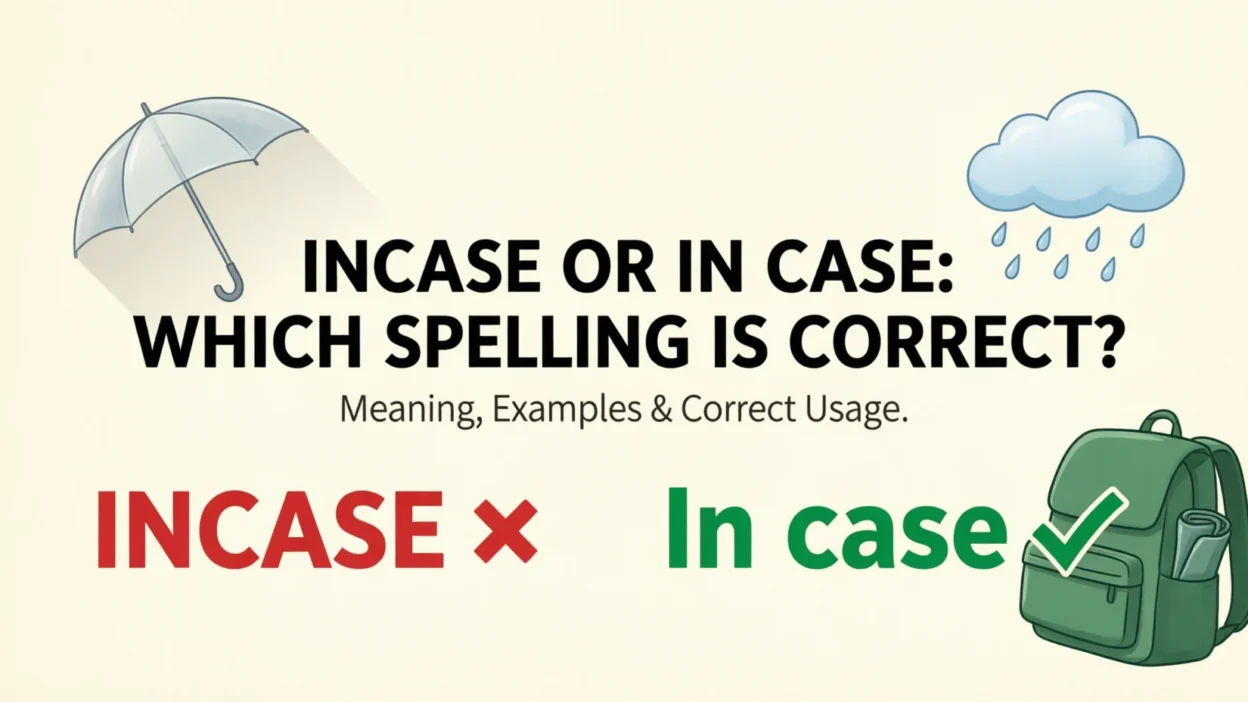
Is it incase or in case? The correct choice in standard English is in case, written as two separate words when you mean “if something happens” or “as a precaution.” For example, “Take an umbrella in case it rains” is correct. Incase is generally considered a misspelling when used with this meaning.
The confusion happens because many English expressions combine words over time, making it easy to assume that in case should also be written as one word. However, spelling the phrase correctly is important in school assignments, emails, professional documents, and everyday writing.
There is also a related verb, encase, which means to cover or enclose something completely. Understanding the difference between in case and encase will help you avoid common spelling mistakes and choose the right expression for your sentence.
Quick Answer
In case is the correct spelling when you mean “if something happens” or “as a precaution.” Write it as two words, as in “Save the receipt in case you need a refund.” Incase is not the standard spelling for this meaning. Do not confuse it with encase, a verb meaning to enclose something.
Why Do People Confuse Incase and In Case?
People confuse incase and in case because the phrase sounds like a single word when spoken naturally. When typing quickly, writers may combine the two words, especially because English contains many compound words.
Another reason is the similarity between in case and encase. Although they look and sound alike, they have different grammatical roles and meanings.
The easiest rule to remember is this: when you mean “if something happens” or “as a precaution,” write in case as two words.
First Word: Incase
Incase is generally an incorrect spelling when someone intends to use the phrase in case. It is not the standard form for expressing a possibility or taking precautions.
- Incorrect: Bring some water incase you get thirsty.
- Incorrect: Save your work incase the computer shuts down.
- Incorrect: Call me incase you need help.
Correct these sentences by separating the words:
- Correct: Bring some water in case you get thirsty.
- Correct: Save your work in case the computer shuts down.
- Correct: Call me in case you need help.
If you want a verb meaning “to enclose,” use encase instead.
Second Word: In Case
In case is a two-word expression used to describe a possible future situation or an action taken as a precaution.
It often means “if something happens,” “if something is needed,” or “to be prepared for a possibility.”
Examples:
- Take a jacket in case it gets cold.
- I saved your number in case I need to contact you.
- Keep some cash in case the card machine does not work.
- Write down the address in case your phone battery dies.
In each example, the action is taken because a particular situation might occur.
Incase vs. In Case: Comparison Table
| Feature | Incase | In Case |
| Standard spelling for this meaning | Incorrect | Correct |
| Number of words | One | Two |
| Meaning | No standard meaning intended here | If something happens; as a precaution |
| Part of speech | Misspelling in this context | Phrase |
| Example | Save it incase it rains. | Save it in case it rains. |
| Recommended use | Avoid for this meaning | Use in standard writing |
Remember that encase is a separate, correctly spelled verb. It means to surround, cover, or enclose something.
Example: “The artist decided to encase the sculpture in glass.”
When to Use Each Word
When Should You Use Incase?
Avoid incase when you want to express a possibility or precaution. In standard English, write in case instead.
For example:
- Incorrect: Bring a charger incase your phone runs out of power.
- Correct: Bring a charger in case your phone runs out of power.
If you encounter incase in a draft, proofread it and separate the words when the intended meaning is “if something happens.”
When Should You Use In Case?
Use in case when you prepare for something that might happen or take an action because a situation is possible.
Examples:
- Carry an umbrella in case it rains.
- Keep a copy of the document in case you lose the original.
- I will leave early in case there is traffic.
- Take my phone number in case you need to call me.
You can often understand the phrase by replacing it with “if” or “as a precaution,” although the exact wording may change.
What About Encase?
Use encase when you mean to surround or cover something completely.
Examples:
- The jeweler will encase the stone in protective material.
- The fossil was encased in rock.
- The display case will encase the valuable artifact.
This word is not interchangeable with in case.
12 Examples of In Case in Sentences
Here are practical examples showing how to use in case correctly in everyday English.
- Take an umbrella in case it rains.
- I packed an extra shirt in case I spill something.
- Save this phone number in case you need assistance.
- Bring some snacks in case you get hungry.
- Leave early in case the roads are busy.
- Keep your receipt in case you need to return the item.
- I downloaded the map in case the internet stops working.
- Take a bottle of water in case you feel thirsty.
- Write down the password in case you forget it.
- Keep a flashlight nearby in case the electricity goes out.
- I brought some cash in case the shop does not accept cards.
- She saved a copy of the report in case the original was lost.
Examples of In Case at the Beginning of a Sentence
The phrase can also appear at the beginning of a sentence.
- In case you need help, call me.
- In case the weather changes, bring a warm jacket.
- In case anyone asks, I will be at the library.
These sentences are correct because in case introduces a possible situation.
Examples of Encase
To understand the difference more clearly, compare these examples:
- The museum will encase the ancient object in glass.
- Thick ice seemed to encase the entire lake.
- The manufacturer designed a shell to encase the electronic components.
In each sentence, encase means to surround or enclose something.
Common Mistakes With Incase and In Case
Even though the difference is simple, writers sometimes make several related mistakes.
1. Joining the words together
Incorrect: “Bring your ID incase they ask for it.”
Correct: “Bring your ID in case they ask for it.”
2. Confusing in case with encase
Incorrect: “Take an extra key to encase you lose yours.”
Correct: “Take an extra key in case you lose yours.”
3. Using in case when you mean because
“In case” refers to a possibility or precaution, not simply the reason something happened.
For example:
- “I brought a jacket in case it got cold” means I prepared for the possibility of cold weather.
- “I brought a jacket because it was cold” means the cold weather was the reason I brought it.
4. Confusing in case with just in case
Both are correct. Just in case adds emphasis to the idea of taking a precaution.
Example: “I packed an extra battery just in case.”
5. Assuming every similar-sounding expression is one word
English has expressions that are written as one word and others that remain separate. Learn the conventional spelling of each expression instead of relying on sound alone.
Memory Trick: How to Remember In Case
Use this simple memory trick:
In case = in preparation for a possibility.
Imagine carrying an umbrella because rain might happen. You carry it in case it rains.
Another way to remember the spelling is to picture two separate words:
- IN + CASE = a possible situation or precaution.
- ENCASE = to enclose something.
Try completing these sentences:
- Take a jacket ___ it gets cold.
- Save your work ___ the computer crashes.
- The artist will ___ the sculpture in glass.
Answers: in case, in case, and encase.
The trick is to remember both the meaning and the spelling. If you are preparing for something that might happen, use two words: in case.
American vs. British English: Is There a Difference?
There is no spelling difference between American and British English for in case. Both varieties use two words when expressing a precaution or possibility.
| Variety of English | Correct form | Example |
| American English | In case | Bring a coat in case it gets cold. |
| British English | In case | Bring a coat in case it gets cold. |
| Australian English | In case | Bring a coat in case it gets cold. |
| Canadian English | In case | Bring a coat in case it gets cold. |
The verb encase is also spelled the same way in these varieties.
Whether you are writing an American school assignment, a British business email, or an Australian blog post, use in case as two words when you mean “if something happens.”
Similar Words and Expressions
Several English words and phrases are related to in case, but they do not always have the same meaning.
1. In Case vs. Just in Case
Both expressions describe preparation for a possible situation. Just in case often emphasizes caution.
- In case: Take some water in case you get thirsty.
- Just in case: I packed an extra bottle, just in case.
2. In Case vs. If
Both can refer to possible situations, but they are used differently depending on the sentence.
- In case: Take an umbrella in case it rains.
- If: If it rains, take an umbrella.
The first sentence focuses on preparation. The second states what to do if the condition occurs.
3. In Case vs. Because
In case expresses a possibility, while because introduces a reason.
- In case: I saved the file in case the computer crashed.
- Because: I saved the file because the computer was crashing.
The first sentence describes a precaution. The second explains a reason.
4. In Case vs. In the Event That
In the event that is a more formal expression that can replace in case in some contexts.
- In case of an emergency, call for help.
- In the event that an emergency occurs, call for help.
The second version sounds more formal and is often suitable for official instructions.
5. In Case vs. Encase
These expressions have different grammatical functions.
- In case: Keep a backup in case the original is lost.
- Encase: The manufacturer will encase the device in plastic.
The first refers to a possible event; the second means to enclose something.
Final Verdict: Incase or In Case?
In case is the correct spelling when you mean “if something happens” or “as a precaution.” It must be written as two words in standard English.
Incase is generally a misspelling of this expression. However, encase is a valid verb meaning to surround or enclose something.
Remember these three forms:
- In case: Prepare for a possibility.
- Incase: Incorrect spelling for this meaning.
- Encase: Enclose or surround something.
Once you understand these meanings, choosing the right form becomes much easier.
FAQs:
1. Is it incase or in case?
In case is correct when you mean “if something happens” or “as a precaution.” Write it as two separate words, as in “Bring a jacket in case it gets cold.”
2. Is incase one word or two?
When expressing a precaution or possibility, the correct form is two words: in case. The one-word spelling incase is generally incorrect for this meaning.
3. Does incase have a meaning?
Incase is not the standard spelling of the common expression in case. The similar word encase is correct and means to cover, surround, or enclose something.
4. What is the difference between in case and encase?
In case refers to a possible situation or precaution. Encase is a verb meaning to surround or enclose something. For example, “Take a coat in case it rains” and “The artist will encase the object in glass.”
5. Is in case correct in American and British English?
Yes. Both American and British English use in case as two words when referring to a possibility or precaution. The spelling does not change between the two varieties.
6. How do you use in case in a sentence?
Use in case when taking action because something might happen. For example, “I saved a copy of the document in case I need it later.”
7. Is just in case grammatically correct?
Yes. Just in case is a common and grammatically correct expression that emphasizes precaution. For example, “I brought an extra pen just in case.”
Remember This
- In case is correct when referring to a possibility or precaution.
- Incase is generally a spelling mistake in this context.
- Encase is a real verb meaning to surround or enclose something.
- In case has the same spelling in American and British English.
- Use just in case when you want to emphasize being prepared.
Conclusion
Choosing between incase and in case is straightforward once you understand the difference. When you mean “if something happens” or “as a precaution,” always write in case as two separate words. This is the standard form used in everyday conversations, academic writing, emails, and professional documents.
Remember that encase is a different word with its own meaning: to surround or enclose something. Practicing these forms with simple sentences will help you avoid common spelling mistakes and communicate more clearly. When in doubt, ask yourself if you mean preparing for a possibility or enclosing an object. That quick check will help you choose the correct expression.

John Morrison is a dedicated content writer at Synomity.com, focused on synonyms, vocabulary development, and word meanings. He creates clear, educational resources that help readers improve language skills and communicate with confidence.