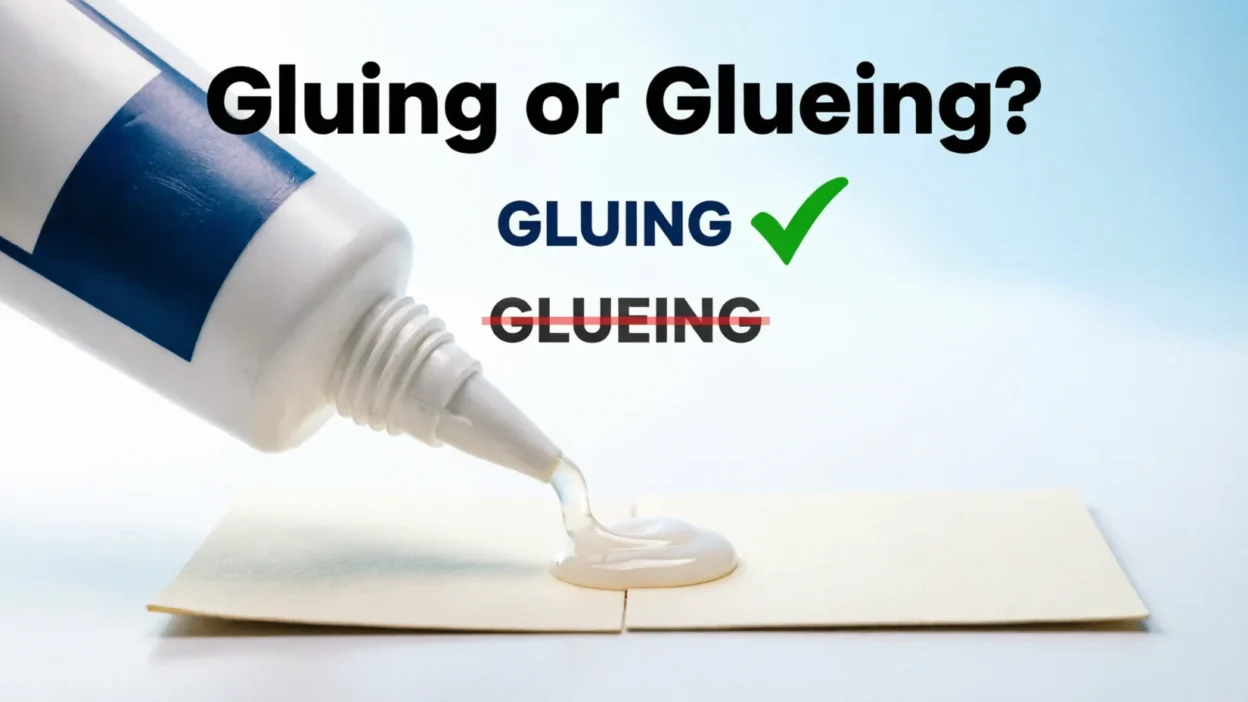
When you want to describe the action of attaching something with glue, you may wonder if the correct spelling is “gluing” or “glueing.” The standard and widely accepted spelling is gluing. For example: “She is gluing the pieces of paper together.” The word gluing is the present participle or gerund form of the verb glue.
This spelling can seem confusing because many English verbs ending in a silent e drop the final e before adding -ing, while some words follow different spelling patterns.
Understanding this rule makes it easier to remember why gluing is preferred over glueing. In this guide, you will learn the difference between gluing and glueing, which form to use, examples in everyday English, and how American and British English treat the word.
Quick Answer
Gluing is the standard spelling of the -ing form of glue. The final e is normally dropped before adding -ing: glue → gluing. Glueing is generally considered a nonstandard or less common spelling, so use gluing in normal writing.
Why Do People Confuse It?
The confusion happens because the base word is glue, which ends in the letter e. When people add -ing, they may simply combine the two parts:
glue + ing = glueing
However, English spelling rules usually remove a final silent e before adding -ing:
- make → making
- write → writing
- use → using
- bake → baking
- glue → gluing
Therefore:
glue → gluing
The spelling glueing looks logical at first, but gluing is the standard form you should normally choose.
First Word: Gluing
Gluing is the standard spelling.
It is formed by removing the final e from glue and adding -ing:
glue + ing → gluing
The word can function as a present participle or gerund.
Examples
- I am gluing the pieces together.
- She is gluing pictures into her notebook.
- He spent the afternoon gluing cardboard.
- They are gluing the broken parts back together.
Second Word: Glueing
Glueing is a spelling that you may occasionally encounter, but it is not the usual standard form in modern general English.
Some dictionaries or historical texts may record glueing, and you might also see it in informal writing. However, for schoolwork, professional writing, websites, emails, and everyday English, gluing is the safer and more conventional choice.
So, if you are unsure, remember:
Use “gluing,” not “glueing.”
Gluing vs Glueing: Comparison Table
| Feature | Gluing | Glueing |
|---|---|---|
| Base word | glue | glue |
| Formation | glue + -ing | glue + -ing |
| Standard modern spelling | Yes | Generally no |
| Common in everyday English | Very common | Uncommon |
| Suitable for formal writing | Yes | Usually avoid |
| Example | She is gluing paper. | She is glueing paper. |
When Should You Use Each?
Use “gluing”
Use gluing whenever you need the -ing form of glue.
Examples:
- The children are gluing their projects.
- I am gluing the label onto the box.
- She enjoys gluing craft materials together.
What about “glueing”?
In normal modern English, it is better to avoid glueing and use gluing instead.
If you are editing an old document or quoting a historical source, you may encounter glueing, but that does not make it the preferred spelling for your own writing.
10+ Examples of “Gluing”
Here are practical examples showing how gluing works in sentences:
- I am gluing the paper to the cardboard.
- She is gluing a photo into her scrapbook.
- The students are gluing colorful shapes onto the poster.
- He is gluing the broken toy back together.
- We spent an hour gluing the model pieces together.
- They are gluing decorations onto the gift box.
- She enjoys gluing craft materials during art class.
- Be careful while gluing the small pieces.
- I finished gluing the final part of the project.
- The teacher showed us how to avoid excess glue when gluing paper.
- He is gluing the pieces in the correct position.
- The children were gluing leaves onto their art project.
Common Mistakes
One common mistake is writing glueing simply because the base word is glue.
Incorrect or nonstandard in ordinary modern usage:
I am glueing the pieces together.
Standard:
I am gluing the pieces together.
Another mistake is assuming that every verb keeps its final e before -ing. In many common verbs, the final silent e is removed:
- hope → hoping
- smile → smiling
- drive → driving
- write → writing
- glue → gluing
Learning these patterns can make English spelling much easier.
Memory Trick
Here is a simple way to remember the spelling:
Glue loses its “e” when “-ing” comes in.
Think of it like this:
GLUE → GLU + ING → GLUING
You can also remember the sentence:
This is not a rule that applies to every English word without exceptions, but it works well for glue → gluing.
American vs British English
Both American and British English generally use gluing as the standard spelling.
There is no major American-versus-British spelling difference here like there is with words such as:
- color / colour
- center / centre
- traveled / travelled
For standard everyday writing in either variety, choose:
gluing
If you are writing for an international audience, gluing is also the clearest choice.
Similar Words
Understanding related forms can help reinforce the spelling.
Glue
The base verb or noun.
Example:
“Please glue the pieces together.”
Glued
The past tense and past participle.
Example:
“She glued the picture to the page.”
Gluing
The present participle or gerund.
Example:
“She is gluing the picture to the page.”
Glue
As a noun, it means a substance used to join things together.
Example:
“The glue is on the table.”
So the basic word family is:
glue → glued → gluing
Final Verdict
The standard spelling is gluing.
When you need the -ing form of glue, drop the final e and add -ing:
glue → gluing
While glueing can sometimes be found in dictionaries, older texts, or less common usage, gluing is the normal spelling to use in modern everyday and formal English.
FAQs:
Is “gluing” or “glueing” correct?
Gluing is the standard spelling used in modern English. It is the -ing form of the verb glue, formed by dropping the final e before adding -ing.
Why is it “gluing” instead of “glueing”?
The final silent e in glue is normally removed before -ing is added. Therefore, glue + ing becomes gluing, not glueing.
Is “glueing” a word?
Glueing can be found in some sources and historical usage, but it is uncommon compared with gluing. For ordinary modern English writing, gluing is the preferred spelling.
Is “gluing” correct in American English?
Yes. Gluing is the standard form in American English.
Is “gluing” correct in British English?
Yes. British English also normally uses gluing.
What is the past tense of glue?
The past tense is glued.
Example: “She glued the pieces together.”
What is the present participle of glue?
The present participle is gluing.
Example: “She is gluing the pieces together.”
What is the easiest way to remember “gluing”?
Remember the spelling pattern:
glue + ing = gluing
The final e is dropped before -ing.
Remember This
Gluing = standard modern spelling.
Glueing = uncommon/nonstandard for ordinary modern usage.
The word family is:
Glue → Glued → Gluing
If you are writing an essay, email, school assignment, article, or social media post, gluing is the spelling you should normally use.
Conclusion
The difference between gluing and glueing is mainly a matter of spelling formation. The standard modern form is gluing, which comes from glue by removing the final e before adding -ing. This follows a common English spelling pattern found in words such as making, writing, and using.
Although you may occasionally see glueing, especially in older or less common sources, gluing is the natural choice for modern English. If you use American or British English, the standard spelling remains the same. When in doubt, simply remember: glue → glued → gluing.