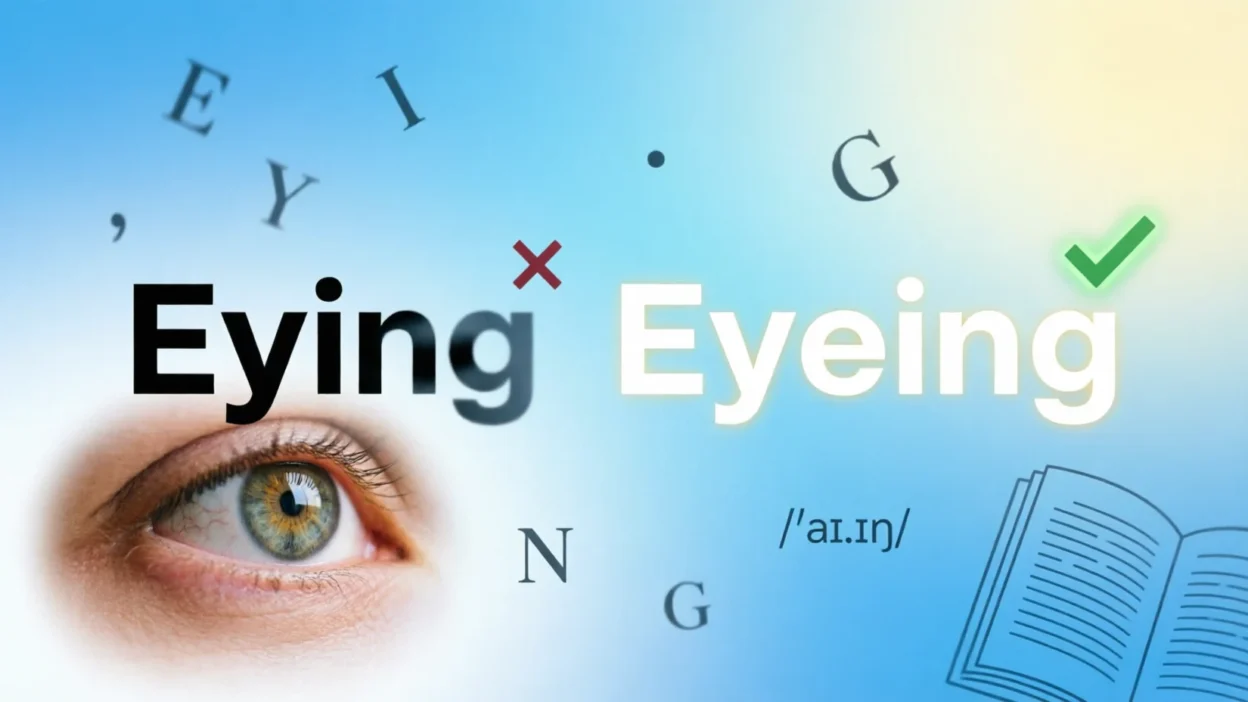
When you want to describe looking at someone or something closely, the correct spelling is usually “eyeing.” For example, “She was eyeing the chocolate cake.” The spelling “eying” also exists, but it is uncommon and generally not the preferred form in modern standard English.
The confusion happens because the verb “eye” already ends in the letter e. When adding -ing, English spelling rules can make the result look unusual.
Understanding the difference between eyeing and eying can help you avoid mistakes in writing, schoolwork, emails, and everyday communication. This guide explains both forms, when to use them, and provides simple examples so you can remember the correct spelling easily.
Quick Answer
“Eyeing” is the standard and most common spelling when you mean looking at someone or something with interest, attention, suspicion, or desire. “Eying” is a less common variant. In normal modern English, especially for learners and general writing, eyeing is the safer choice.
Why Do People Confuse It?
The confusion comes from the verb eye, which means to look at or watch someone or something carefully.
When -ing is added, you might expect the final e to disappear, producing eying. However, eye is an unusual verb because keeping the e makes the pronunciation and meaning clearer.
So:
- eye + ing = eyeing
- Eying is also found as a variant, but it is much less common.
- Eyeing is the form most readers expect.
First Word: Eyeing
Eyeing is the present participle or gerund form of the verb eye.
To eye something means to look at it carefully, often because you are interested in it, considering it, suspicious of it, or attracted to it.
Examples:
- He was eyeing the last piece of pizza.
- She kept eyeing the new phone.
- The cat was eyeing the bird.
- I noticed him eyeing my new shoes.
The word can describe a neutral look, but it often suggests interest, attention, desire, or suspicion.
Second Word: Eying
Eying is an alternative spelling of the present participle of eye. It appears in some dictionaries and published writing, but it is considerably less common than eyeing.
For English learners, eyeing is generally the easiest and most recognizable spelling to use.
For example:
This looks natural to most modern English readers.
Eyeing vs. Eying: Comparison Table
| Feature | Eyeing | Eying |
|---|---|---|
| Base verb | Eye | Eye |
| Meaning | Looking at carefully | Looking at carefully |
| Commonness | Very common | Much less common |
| Standard everyday choice | Yes | Usually avoid |
| Example | He is eyeing the car. | He is eying the car. |
| Best for learners | Yes | No |
When Should You Use Each?
Use “Eyeing” in Most Situations
Choose eyeing when writing everyday English.
Example:
“Tom is eyeing the expensive watch.”
It can describe someone looking at something because they want it, are interested in it, or are watching it carefully.
When Might You See “Eying”?
You may encounter eying in dictionaries, older texts, or writing that follows a particular spelling preference. It is not necessarily incomprehensible or grammatically impossible, but it is far less familiar to many readers.
If you are unsure, choose eyeing.
10+ Examples of “Eyeing”
- She was eyeing the beautiful dress in the window.
- He kept eyeing the plate of cookies.
- The dog was eyeing the food on the table.
- They were eyeing a house near the beach.
- I caught him eyeing my new laptop.
- The children were eyeing the toys.
- She sat quietly, eyeing the strange object.
- He was eyeing the empty seat.
- The player was eyeing the goal.
- My brother is eyeing a new bicycle.
- The cat sat there, eyeing the fish.
- She was eyeing the cake but decided not to eat it.
Common Mistakes
Mistake 1: Assuming the Final “e” Must Disappear
Many learners know that verbs ending in e often drop the e before -ing:
- make → making
- take → taking
- write → writing
Because of this, they may automatically write eying.
However, eye is an exception-like spelling where eyeing is the much more common form.
Mistake 2: Thinking “Eyeing” Is a Different Word
Eyeing and eying are not normally different in meaning. The main difference is spelling preference and frequency.
Mistake 3: Using “Seeing” Instead
Eyeing does not simply mean seeing.
- Seeing = noticing or perceiving something with your eyes.
- Eyeing = looking at something deliberately or attentively.
Compare:
The second sentence suggests deliberate attention toward the bird.
Memory Trick
Think:
EYE + ING = EYEING 👀
Imagine the word EYE staying visible while -ING is added:
EYE → EYEING
A simple memory sentence is:
This can help you remember the spelling.
American vs. British English
In both American and British English, eyeing is the familiar and widely used spelling.
The basic meaning is the same in both varieties:
You may encounter eying in some British or American sources, but eyeing remains the more recognizable choice for general writing.
Similar Words
Several words can express related ideas, but they are not exact replacements for eyeing.
- Looking at — directing your eyes toward something.
- Watching — observing something for a period of time.
- Staring — looking at something continuously, often intensely.
- Glancing — looking quickly.
- Observing — watching carefully, often to understand something.
- Inspecting — examining something closely.
- Noticing — becoming aware of something.
- Gazing — looking steadily, often with admiration or thoughtfulness.
For example:
This can suggest that she was interested in or tempted by the cake, rather than simply seeing it.
Final Verdict
For ordinary modern English, eyeing is the spelling to choose.
Eyeing means looking at someone or something with attention, interest, desire, or suspicion. Eying can be found as a variant, but it is much less common.
If you’re writing an essay, email, social media post, school assignment, or everyday message, eyeing is the clear and familiar choice.
FAQs:
Is “eying” a correct word?
Yes, eying is found as a variant spelling of the present participle of eye, but it is much less common than eyeing.
Is “eyeing” grammatically correct?
Yes. Eyeing is the standard present participle and gerund form commonly used from the verb eye.
What does “eyeing” mean?
Eyeing means looking at someone or something carefully or deliberately, often because of interest, desire, curiosity, or suspicion.
Which is more common: eyeing or eying?
Eyeing is much more common in general modern English. It is therefore the better choice for most everyday and formal writing.
Why does eye become eyeing instead of eying?
The spelling eyeing preserves the recognizable form of the base word eye. Although many verbs ending in e drop the final e before -ing, eye commonly keeps it.
Is “eyeing” the same as “looking”?
They are related but not identical. Eyeing usually suggests deliberate or attentive looking, while looking has a much broader meaning.
Can I use “eying” in an essay?
You may encounter eying as a recognized variant, but eyeing is the more familiar choice and is generally preferable for clear modern writing.
What is the past tense of “eye”?
The simple past tense is eyed.
Example:
“She eyed the painting carefully.”
Remember This
Eyeing = the preferred everyday spelling. 👀
Remember:
EYE + ING = EYEING
If you mean looking at something carefully, especially with interest or attention, eyeing is usually the spelling you want.
Conclusion
The difference between eyeing and eying is mainly a matter of spelling preference and usage frequency rather than meaning. Both forms can refer to looking at someone or something, but eyeing is considerably more common and recognizable in modern English.
For students, ESL learners, and anyone who wants clear everyday writing, choosing eyeing is the simplest approach. If you are describing someone looking at a delicious meal, an attractive product, a suspicious object, or a potential opportunity, eyeing communicates the idea naturally and clearly.

John Morrison is a dedicated content writer at Synomity.com, focused on synonyms, vocabulary development, and word meanings. He creates clear, educational resources that help readers improve language skills and communicate with confidence.