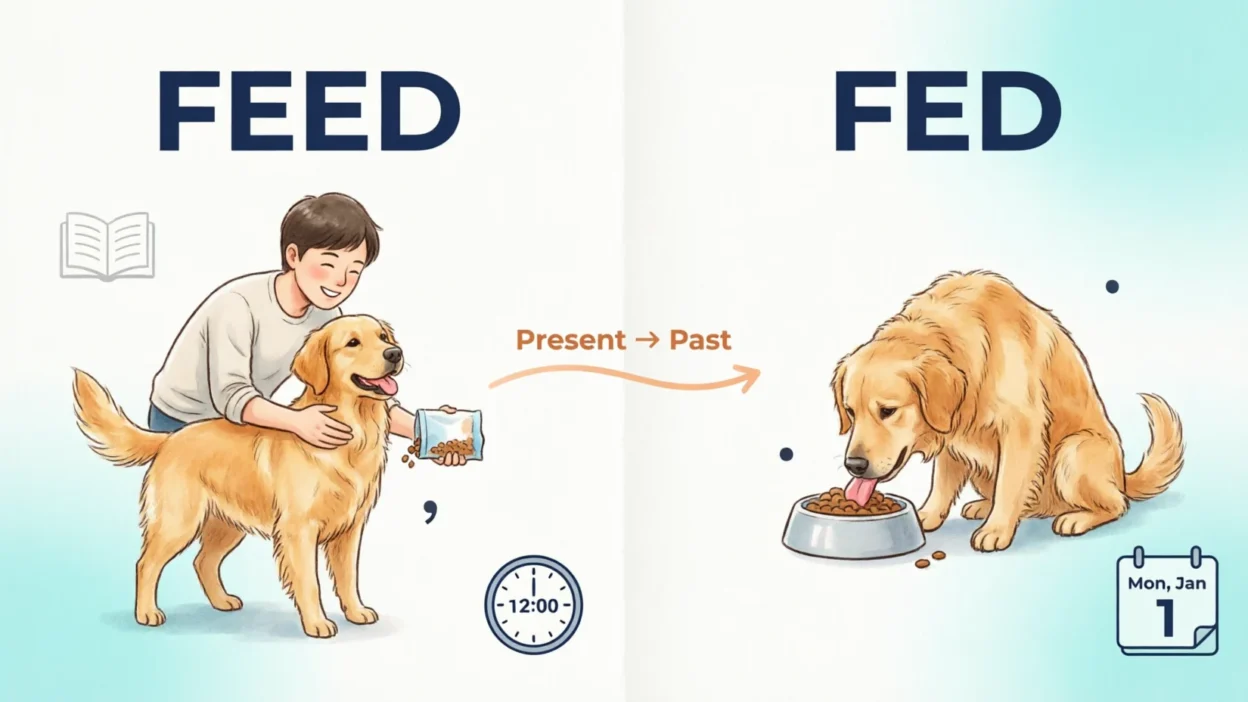
Have you ever wondered if to use feed or fed in a sentence? These two words are forms of the same English verb, but they are used at different times. Understanding the difference will help you write more accurately, speak confidently, and avoid common grammar mistakes. If you are learning English, writing an assignment, or improving your everyday communication, knowing when to use feed and fed is essential.
The main difference is simple: feed is the base form of the verb, while fed is its past tense and past participle. Use feed when talking about the present, giving instructions, or describing an action that will happen in the future. Use fed when describing something that happened in the past or when forming certain perfect tenses.
For example, “I feed my cat every morning” describes a regular routine, while “I fed my cat yesterday” describes a completed past action. Once you learn this rule, choosing between feed and fed becomes much easier.
Quick Answer: Feed vs. Fed
Feed is the base form of the verb meaning to give food to a person or animal, or to supply something with what it needs. Fed is the past tense and past participle of feed. Say “I feed the dog every day” for a routine and “I fed the dog yesterday” for a past action.
Why Do People Confuse Feed and Fed?
People sometimes confuse feed and fed because both words describe the same basic action: providing food or nourishment. The difference is not in the meaning of the action itself but in the verb form and the time or grammatical structure of the sentence.
Feed is an irregular verb, which means its past tense does not follow the usual pattern of adding -ed to the base form. Instead, feed changes to fed.
For example:
- Present: I feed the birds every morning.
- Past: I fed the birds yesterday.
- Present perfect: I have fed the birds already.
Learning these forms will help you use the verb correctly in everyday conversations and written English.
1. What Does Feed Mean?
Feed is the base form of a verb that means to give food to someone or something. It can also mean supplying a person, animal, machine, or system with something it needs.
The word can be used in the present tense, after modal verbs such as will and can, and in the infinitive form to feed.
Examples of Feed
- I feed my cat twice a day.
- They feed the chickens every morning.
- Please feed the baby before leaving.
- We need to feed the guests at noon.
- Farmers feed their animals nutritious food.
How to Use Feed in a Sentence
Use feed when describing a current habit, a general fact, an instruction, or an action that has not yet happened.
For regular habits:
- She feeds her dog before work.
- I feed the fish every evening.
For instructions:
- Feed the baby slowly.
- Please feed the horses before sunset.
For future actions:
- I will feed the animals tomorrow.
- We are going to feed the children soon.
Remember that with he, she, or it in the simple present tense, the verb usually becomes feeds.
2. What Does Fed Mean?
Fed is the past tense and past participle of feed. It describes an action that happened in the past or is used with helping verbs to form perfect tenses and passive constructions.
Examples of Fed
- I fed my dog this morning.
- She fed the baby an hour ago.
- They fed the horses before the storm.
- We have fed everyone already.
- The animals were fed before sunrise.
How to Use Fed in a Sentence
Use fed when the action happened in the past or when the grammar of the sentence requires the past participle.
For completed past actions:
- He fed the birds yesterday.
- I fed my younger brother after school.
With have, has, or had:
- I have fed the cat already.
- She has fed the children.
- They had fed the animals before the guests arrived.
In passive sentences:
- The dog was fed by its owner.
- The children were fed before the trip.
The key rule is that fed is the correct past form of feed. Do not write feeded in standard English.
Feed vs. Fed: Comparison Table
| Feature | Feed | Fed |
| Verb form | Base form | Past tense and past participle |
| Main use | Present, instructions, infinitives, future with auxiliaries | Past actions and perfect or passive constructions |
| Example | I feed my cat daily. | I fed my cat yesterday. |
| With “will” | I will feed the dog. | Not “will fed” |
| With “have” | Not “have feed” in standard perfect constructions | I have fed the dog. |
| With “to” | To feed the animals | Not “to fed” |
| Regular or irregular? | Base form of an irregular verb | Irregular past form |
The most important distinction is that feed is the base form, while fed is the past tense and past participle.
When Should You Use Feed or Fed?
Choosing the right form depends on when the action happens and how the sentence is structured.
Use Feed for Present Habits and General Statements
Choose feed when talking about routines or using the base form after words such as to, will, can, or must.
Examples:
- I feed my dog every morning.
- We feed the ducks at the park.
- You should feed the baby before bedtime.
- She will feed the rabbits later.
Remember that the third-person singular present form is feeds: “He feeds the cat every night.”
Use Fed for Past Actions
Choose fed when an action happened and was completed in the past.
Examples:
- I fed the dog last night.
- She fed the baby before leaving.
- They fed the chickens yesterday morning.
Words such as yesterday, last night, and two hours ago often signal that the simple past tense is needed.
Use Fed With Perfect Tenses
Use fed after have, has, or had when forming the perfect tenses.
Examples:
- I have fed the animals.
- He has fed the baby already.
- We had fed everyone before the meeting started.
Use Fed in Passive Sentences
Use fed when the subject receives the action rather than performing it.
Examples:
- The cat was fed by its owner.
- The children were fed before the journey.
- The animals have been fed.
12 Examples of Feed and Fed in Sentences
These examples show how the two verb forms work in everyday English.
- Feed: I feed my dog every morning before work.
- Fed: I fed my dog before leaving home yesterday.
- Feed: Please feed the fish while I am away.
- Fed: She fed the birds in the garden this morning.
- Feed: Farmers feed their cattle fresh grass.
- Fed: The farmer fed the cattle before sunset.
- Feed: We will feed the guests after the ceremony.
- Fed: They fed all the guests at the wedding.
- Feed: You should feed your pet according to its needs.
- Fed: I have fed the kitten, so it should be comfortable now.
- Feed: He needs to feed the horses before the ride.
- Fed: The horses had been fed before we arrived.
Notice how feed appears in the base form, while fed is used for past actions and specific verb constructions.
Common Mistakes With Feed and Fed
Although the rule is straightforward, several errors are common among English learners.
Mistake 1: Saying “Feeded” Instead of “Fed”
Incorrect: I feeded the dog yesterday.
Correct: I fed the dog yesterday.
Why? Feed is an irregular verb. Its past tense is fed, not feeded.
Mistake 2: Using Fed After “Will”
Incorrect: I will fed the cat later.
Correct: I will feed the cat later.
Why? After the modal verb will, use the base form of the main verb.
Mistake 3: Using Feed After “Have”
Incorrect: I have feed the animals.
Correct: I have fed the animals.
Why? The present perfect tense uses have or has followed by the past participle, which is fed.
Mistake 4: Using Fed After “To”
Incorrect: I need to fed the baby.
Correct: I need to feed the baby.
Why? The infinitive uses to followed by the base form of the verb.
Mistake 5: Forgetting “Feeds” in the Simple Present
Incorrect: She feed the cat every day.
Correct: She feeds the cat every day.
Why? In the simple present tense, verbs generally take an -s ending with he, she, or it.
An Easy Memory Trick for Feed vs. Fed
Here is a simple way to remember the difference:
Feed = now, routine, or base form.
Fed = past action or past participle.
Think of this example:
- Today, I feed my dog.
- Yesterday, I fed my dog.
You can also memorize the three main forms of this irregular verb:
Feed → Fed → Fed
- Base form: feed
- Simple past: fed
- Past participle: fed
Practice saying “I feed,” “I fed,” and “I have fed.” These short examples help you remember which form belongs in each sentence.
Feed vs. Fed in American and British English
There is no spelling difference between feed and fed in American and British English. Both varieties use the same irregular verb forms and follow the same basic grammar rules.
| Situation | American English | British English |
| Present routine | I feed the dog daily. | I feed the dog daily. |
| Past action | I fed the dog yesterday. | I fed the dog yesterday. |
| Present perfect | I have fed the dog. | I have fed the dog. |
| Future action | I will feed the dog. | I will feed the dog. |
You can use feed and fed confidently in either variety of English.
Similar Words That Are Easy to Confuse
English has several irregular verbs whose forms can be confusing. Learning their patterns can improve your grammar.
Eat vs. Ate
- Eat: Base form — I eat breakfast every morning.
- Ate: Past tense — I ate breakfast yesterday.
Give vs. Gave
- Give: Base form — I give my dog fresh water.
- Gave: Past tense — I gave my friend a gift.
Lead vs. Led
- Lead: Base form, pronounced with a long “ee” sound — I lead the team.
- Led: Past tense — I led the team last year.
Read vs. Read
The spelling stays the same, but the pronunciation changes.
- Read (present): I read every day. Pronounced like “reed.”
- Read (past): I read that book yesterday. Pronounced like “red.”
Bring vs. Brought
- Bring: Base form — Please bring your notebook.
- Brought: Past tense — She brought her notebook yesterday.
Like feed and fed, these pairs require you to choose the correct form according to the sentence.
Final Verdict: Which One Is Correct?
Both feed and fed are correct, but they serve different grammatical purposes.
Use feed for the base form, present habits, instructions, and future actions with helping verbs. Use fed for completed past actions and as the past participle in perfect tenses and passive constructions.
For example:
- Correct: I feed my cat every morning.
- Correct: I fed my cat yesterday.
- Correct: I have fed my cat already.
Remember the irregular verb pattern: feed, fed, fed. Avoid feeded, and always check whether your sentence requires the base form or a past form.
FAQs:
1. Is it feed or fed?
Both are correct forms of the verb. Feed is the base form, while fed is the simple past tense and past participle. Use feed for present routines or after will, and use fed for past actions or after have and has.
2. Is “feeded” a correct English word?
No. In standard English, the past tense of feed is fed, not feeded. For example, say “I fed the dog yesterday,” rather than “I feeded the dog yesterday.”
3. What is the past tense of feed?
The past tense of feed is fed. For example, “I feed my cat every morning” describes a routine, while “I fed my cat this morning” describes a past action.
4. What is the past participle of feed?
The past participle of feed is also fed. It is used in perfect tenses and passive constructions, as in “I have fed the animals” and “The animals were fed before noon.”
5. Should I say “I have feed” or “I have fed”?
Say “I have fed.” The present perfect tense requires have or has followed by the past participle. Since the past participle of feed is fed, “I have feed” is incorrect in standard English.
6. Is it “will feed” or “will fed”?
The correct phrase is “will feed.” Modal verbs such as will, can, and should are followed by the base form of the main verb. For example, “I will feed the dog later.”
7. Are feed and fed used differently in British and American English?
No. Feed and fed have the same spelling, meaning, and basic grammatical usage in both American and British English.
Remember This
- Feed is the base form of the verb.
- Fed is both the simple past tense and past participle.
- Say “I feed the dog daily.”
- Say “I fed the dog yesterday.”
- Say “I have fed the dog already.”
- Never use feeded in standard English.
The easiest way to remember the rule is: Feed → Fed → Fed.
Conclusion
Understanding the difference between feed and fed is an important step toward using English verbs correctly. Feed is the base form used for routines, instructions, and future actions with helping verbs. Fed is the past tense and past participle used for completed actions, perfect tenses, and passive sentences. Knowing these forms will help you communicate more clearly in both writing and conversation.
Whenever you are unsure which form to use, think about the time and structure of your sentence. If you are describing a routine, use feed or feeds as appropriate. If the action happened in the past, use fed. With regular practice and the examples in this guide, you can confidently choose the correct form and avoid common mistakes.

Evelyn Mia is a passionate language writer and vocabulary enthusiast at Synomity.com, specializing in synonyms, word meanings, and language learning. She creates informative content that helps readers expand vocabulary and communicate more effectively.