
Have you ever wondered if to write “whose” or “who’s” in a sentence? These two words sound exactly the same, but they have different meanings and grammatical uses. Choosing the correct one can make your writing clearer and help you avoid common spelling mistakes in emails, school assignments, essays, and everyday conversations.
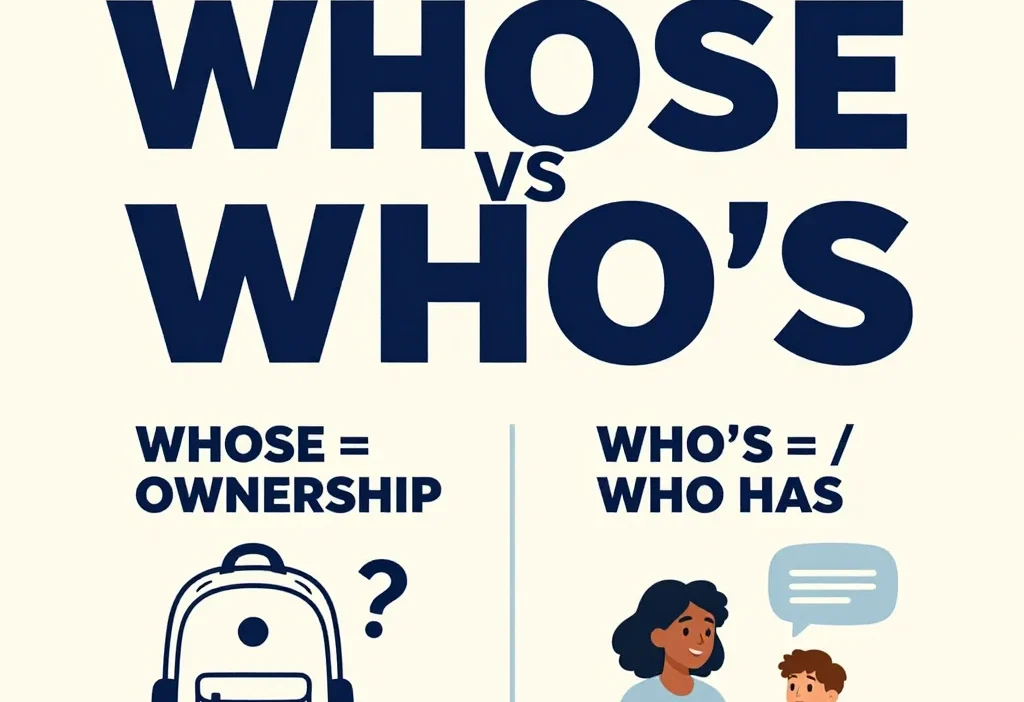
The main difference is simple: “whose” shows possession, while “who’s” is a contraction of “who is” or “who has.” For example, “Whose bag is this?” asks who owns the bag, while “Who’s coming to the party?” means “Who is coming to the party?” Although the apostrophe in “who’s” may make it look possessive, that is not how it works. Learning one simple rule can help you choose the correct word every time.
Quick Answer: Whose vs. Who’s
Whose indicates ownership or possession, as in “Whose phone is ringing?” Who’s is the shortened form of “who is” or “who has,” as in “Who’s at the door?” or “Who’s finished the assignment?” If you can replace the word with “who is” or “who has,” use “who’s.” Otherwise, “whose” may be correct.
Why Do People Confuse Whose and Who’s?
People often confuse these words because they have the same pronunciation. When speaking, there is no noticeable difference between them, so the correct choice depends on the meaning and grammar of the sentence.
Another reason is the apostrophe. In English, apostrophes often indicate possession, as in “Sarah’s book.” However, who’s does not show possession. It represents two words combined into one.
For example:
- Whose jacket is this? — Asks who owns the jacket.
- Who’s wearing my jacket? — Means “Who is wearing my jacket?”
Understanding the purpose of each word makes the difference easy to remember.
First Word: Whose
What Does Whose Mean?
Whose is a word used to ask about or identify ownership, possession, or a relationship to someone or something. It can appear in questions and statements.
Examples:
- Whose shoes are these?
- Do you know whose keys were left here?
- The student whose project won the prize is my friend.
- Whose turn is it to speak?
In each example, “whose” connects a person with something that belongs to them or is associated with them.
How to Use Whose in a Sentence
Use “whose” when asking who owns something or when describing a person or thing connected to someone.
Examples:
- Whose house is that? — Asks who owns the house.
- I met a writer whose books are popular. — Connects the writer with the books.
- Do you know whose coat this is? — Asks about the coat’s owner.
- The girl whose bicycle was stolen called the police. — Identifies the girl through her bicycle.
Remember that “whose” can appear in the middle of a sentence, not just at the beginning of a question.
Second Word: Who’s
What Does Who’s Mean?
Who’s is a contraction of either “who is” or “who has.” The apostrophe replaces the missing letters in the shortened expression.
Examples:
- Who’s your favorite singer? — Who is your favorite singer?
- Who’s calling me? — Who is calling me?
- Who’s finished the test? — Who has finished the test?
- Who’s been to London? — Who has been to London?
The correct meaning depends on the rest of the sentence. “Who’s” is not a possessive form of “who.”
How to Use Who’s in a Sentence
Use “who’s” when you can expand it to “who is” or “who has” without changing the sentence’s intended meaning.
Examples:
- Who’s at the door? — Who is at the door?
- Who’s going to the meeting? — Who is going to the meeting?
- Who’s taken my notebook? — Who has taken my notebook?
- Who’s already eaten dinner? — Who has already eaten dinner?
In informal writing, conversations, and everyday messages, “who’s” is common. In formal writing, contractions may be less frequent depending on the style, but they are still grammatically correct.
Whose vs. Who’s: Comparison Table
| Feature | Whose | Who’s |
| Meaning | Belonging to whom | Who is or who has |
| Grammar | Possessive interrogative or relative determiner | Contraction |
| Apostrophe | No | Yes |
| Used to show ownership | Yes | No |
| Example | Whose bag is this? | Who’s carrying the bag? |
| Simple test | Ask about ownership | Expand to “who is” or “who has” |
The easiest distinction is that “whose” expresses possession, while “who’s” shortens a phrase containing “who.”
When to Use Whose and Who’s
Use Whose for Ownership
Choose “whose” when asking who something belongs to or identifying someone through something associated with them.
Examples:
- Whose laptop is on the table?
- I know a teacher whose lessons are easy to understand.
- Whose name is written on the paper?
- The man whose car broke down called for help.
Use Who’s for Who Is
Choose “who’s” when the sentence means “who is.”
Examples:
- Who’s responsible for this project?
- Who’s waiting outside?
- Who’s your new English teacher?
- Who’s ready to leave?
Use Who’s for Who Has
Choose “who’s” when the sentence means “who has,” usually before a past participle or another suitable phrase.
Examples:
- Who’s completed the homework?
- Who’s seen this movie before?
- Who’s been working all morning?
- Who’s taken my seat?
Important: Do not choose between the words based on whether the sentence is a question. Both words can appear in questions and statements. Choose according to meaning and grammar.
12 Examples of Whose and Who’s in Sentences
These examples show how each word works in everyday English.
- Whose shoes are beside the door?
- Who’s coming to dinner tonight?
- Do you know whose phone is ringing?
- Who’s responsible for cleaning the classroom?
- The boy whose father is a doctor lives next door.
- Who’s taken my favorite pen?
- Whose idea was it to organize the event?
- Who’s going to help us with the project?
- I spoke to a woman whose daughter studies abroad.
- Who’s been using my computer?
- Can you tell me whose bag was left on the bus?
- Who’s your favorite football player?
Notice that “whose” identifies ownership or a relationship, while “who’s” can be expanded to “who is” or “who has.”
Common Mistakes With Whose and Who’s
Even fluent English speakers sometimes make mistakes with these words. Here are the most common ones and how to correct them.
Mistake 1: Using Who’s to Show Possession
Incorrect: Who’s book is on the desk?
Correct: Whose book is on the desk?
Why? The sentence asks who owns the book. It does not mean “Who is book” or “Who has book.”
Mistake 2: Forgetting the Apostrophe in Who’s
Incorrect: Whos coming to the party?
Correct: Who’s coming to the party?
Why? “Who’s” is a contraction of “who is” in this sentence, so it needs an apostrophe.
Mistake 3: Using Whose When You Mean Who Is
Incorrect: Whose going to the store?
Correct: Who’s going to the store?
Why? The intended meaning is “Who is going to the store?”
Mistake 4: Assuming Every Apostrophe Shows Ownership
Incorrect: Who’s car is parked outside?
Correct: Whose car is parked outside?
Why? Although apostrophes often show possession, “who’s” is a contraction. The possessive form of “who” is “whose.”
Mistake 5: Ignoring the Meaning of the Sentence
Incorrect: I met a woman who’s brother is a pilot.
Correct: I met a woman whose brother is a pilot.
Why? The sentence identifies the woman through her brother. “Who’s brother” would mean “who is brother” or “who has brother,” neither of which fits the sentence.
Memory Trick: How to Remember Whose vs. Who’s
Use this quick trick whenever you are unsure which spelling to choose.
The replacement test:
- Write the sentence with “who’s.”
- Replace “who’s” with “who is.”
- If the sentence still makes sense, “who’s” is probably correct. If not, try “who has.”
- If neither replacement works and the sentence asks about ownership or describes a relationship, use “whose.”
Examples:
- Who’s at home? → Who is at home? Correct.
- Who’s finished eating? → Who has finished eating? Correct.
- Whose phone is this? → “Who is phone is this?” Incorrect. Use “whose.”
Easy reminder: Whose = ownership. Who’s = who is or who has.
Whose vs. Who’s in American and British English
There is no spelling difference between “whose” and “who’s” in American and British English. Both varieties use the same forms with the same meanings.
| English variety | Possession | Contraction |
| American English | Whose | Who’s |
| British English | Whose | Who’s |
| Australian English | Whose | Who’s |
| Canadian English | Whose | Who’s |
For example, an American writer might ask, “Whose jacket is this?” A British writer would use the same sentence. Both would write “Who’s coming to dinner?” when they mean “Who is coming to dinner?”
The difference is grammatical, not regional. Always use “whose” for possession and “who’s” for “who is” or “who has.”
Similar Words That Are Easy to Confuse
Whose and who’s are part of a larger group of English words that sound alike or look similar but have different meanings.
- Your vs. you’re: “Your” shows possession, while “you’re” means “you are.” Example: “Your bag is here” versus “You’re late.”
- Their vs. they’re: “Their” shows possession, while “they’re” means “they are.” Example: “Their house is large” versus “They’re coming.”
- Its vs. it’s: “Its” shows possession, while “it’s” means “it is” or “it has.” Example: “The dog wagged its tail” versus “It’s raining.”
- Who vs. whom: “Who” commonly refers to the subject of a sentence, while “whom” is used for the object in more formal grammar. Example: “Who called?” versus “Whom did you invite?”
- Whose vs. whom: “Whose” asks about possession, while “whom” refers to the person receiving an action or following a preposition in formal usage.
Learning these distinctions can improve spelling, grammar, and confidence in everyday writing.
Final Verdict: Which One Is Correct?
Both “whose” and “who’s” are correct English words, but they cannot usually replace each other.
Use “whose” when asking who owns something or connecting a person with something related to them. Use “who’s” when you mean “who is” or “who has.”
Compare these sentences:
- Whose keys are these? — Who owns the keys?
- Who’s looking for the keys? — Who is looking for the keys?
If you remember the replacement test, you can quickly identify the correct word and avoid one of the most common English grammar mistakes.
FAQs:
1. Is it whose or who’s?
Both are correct, depending on the meaning. Use “whose” for possession and “who’s” as a contraction of “who is” or “who has.” For example, “Whose coat is this?” asks about ownership, while “Who’s wearing a coat?” means “Who is wearing a coat?”
2. Is whose possessive?
Yes. “Whose” is the possessive form of “who” and can also introduce a relative clause. It identifies the person associated with something. For example, “The student whose notebook is missing went to the office.”
3. Does who’s mean who is or who has?
“Who’s” can mean either “who is” or “who has.” The surrounding words determine its meaning. For example, “Who’s here?” means “Who is here?” while “Who’s finished?” means “Who has finished?”
4. Why does whose not have an apostrophe?
“Whose” is already the established possessive form of “who.” It does not need an apostrophe to show possession. “Who’s,” by contrast, is a contraction, and its apostrophe represents omitted letters.
5. Can whose be used in the middle of a sentence?
Yes. “Whose” can introduce a relative clause in the middle of a sentence. For example, “I know a girl whose mother is a nurse.” It connects the girl with her mother.
6. Is “who’s book” ever correct?
Not when you mean to ask who owns a book. The correct phrase is “whose book.” However, “who’s” can appear before a longer phrase containing “book,” as in “Who’s reading the book?” because it means “who is.”
7. How can I check whether to use whose or who’s?
Try replacing “who’s” with “who is.” If that does not work, try “who has.” If either version fits the intended meaning, use “who’s.” If the sentence expresses ownership or a relationship, use “whose.”
Remember This
- Whose = possession: Whose phone is this?
- Who’s = who is: Who’s calling?
- Who’s = who has: Who’s finished the task?
- No apostrophe in whose: It is already the possessive form.
- Use the replacement test: Try “who is” or “who has” before choosing “who’s.”
These simple rules make it easier to choose the right word in schoolwork, emails, social media posts, and everyday conversations.
Conclusion
The difference between “whose” and “who’s” becomes easy once you understand their meanings. “Whose” shows ownership or a relationship between a person and something connected to them. “Who’s” is a contraction that means “who is” or “who has.” Although both words sound alike, they perform different grammatical jobs.
Whenever you are unsure, read the sentence carefully and try expanding “who’s” into “who is” or “who has.” If neither expression fits and the sentence refers to ownership, choose “whose.” With a little practice, you will be able to use both words confidently and write clearer, more accurate English.


