
Have you ever wondered if to write advise or advice? These two words look almost identical and have closely related meanings, but they serve different grammatical purposes. Choosing the correct word can be confusing for students, English learners, and even experienced writers. The good news is that a simple rule can help you remember the difference.
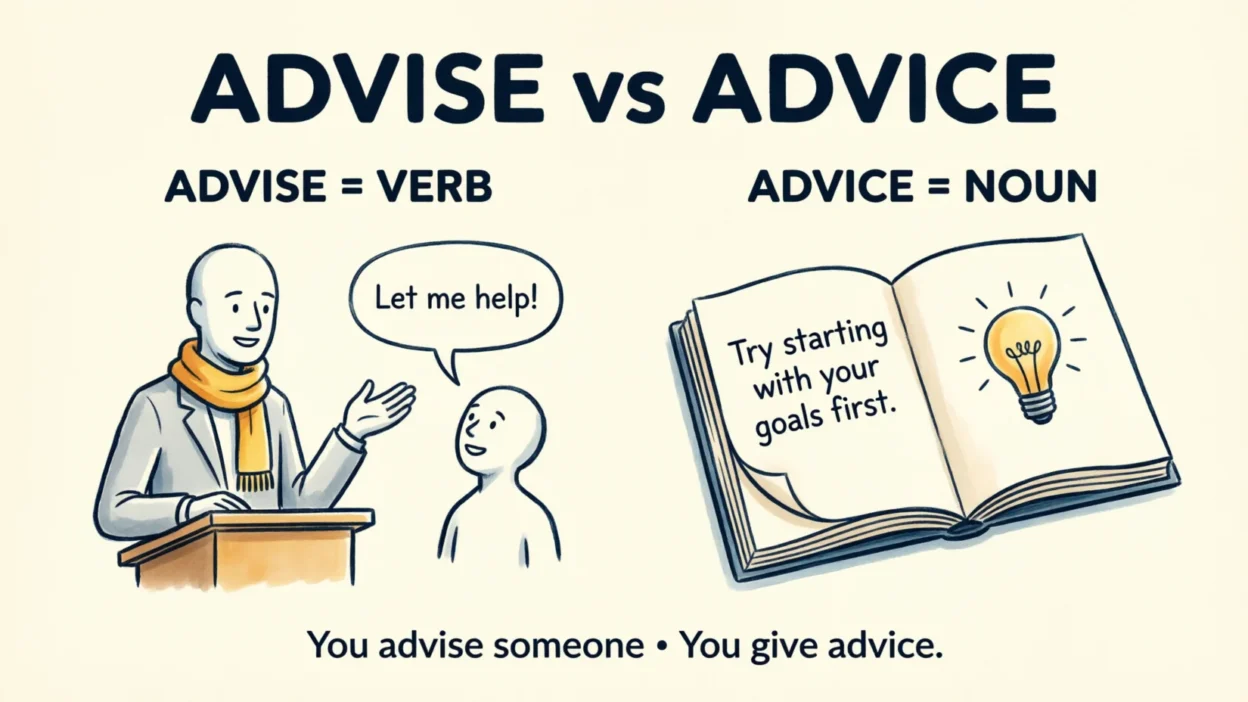
Advise is a verb, while advice is a noun. You advise someone when you recommend what they should do. Advice is the recommendation or guidance you give them. For example, “I advise you to study regularly” is correct because advise describes an action.
“Thank you for your advice” is also correct because advice refers to the guidance you received. Understanding this distinction will help you avoid common spelling and grammar mistakes in emails, school assignments, workplace communication, and everyday conversations.
Quick Answer: Advise vs. Advice
Advise is a verb meaning to recommend or suggest what someone should do. Advice is a noun meaning a recommendation or guidance. For example, “My teacher advised me to practice” describes an action, while “My teacher gave me useful advice” refers to the guidance itself. Remember: you advise someone, but you give advice.
Why Do People Confuse Advise and Advice?
People often confuse advise and advice because they share the same root, have similar spellings, and express related ideas. Both words are connected to recommendations, suggestions, and guidance.
However, their grammatical roles are different:
- Advise: An action word (verb).
- Advice: A naming word (noun).
Pronunciation also contributes to the confusion. In standard English, the final sound differs: advise ends with a /z/ sound, while advice ends with an /s/ sound.
Compare these sentences:
- I advise you to save money.
- My advice is to save money.
Both sentences communicate a recommendation, but each uses a different word because the sentence structure is different.
1. What Does Advise Mean?
Advise is a verb that means to recommend, suggest, or tell someone what you think they should do. It often involves sharing knowledge, experience, or an opinion to help someone make a decision.
Examples of Advise
- I advise you to arrive early.
- Doctors advise people to exercise regularly.
- My parents advised me to save money.
- She advises students about their career options.
- The manager advised us to review the report.
How to Use Advise in a Sentence
Use advise when describing the act of giving a recommendation.
Common sentence patterns include:
- Advise someone to do something: I advise you to read the instructions.
- Advise someone against something: They advised us against traveling during the storm.
- Advise someone on something: She advised me on my career choices.
- Advise that something happen: The lawyer advised that we seek professional assistance.
The verb changes according to tense and subject:
- Present: I advise my friends.
- Past: I advised my friend yesterday.
- Present participle: I am advising my colleague.
- Third-person singular: She advises her clients.
2. What Does Advice Mean?
Advice is a noun that means a recommendation, opinion, or guidance offered to help someone make a decision.
It can refer to a small suggestion or more detailed guidance about education, work, relationships, money, or everyday life.
Examples of Advice
- Thank you for your advice.
- Her advice helped me choose a university.
- I need some advice about my career.
- His advice was practical and helpful.
- My teacher gave me good advice before the exam.
How to Use Advice in a Sentence
Use advice when referring to the recommendation itself rather than the act of recommending.
Common expressions include:
- Give advice: My father gave me useful advice.
- Offer advice: She offered advice to the new employee.
- Ask for advice: I asked my teacher for advice.
- Follow advice: He followed his doctor’s advice.
- A piece of advice: Let me give you a piece of advice.
An important grammar rule is that advice is generally an uncountable noun in standard English. Avoid saying “an advice” or “two advices.” Instead, say “a piece of advice” or “two pieces of advice.”
Advise vs. Advice: Comparison Table
| Feature | Advise | Advice |
| Part of speech | Verb | Noun |
| Meaning | To recommend or guide | A recommendation or guidance |
| Pronunciation ending | /z/ sound | /s/ sound |
| Example | I advise you to rest. | My advice is to rest. |
| Common phrase | Advise someone to act | Give someone advice |
| Past-tense form | Advised | No verb tense |
| Can you say “an”? | Not applicable | Not usually |
| Correct expression | She advised me. | She gave me advice. |
The main distinction is simple: advise describes giving guidance, whereas advice is the guidance being given.
When Should You Use Advise or Advice?
Choose the word that matches the grammatical role in your sentence.
Use Advise When Describing an Action
Use advise when someone recommends a course of action.
Examples:
- I advise you to check your work.
- The teacher advised the students to revise.
- My colleagues advise me on difficult decisions.
A useful clue is that advise is often followed by a person and a recommendation.
Use Advice When Talking About Guidance
Use advice when naming a recommendation or opinion.
Examples:
- I appreciate your advice.
- She gave me excellent advice.
- We asked for advice before making the decision.
How Can You Check Which Word Is Correct?
Try replacing the word with a related expression.
- If you mean “recommend” or “suggest,” use advise.
- If you mean “guidance” or “recommendation,” use advice.
For example:
“I advise you to practice daily” means “I recommend that you practice daily.”
“My advice is to practice daily” means “My recommendation is to practice daily.”
12 Examples of Advise and Advice in Sentences
Here are examples showing how both words work in everyday English.
- Advise: I advise you to drink enough water throughout the day.
- Advice: Thank you for your advice about my studies.
- Advise: The teacher advised us to read the chapter carefully.
- Advice: Her advice helped me prepare for the interview.
- Advise: My parents advise me to think before making decisions.
- Advice: I asked my friend for advice about buying a laptop.
- Advise: The lawyer advised the client to review the contract.
- Advice: His advice was helpful during a difficult time.
- Advise: I would advise against making a rushed decision.
- Advice: Can you give me a piece of advice?
- Advise: Our manager advises us on professional development.
- Advice: She ignored the advice and made her own choice.
These examples demonstrate that the correct word depends on whether you are describing an action or referring to guidance.
Common Mistakes With Advise and Advice
Even though the difference is straightforward, several mistakes occur frequently.
Mistake 1: Using Advice as a Verb
Incorrect: I advice you to study harder.
Correct: I advise you to study harder.
Why? The sentence describes the action of recommending something, so the verb advise is needed.
Mistake 2: Using Advise as a Noun
Incorrect: Thank you for your advise.
Correct: Thank you for your advice.
Why? The sentence refers to guidance someone has given, so advice is the correct noun.
Mistake 3: Saying “An Advice”
Incorrect: She gave me an advice.
Correct: She gave me some advice.
Also correct: She gave me a piece of advice.
Why? Advice is generally uncountable in English.
Mistake 4: Writing “Advices” for the Plural
Incorrect: He gave me three advices.
Correct: He gave me three pieces of advice.
Why? Use pieces of advice when counting individual recommendations.
Mistake 5: Confusing Advised and Advice
Incorrect: My friend advice me yesterday.
Correct: My friend advised me yesterday.
Why? The sentence describes a past action, so you need the past-tense verb advised.
An Easy Memory Trick for Advise vs. Advice
Use this simple trick to remember the difference:
Advise = Verb = Action.
Advice = Noun = Guidance.
Think of these two sentences:
- I advise you to work hard.
- My advice is to work hard.
You can also remember the pronunciation:
- Advise ends with a /z/ sound, like the sound in “zoo.”
- Advice ends with an /s/ sound, like the sound in “ice.”
Another useful trick is to remember that you can give advice but you advise someone.
Practice this distinction a few times, and choosing the correct word will become much easier.
Advise or Advice in American vs. British English
There is no spelling difference between American and British English for advise and advice. Both varieties use advise as a verb and advice as a noun.
| Situation | American English | British English |
| Giving a recommendation | I advise you to wait. | I advise you to wait. |
| Referring to guidance | I need your advice. | I need your advice. |
| Past-tense verb | She advised me. | She advised me. |
| Counting recommendations | Two pieces of advice | Two pieces of advice |
The spelling and grammatical rules remain the same in both varieties. You can confidently use these forms in American, British, Australian, and other standard varieties of English.
Similar Words That Are Easy to Confuse
Advise and advice are not the only English words that look or sound similar but serve different grammatical purposes.
Practice vs. Practise
In American English, practice is used as both a noun and a verb. In British English, practice is generally the noun, while practise is the verb.
- American: I practice every day.
- British: I practise every day.
- Both: I need more practice.
Device vs. Devise
- Device: A noun meaning a tool or piece of equipment.
- Devise: A verb meaning to invent or plan something.
Example: She devised a plan using a simple electronic device.
License vs. Licence
In American English, license is used for both the noun and verb. In British English, licence is traditionally the noun and license the verb.
Example: He applied for a driving licence in the UK.
Affect vs. Effect
- Affect: Usually a verb meaning to influence.
- Effect: Usually a noun meaning a result.
Example: Lack of sleep can affect your concentration, and one effect is reduced alertness.
Learning these distinctions can improve your spelling, vocabulary, and overall writing accuracy.
Final Verdict: Which One Is Correct?
Both advise and advice are correct English words, but they cannot be used interchangeably.
Use advise when describing the action of recommending or guiding someone. Use advice when referring to the recommendation or guidance itself.
For example:
- Correct: I advise you to take a break.
- Correct: My advice is to take a break.
Remember that advice is generally uncountable, so write “some advice” or “a piece of advice,” not “an advice.”
Once you understand the difference between a verb and a noun, choosing between advise and advice becomes simple.
FAQs:
1. Is it advise or advice?
Both are correct, but they have different grammatical roles. Advise is a verb meaning to recommend or guide, while advice is a noun meaning a recommendation or guidance. Use advise for the action and advice for the information given.
2. What is the difference between advise and advice?
Advise describes the act of recommending something, whereas advice refers to the recommendation itself. For example, “I advise you to rest” uses a verb, while “My advice is to rest” uses a noun.
3. Is advice a verb or a noun?
Advice is a noun. It refers to guidance, suggestions, or recommendations. The related verb is advise. For example, “She gave me advice” is correct, as is “She advised me.”
4. Can I say “an advice”?
No. Advice is generally an uncountable noun, so “an advice” is not standard English. Say “some advice,” “a little advice,” or “a piece of advice” instead.
5. What is the plural of advice?
Advice generally has no plural form in standard English. To refer to multiple recommendations, say “pieces of advice.” For example, “My teacher gave me three pieces of advice.”
6. How do you pronounce advise and advice?
Advise ends with a /z/ sound, while advice ends with an /s/ sound. The difference is in the final consonant sound, even though the words look similar and have closely related meanings.
7. Is advise or advice correct in British English?
Both words are correct in British English, just as they are in American English. Advise is the verb, and advice is the noun. The distinction does not change between these varieties of English.
Remember This
- Advise is a verb: I advise you to be careful.
- Advice is a noun: Thank you for your advice.
- Advise ends with a /z/ sound; advice ends with an /s/ sound.
- Advice is generally uncountable: say “a piece of advice,” not “an advice.”
- Both words follow the same rules in American and British English.
The easiest rule to remember is this: You advise someone, and you give them advice.
Conclusion
The difference between advise and advice comes down to grammar. Advise is the verb used when someone recommends or suggests something, while advice is the noun used for the guidance or recommendation itself. Knowing how each word functions will help you write clear, correct sentences in academic work, professional messages, and everyday communication.
Whenever you are unsure which word to use, ask yourself if you are describing an action or naming a recommendation. If you are recommending something, choose advise. If you are talking about the guidance itself, choose advice. Remember this simple rule, practice with the examples, and you will be able to use both words confidently.

Evelyn Mia is a passionate language writer and vocabulary enthusiast at Synomity.com, specializing in synonyms, word meanings, and language learning. She creates informative content that helps readers expand vocabulary and communicate more effectively.