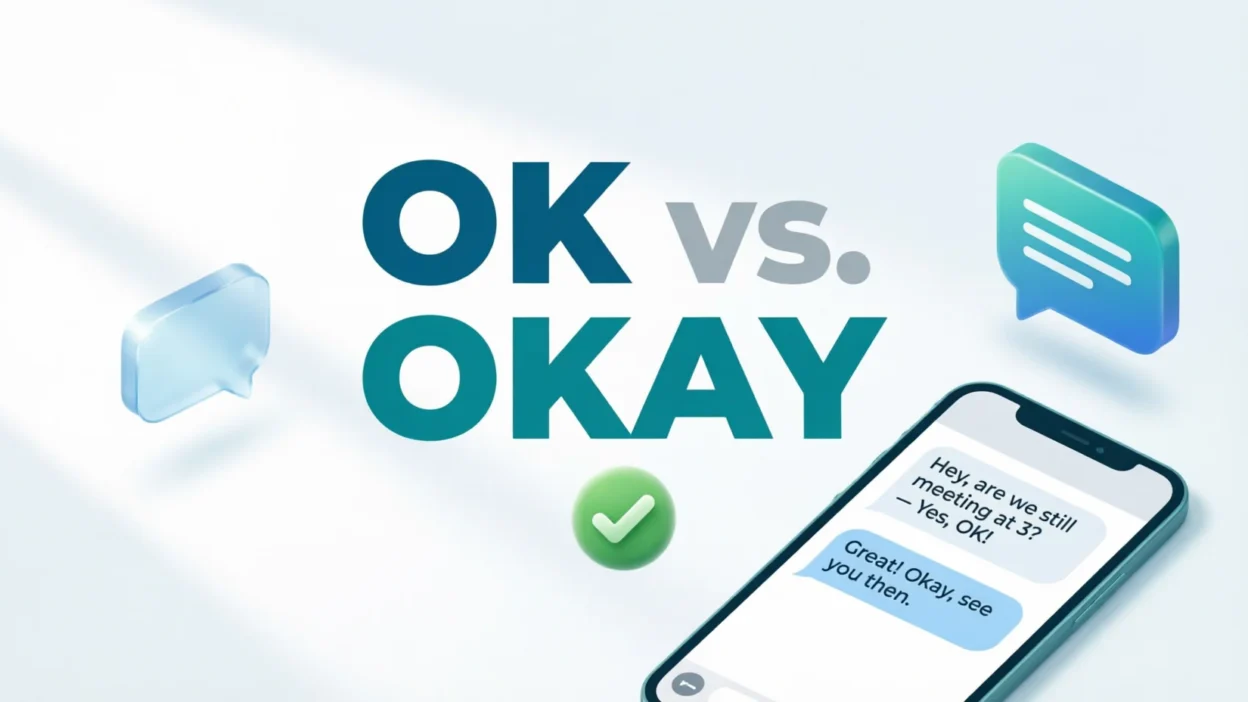
Have you ever wondered if to write OK or okay? Both forms are common in everyday English, text messages, emails, and conversations. Although they look different, they have the same basic meaning. They can express agreement, approval, acceptance, or that something is satisfactory. The main difference is their spelling and the style you may prefer in a particular situation.
The good news is that both OK and okay are correct spellings. You can use either one in most everyday situations without changing the meaning of your sentence.
For example, “I’m OK with the plan” and “I’m okay with the plan” are both correct. However, one form may fit a particular writing style, publication, or workplace preference better than the other. In this guide, you will learn what OK and okay mean, how to use them in sentences, whether one is more formal, and how to choose the right form for your writing.
Quick Answer: OK vs. Okay
OK and okay are both correct English spellings with the same basic meaning. They can express agreement, approval, acceptance, or an acceptable condition. For example, “Everything is OK” and “Everything is okay” mean the same thing. Choose either spelling, but follow a style guide or workplace preference when one applies.
Why Do People Confuse OK and Okay?
People often wonder about OK and okay because the two forms are pronounced the same and have the same meaning. Their difference is mainly visual rather than grammatical.
Both forms are widely used in modern English. However, readers sometimes associate OK with short messages, signs, or quick responses, while okay may look more natural in ordinary prose.
For example:
- OK: Your application is OK.
- Okay: Your application is okay.
Both sentences are correct. The choice often depends on personal preference, context, and consistency.
1. What Does OK Mean?
OK is a standard spelling of a word used to express agreement, approval, acceptance, or satisfactory condition. It can function as an adjective, an interjection, a verb, or a noun, depending on the sentence.
Examples of OK
- Your answer is OK.
- OK, I understand.
- Is everything OK?
- The manager gave the proposal the OK.
- Please OK the final design before publication.
In the last example, OK is used as a verb meaning to approve something. In everyday writing, however, it is especially common as a response or a description of something acceptable.
How to Use OK in a Sentence
Use OK when you want a short, familiar expression of agreement or acceptability.
Examples:
- Agreement: OK, I’ll meet you at six.
- Condition: My laptop is OK now.
- Approval: We received the OK to begin.
- Acceptance: That arrangement is OK with me.
OK is especially convenient when you want a brief, direct expression.
2. What Does Okay Mean?
Okay is another standard spelling of the same word. It has the same basic meaning as OK and can be used in the same kinds of sentences.
Many writers prefer okay in continuous prose because it looks like a fully spelled-out word. However, this is a matter of style rather than a strict grammatical rule.
Examples of Okay
- Your work looks okay.
- Okay, let’s get started.
- Are you feeling okay?
- The food was okay, but not excellent.
- Is it okay if I leave early?
How to Use Okay in a Sentence
Use okay when expressing agreement, describing a condition, or asking whether something is acceptable.
Examples:
- Agreement: Okay, I’ll send the email.
- Condition: She’s feeling okay today.
- Permission: Is it okay to use your phone?
- Quality: The movie was okay, but the ending was disappointing.
Like OK, okay can communicate different meanings depending on the context and tone.
OK vs. Okay: Comparison Table
| Feature | OK | Okay |
| Correct spelling | Yes | Yes |
| Basic meaning | Agreement or acceptability | Agreement or acceptability |
| Pronunciation | /ˌoʊˈkeɪ/ | /ˌoʊˈkeɪ/ |
| Everyday messages | Common | Common |
| Formal writing | Acceptable, depending on style | Acceptable, depending on style |
| Example of agreement | OK, I’ll help. | Okay, I’ll help. |
| Example of condition | I’m OK. | I’m okay. |
The key point is that neither spelling is inherently wrong. Both are established forms of the same English word.
When Should You Use OK or Okay?
Choosing between OK and okay is usually a matter of writing style, not meaning.
Use OK for Short, Direct Communication
OK is useful in brief replies, labels, interface text, and situations where space is limited.
Examples:
- OK, thanks!
- Everything is OK.
- Click OK to continue.
- The plan is OK with me.
In software interfaces, OK is a familiar label for confirming an action.
Use Okay in Everyday Prose
Okay is equally correct and may suit paragraphs, articles, personal writing, and conversational explanations.
Examples:
- I hope you’re feeling okay.
- It’s okay to ask questions.
- The presentation was okay, but it could be improved.
- Okay, let’s discuss the next step.
Which Is Better for Formal Writing?
Neither form is automatically more formal in every context. Both are widely understood, but a formal document may benefit from a more precise expression.
For example:
- Casual: Your proposal is okay.
- More formal: Your proposal is acceptable.
- Casual: OK, we’ll proceed.
- More formal: We approve the proposal and will proceed.
For professional writing, choose the word that best expresses your intended meaning. If your organization has a style guide, follow its preferred spelling.
12 Examples of OK and Okay in Sentences
These examples show how both forms work in common situations.
- OK: OK, I’ll call you when I arrive.
- Okay: Is it okay to open the window?
- OK: Everything is OK after the repair.
- Okay: I hope your family is doing okay.
- OK: The teacher said my answer was OK.
- Okay: Okay, let’s begin the meeting.
- OK: We got the OK to publish the article.
- Okay: It’s okay to make mistakes while learning.
- OK: Are you OK with this arrangement?
- Okay: The food was okay, but the dessert was excellent.
- OK: Press OK to save your changes.
- Okay: Okay, I understand what you mean.
Each sentence uses a correct spelling. You can generally replace OK with okay, or okay with OK, without changing the basic meaning.
Common Mistakes With OK and Okay
Although both forms are correct, writers sometimes use them inconsistently or misunderstand their tone.
Mistake 1: Thinking Okay Is Wrong
Incorrect claim: Only OK is correct.
Correct rule: Both OK and okay are standard spellings.
Example: “It’s okay to ask for help” is perfectly correct.
Mistake 2: Thinking OK Is Always Informal
OK is common in casual communication, but it also appears in established labels, instructions, and professional contexts. Whether it fits depends on the situation and the applicable style guide.
Mistake 3: Writing “O.K.” When a Style Guide Prefers “OK”
O.K. is a historical variant that some writers and publications have used. However, OK and okay are more familiar modern forms. Follow the spelling conventions required by your publication or organization.
Mistake 4: Using Okay When You Mean Excellent
Okay usually means satisfactory, acceptable, or reasonably well. It does not necessarily mean excellent.
For example:
- “The movie was okay” means it was acceptable but perhaps not impressive.
- “The movie was excellent” expresses much stronger praise.
Choose the word that accurately reflects your opinion.
Mistake 5: Using OK to Avoid Being Specific
In professional communication, OK may not clearly communicate whether you agree, approve, or simply understand.
Instead of writing “OK,” consider a more precise response when needed:
- “I approve the revised plan.”
- “I understand the instructions.”
- “The proposed time works for me.”
An Easy Memory Trick for OK vs. Okay
Remember this simple rule:
OK = short spelling. Okay = full-letter spelling. Both mean the same thing.
Think of these examples:
- OK, see you tomorrow.
- Okay, see you tomorrow.
Both are correct and communicate the same message.
If you’re unsure which one to use, follow these steps:
- Check whether your workplace, teacher, or publication has a preferred style.
- If there is no preference, choose either OK or okay.
- Keep your spelling consistent throughout the same document.
- Use a more precise word when the situation requires a clear statement of approval or agreement.
You do not need to memorize separate grammar rules for these two spellings.
OK or Okay in American vs. British English
Both OK and okay are used in American and British English. Neither spelling belongs exclusively to one variety.
| Situation | American English | British English |
| Agreement | OK, sounds good. | Okay, sounds good. |
| Asking about well-being | Are you OK? | Are you okay? |
| Acceptable quality | The result is okay. | The result is OK. |
| Giving approval | We got the OK. | We got the okay. |
The preferred form may vary between individuals, publications, and organizations, but the basic meaning remains the same in both varieties.
Similar Words That Are Easy to Confuse
OK and okay have several related expressions that can communicate agreement, approval, or an acceptable condition. However, these words are not always interchangeable.
All Right vs. Alright
All right is the widely accepted standard form in formal writing. Alright is common in informal use but may be avoided by some editors and style guides.
- All right, I’ll help you.
- Are you all right?
Fine vs. Okay
Fine can mean satisfactory or well, but it can also suggest a stronger level of acceptance or a different emotional tone depending on context.
- The room is fine.
- I’m feeling fine today.
Acceptable vs. Okay
Acceptable often sounds more formal and means that something meets a required standard.
- Your application is acceptable.
- The quality is okay.
Approved vs. OK
Approved clearly indicates that someone with the appropriate authority has given permission or authorization.
- The manager approved the request.
- The manager gave the request the OK.
These alternatives can help you choose more precise language for academic, professional, and everyday situations.
Final Verdict: Which One Is Correct?
Both OK and okay are correct. They share the same basic meaning and can generally be used in the same sentences.
Choose OK when you prefer the shorter spelling, especially in concise messages or interface labels. Choose okay when you prefer the fully spelled-out form in ordinary prose. Neither choice is automatically more formal in every situation.
For example:
- OK, I’ll be there soon.
- Okay, I’ll be there soon.
Both sentences are correct. The most important thing is to use the spelling consistently and make sure your wording fits the context.
FAQs:
1. Is it OK or okay?
Both spellings are correct in standard English. OK and okay have the same basic meaning and are generally interchangeable. Your choice can depend on personal preference, the type of writing, or a style guide.
2. Is okay a real word?
Yes. Okay is an established English word used to express agreement, approval, acceptability, or a satisfactory condition. It is not an incorrect or unofficial alternative to OK.
3. Is OK more formal than okay?
Not necessarily. Both forms are widely used, and neither is universally more formal. In a formal document, the best choice depends on the style guide and context. Words such as “acceptable,” “approved,” or “satisfactory” may communicate your meaning more precisely.
4. Should I write OK, O.K., or okay?
OK and okay are the most familiar modern forms. O.K. is a historical variant that is still encountered, but some modern style guides prefer the forms without periods. Follow the conventions of your publication or workplace.
5. Are OK and okay pronounced the same?
Yes. Both are pronounced the same way, usually as two syllables: “oh-KAY.” Their difference is in spelling, not pronunciation.
6. Is OK used in British English?
Yes. OK is used in both British and American English, as is okay. Preferences can vary by writer and publication, but neither form is restricted to one variety.
7. Can I use okay in formal writing?
Yes, in many contexts. However, formal documents sometimes benefit from more precise expressions, such as “acceptable,” “approved,” or “satisfactory.” Follow any relevant style requirements and choose the wording that best expresses your intended meaning.
Remember This
- OK and okay are both correct.
- Both forms have the same basic meaning.
- OK is the shorter spelling; okay is the fully spelled-out form.
- Neither is automatically more formal in every situation.
- Follow your style guide and remain consistent.
- Consider alternatives such as “acceptable” or “approved” when precision matters.
Conclusion
The difference between OK and okay is simple: both are correct spellings of the same English word. They express agreement, approval, acceptance, or a satisfactory condition. Although some writers prefer OK for short messages and okay for ordinary prose, this is a stylistic preference rather than a strict grammatical rule.
When choosing between the two, consider your audience, writing context, and any style guidelines you need to follow. If there is no specific requirement, use whichever spelling feels natural and keep it consistent throughout your writing. Understanding this small distinction will help you communicate clearly and confidently in everyday conversations, emails, school assignments, and professional documents.

John Morrison is a dedicated content writer at Synomity.com, focused on synonyms, vocabulary development, and word meanings. He creates clear, educational resources that help readers improve language skills and communicate with confidence.