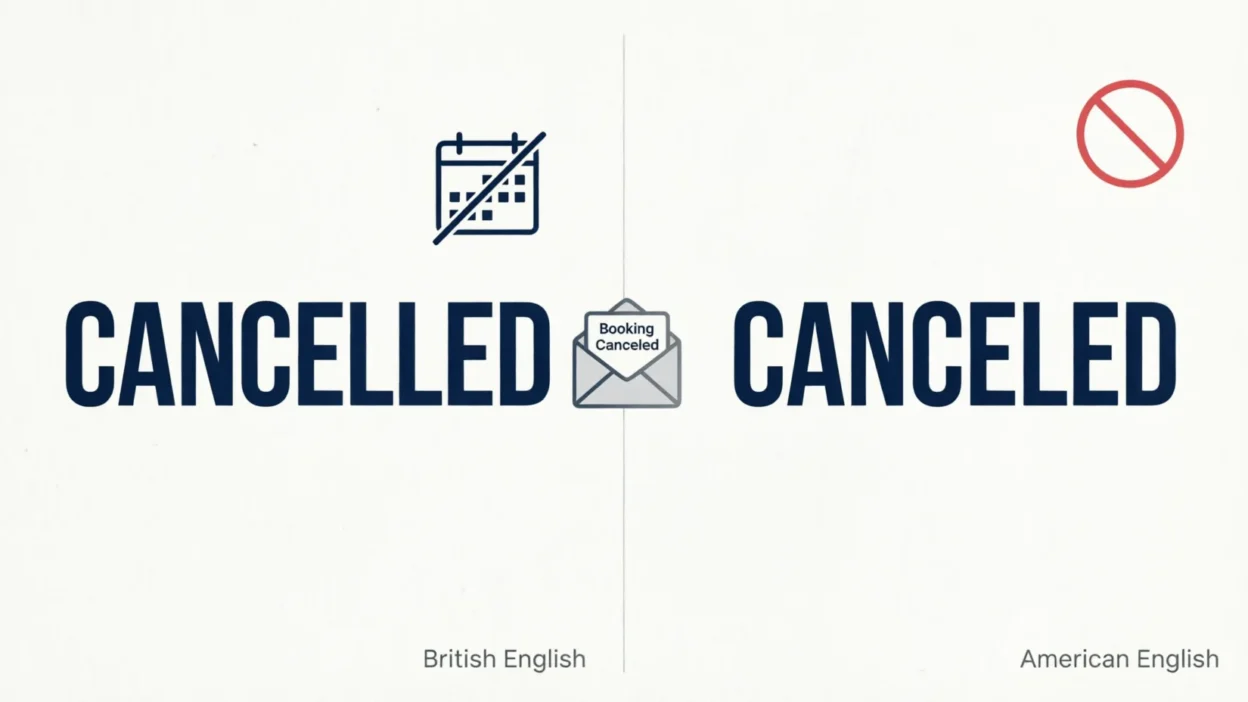
Have you ever wondered if to write cancelled or canceled? Both spellings are correct, and they have the same meaning. The main difference is regional: cancelled is the preferred spelling in British English, while canceled is the more common spelling in American English. Both words are forms of the verb “cancel,” which means to call off, stop, or decide that something planned will not happen.
Choosing between these spellings can be confusing when writing emails, school assignments, business documents, or social media posts. The good news is that you do not need to memorize two different meanings.
You only need to understand the spelling conventions used in your audience’s variety of English. In this guide, you will learn when to use cancelled or canceled, explore examples, discover common spelling mistakes, and understand how the same rule applies to related words such as cancelling and canceling.
Quick Answer: Cancelled vs. Canceled
Cancelled and canceled are both correct past-tense and past-participle forms of “cancel.” British English generally prefers cancelled, with two Ls, while American English generally prefers canceled, with one L. Both mean that something was called off or stopped. Choose the spelling that matches your audience and use it consistently.
Why Do People Confuse Cancelled and Canceled?
People often confuse these words because they look almost identical and have exactly the same meaning. The difference comes from spelling conventions rather than grammar or pronunciation.
English spelling varies between countries. British English commonly doubles the final L when adding endings to words such as “cancel,” while American English often keeps a single L in these forms.
For example:
- British English: The match was cancelled because of rain.
- American English: The match was canceled because of rain.
Both sentences are correct. The only difference is the spelling of the word, not its meaning or grammatical function.
1. What Does Cancelled Mean?
Cancelled is the past-tense and past-participle form of “cancel,” commonly used in British English and many other varieties of English.
It means that an event, appointment, plan, order, or arrangement has been called off or will no longer take place.
Examples of Cancelled
- The concert was cancelled because of bad weather.
- My doctor cancelled the appointment.
- The airline cancelled our flight.
- The school trip was cancelled at the last minute.
- They have cancelled the meeting.
How to Use Cancelled in a Sentence
Use cancelled when writing in British English or following a style guide that prefers the double-L spelling.
Examples:
- Past tense: The manager cancelled the booking yesterday.
- Present perfect: We have cancelled our reservation.
- Passive voice: The event was cancelled due to heavy rain.
- Past participle: The cancelled flight caused delays.
Remember that cancelled is not more correct than canceled in every situation. It is simply the preferred spelling in British-style writing.
2. What Does Canceled Mean?
Canceled is the past-tense and past-participle form of “cancel,” commonly preferred in American English.
It has exactly the same meaning as cancelled: to call something off, discontinue an arrangement, or decide that a planned event will not happen.
Examples of Canceled
- The game was canceled because of rain.
- I canceled my subscription yesterday.
- The company canceled the order.
- She has canceled her appointment.
- The flight was canceled without warning.
How to Use Canceled in a Sentence
Use canceled when writing in American English or following a style guide that prefers the single-L spelling.
Examples:
- Past tense: He canceled the meeting.
- Present perfect: They have canceled the event.
- Passive voice: The reservation was canceled.
- Past participle: The canceled order was refunded.
The word canceled is standard English, not a spelling mistake. It is especially common in American newspapers, business communication, and everyday writing.
Cancelled vs. Canceled: Comparison Table
| Feature | Cancelled | Canceled |
| Meaning | Called off or stopped | Called off or stopped |
| Part of speech | Verb form | Verb form |
| Preferred variety | British English | American English |
| Number of Ls | Two | One |
| Pronunciation | The same | The same |
| Example | The flight was cancelled. | The flight was canceled. |
| Correct spelling? | Yes | Yes |
The key difference is regional spelling preference. Neither spelling changes the meaning of the sentence.
When Should You Use Cancelled or Canceled?
The best spelling depends on your audience, publication requirements, and the variety of English you are using.
Use Cancelled in British English
Choose cancelled when writing for a British audience or following British English conventions.
Examples:
- The football match was cancelled.
- We cancelled our hotel reservation.
- The train service has been cancelled.
This spelling is also commonly used in other varieties that follow British spelling conventions.
Use Canceled in American English
Choose canceled when writing for an American audience or following American English conventions.
Examples:
- The baseball game was canceled.
- I canceled my online order.
- The meeting has been canceled.
What If You Are Writing for an International Audience?
Either spelling is understandable to most English readers. However, consistency is important.
- If your website uses British English, choose cancelled.
- If your website uses American English, choose canceled.
- If a teacher, employer, publisher, or organization specifies a style guide, follow its preference.
Do not switch between the two spellings randomly in the same document.
12 Examples of Cancelled and Canceled in Sentences
Here are practical examples showing how both spellings work in everyday situations.
- Cancelled: The school cancelled the picnic because of heavy rain.
- Canceled: The school canceled the picnic because of heavy rain.
- Cancelled: My appointment was cancelled this morning.
- Canceled: My appointment was canceled this morning.
- Cancelled: They have cancelled the concert.
- Canceled: They have canceled the concert.
- Cancelled: The airline cancelled several flights.
- Canceled: The airline canceled several flights.
- Cancelled: We cancelled our dinner reservation.
- Canceled: We canceled our dinner reservation.
- Cancelled: The company has cancelled the contract.
- Canceled: The company has canceled the contract.
Each pair communicates the same message. The spelling changes according to regional convention, not meaning.
Common Mistakes With Cancelled and Canceled
Although both spellings are correct, writers sometimes make mistakes when choosing between them or using related forms.
Mistake 1: Assuming Canceled Is Always Wrong
Incorrect claim: Canceled is never correct.
Correct explanation: Canceled is the standard preferred spelling in American English.
For example, “The event was canceled” is perfectly acceptable American English.
Mistake 2: Assuming Cancelled Is Always Wrong
Incorrect claim: Cancelled is a spelling mistake.
Correct explanation: Cancelled is the standard preferred spelling in British English.
For example, “The event was cancelled” is correct in British English.
Mistake 3: Mixing Both Spellings in One Document
Inconsistent: The meeting was canceled, but the second event was cancelled.
Better: The meeting was canceled, but the second event was canceled.
Alternatively, use cancelled in both sentences if following British English.
Mistake 4: Confusing Canceled With Cancelling
The preferred regional spellings also differ in the present participle:
- British English: cancelling
- American English: canceling
Both are correct in their respective spelling systems.
Mistake 5: Using the Wrong Verb Form
Incorrect: The event has cancel yesterday.
Correct: The event was canceled yesterday.
Correct: The event has been canceled.
The correct form depends on the tense and sentence structure, regardless of the regional spelling.
An Easy Memory Trick for Cancelled vs. Canceled
Use this simple trick:
British = Double L. American = Single L.
- British English: cancelled, cancelling
- American English: canceled, canceling
Think of the word “travel” for another useful comparison:
- British English: travelled, travelling
- American English: traveled, traveling
This pattern is common in many words ending in a single L, although spelling conventions can vary depending on the word and the style guide.
If you remember which variety of English you are writing in, you can usually choose the correct form quickly.
Cancelled or Canceled in American vs. British English
The difference between cancelled and canceled is a familiar example of regional spelling variation.
| Word form | British English | American English |
| Past tense | Cancelled | Canceled |
| Past participle | Cancelled | Canceled |
| Present participle | Cancelling | Canceling |
| Noun | Cancellation | Cancellation |
| Base verb | Cancel | Cancel |
Notice that cancellation is normally spelled with two Ls in both American and British English. This is a useful exception to remember when learning the different forms of the word.
Other regional differences follow similar patterns, including travelled/traveled and labelled/labeled.
Similar Words That Are Easy to Confuse
Cancelled and canceled belong to a group of English words whose spellings vary between British and American English.
Travelled vs. Traveled
Both mean that someone went from one place to another.
- British: She travelled to London.
- American: She traveled to New York.
Labelled vs. Labeled
Both refer to something marked with a label.
- British: The box was labelled clearly.
- American: The box was labeled clearly.
Fuelled vs. Fueled
Both are past-tense forms of “fuel,” meaning to supply energy or motivate something.
- British: The debate was fuelled by new evidence.
- American: The debate was fueled by new evidence.
Jewellery vs. Jewelry
Both refer to decorative items such as rings, necklaces, and bracelets.
- British: She bought some jewellery.
- American: She bought some jewelry.
These examples show why it is useful to identify your preferred variety of English before editing a document.
Final Verdict: Which Spelling Is Correct?
Both cancelled and canceled are correct. The difference is regional spelling preference, not meaning or grammar.
Choose cancelled when writing in British English and canceled when writing in American English. If you are following a publication’s style guide or an organization’s writing rules, use the spelling it recommends.
Also remember that the related forms are usually cancelling in British English and canceling in American English, while cancellation generally keeps two Ls in both varieties.
The most important rule is to choose one spelling system and use it consistently throughout your writing.
FAQs:
1. Is it cancelled or canceled?
Both spellings are correct. Cancelled is generally preferred in British English, while canceled is generally preferred in American English. They have the same meaning and are pronounced the same way.
2. Is canceled incorrect in British English?
Canceled is widely recognized, but cancelled is the usual preferred spelling in standard British English. If you are writing for a British audience, cancelled is generally the safer choice unless a style guide says otherwise.
3. Is cancelled incorrect in American English?
No. Cancelled is understood and used in American English, but canceled is the more common standard spelling in the United States. Follow the spelling conventions required by your audience or publication.
4. Is it cancelling or canceling?
Both are correct. British English generally uses cancelling, with two Ls, while American English generally uses canceling, with one L. The same regional pattern applies to cancelled and canceled.
5. Is cancellation spelled with one L or two?
Cancellation is generally spelled with two Ls in both British and American English. For example, “The cancellation of the event surprised everyone” is correct in both varieties.
6. Why does British English use cancelled with two Ls?
British spelling conventions generally double the final L in forms such as cancelled and cancelling. American English commonly uses a single L in canceled and canceling. These are established regional spelling differences.
7. Which spelling should I use in a formal email?
Use the spelling that matches your recipient, organization, or preferred variety of English. Choose cancelled for British English and canceled for American English. Most importantly, keep the spelling consistent throughout the email.
Remember This
- Cancelled: Preferred in British English.
- Canceled: Preferred in American English.
- Both spellings mean the same thing.
- British English generally uses cancelling; American English generally uses canceling.
- Cancellation is normally spelled with two Ls in both varieties.
- Consistency matters more than choosing one regional spelling over the other.
Conclusion
The difference between cancelled and canceled is simple once you understand regional English spelling. Both words describe an event, appointment, order, or arrangement that has been called off. Cancelled is the preferred form in British English, whereas canceled is more common in American English. Neither spelling is universally better or more correct than the other.
When writing, consider who will read your work and which spelling convention they expect. Use cancelled for British-style writing and canceled for American-style writing, unless a specific style guide requires something different. By following this rule and staying consistent, you can write more clearly and confidently.