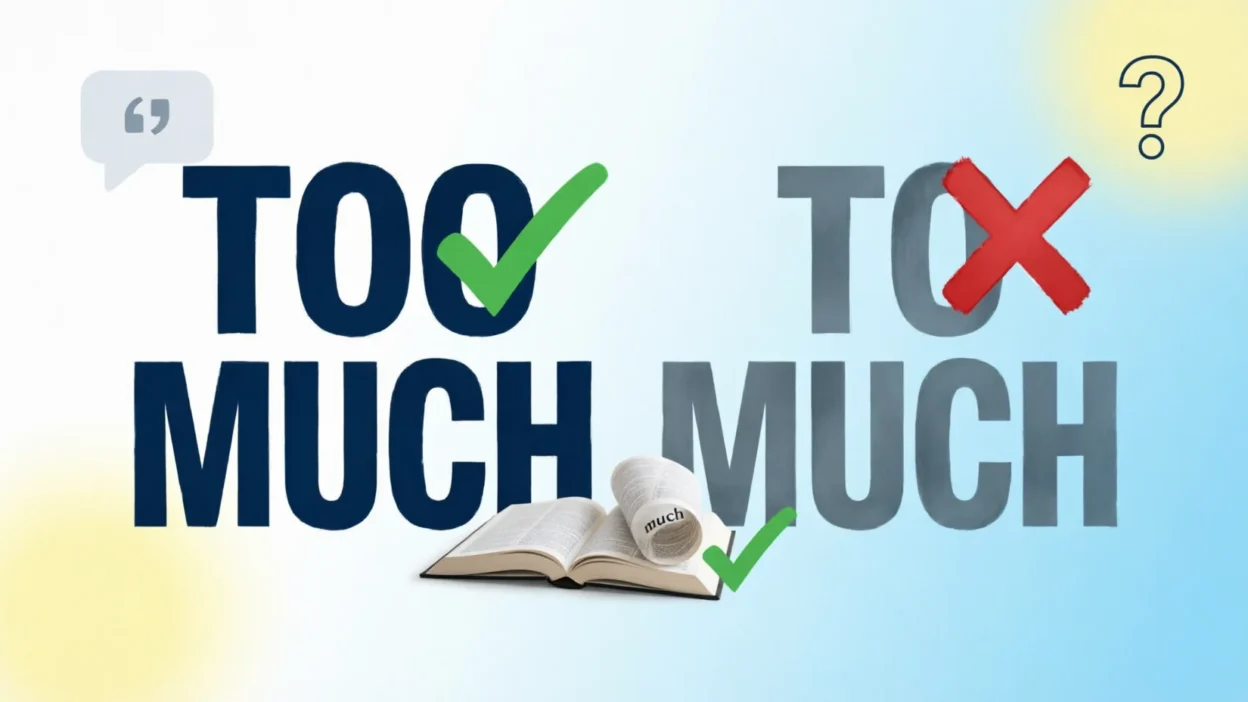
If you are wondering whether “too much” or “to much” is correct, the answer is “too much.” The phrase too much is used when you mean an excessive amount of something. For example, “I have too much work today” means you have more work than you need or can comfortably handle. To much is generally incorrect when you want to express this meaning.
The confusion happens because to and too sound similar in everyday speech. However, they have different meanings and grammatical functions. Too can mean “more than necessary” or “also,” while to is commonly used before verbs and for showing direction or relationships. Learning this simple difference will help you avoid one of the most common spelling mistakes in English.
Quick Answer
“Too much” is correct; “to much” is incorrect when you mean an excessive amount. Use too much with uncountable nouns such as water, money, time, and work. Remember: too = excessively, while to usually shows direction or comes before a verb.
Why Do People Confuse “Too Much” and “To Much”?
People often confuse these expressions because to and too are pronounced similarly. When speaking quickly, the extra o in too is easy to overlook when writing.
There is also a useful meaning difference:
- Too = more than necessary or excessively
- To = used for direction, purpose, or before a verb
For example:
- I drank too much coffee.
- I want to drink coffee.
The first sentence describes an excessive amount. The second uses to before the verb drink.
What Does “Too” Mean?
Too is an adverb with several common uses. One important use is to mean “more than is wanted, needed, or appropriate.”
Examples:
- The soup is too hot.
- She spends too much money.
- You talk too loudly.
- There is too much noise here.
Too can also mean “also.”
- I want to come too.
- She likes chocolate too.
When you are talking about an excessive amount, too much is the correct phrase.
What Does “To” Mean?
To is a very common English word. It is often used before a verb to form the infinitive.
Examples:
- I want to learn.
- They need to leave.
- He likes to read.
- We decided to stay.
It can also show direction or movement:
- She went to school.
- We drove to Lahore.
- He walked to the store.
So, to much does not normally work as a phrase meaning “an excessive amount.”
Too Much vs To Much: Comparison Table
| Expression | Correct? | Meaning | Example |
|---|---|---|---|
| too much | ✅ Yes | More than necessary | I have too much work. |
| to much | ❌ No | Not correct for excessive quantity | I have to much work. |
| too | ✅ Yes | Excessively / also | It is too expensive. |
| to | ✅ Yes | Direction or infinitive marker | I want to go. |
When Should You Use “Too Much”?
Use too much when you are talking about an excessive amount of something that is normally treated as uncountable.
Common examples include:
- too much water
- too much money
- too much time
- too much food
- too much work
- too much noise
- too much information
- too much traffic
- too much pressure
- too much stress
For example:
Here, traffic is treated as an uncountable noun, and too much means an excessive amount.
When Should You Use “To”?
Use to in several common grammatical situations.
Before a Verb
- I want to sleep.
- She needs to study.
- We plan to travel.
- He hopes to win.
To Show Direction
- I went to school.
- They moved to London.
- She walked to the office.
To Show a Relationship or Recipient
- Give the book to John.
- I spoke to my teacher.
- Send this message to her.
These uses are completely different from too much.
10+ Examples of “Too Much”
Here are practical examples to help you remember the correct form:
- I have too much work today.
- You are putting too much sugar in the tea.
- She spends too much money on clothes.
- There is too much noise outside.
- He eats too much food at night.
- We don’t have too much time.
- This bag has too much weight in it.
- They are under too much pressure.
- I received too much information at once.
- There is too much traffic this morning.
- Don’t add too much salt.
- He watches too much television.
In every example, too much refers to an amount that is greater than necessary, desirable, or manageable.
Common Mistakes With “Too Much” and “To Much”
Mistake 1: Writing “to much”
❌ I have to much homework.
✅ I have too much homework.
Mistake 2: Confusing “too much” and “too many”
Use too much with uncountable nouns:
- too much water
- too much money
- too much time
Use too many with countable plural nouns:
- too many books
- too many questions
- too many people
For example:
Not:
Mistake 3: Forgetting That “Too” Can Mean “Also”
Too does not always mean excessive.
- I want to go too. = I also want to go.
- This coffee is too hot. = This coffee is excessively hot.
The surrounding sentence tells you which meaning applies.
A Simple Memory Trick
Remember:
Too = extra
The word too has an extra o, just like something excessive has something extra.
So:
For example:
Too much sugar = more sugar than needed.
You can remember it as:
This is a simple way to distinguish too from to when writing.
American vs British English
There is no spelling difference between too much in American English and British English.
Both varieties use:
- too much time
- too much money
- too much food
- too much work
The phrase is standard English in both varieties.
Differences between American and British English may appear in vocabulary, pronunciation, spelling, or certain grammatical preferences, but too much remains the same.
Similar Words and Phrases
Understanding related expressions can make the difference easier to remember.
Too Much
Means an excessive amount.
Too Many
Means an excessive number of countable things.
Very Much
Usually means to a great degree, but it does not necessarily mean excessive.
So Much
Means a large amount or degree and can express emphasis.
Much Too
This has a different word order but still expresses excessiveness.
Final Verdict: Too Much or To Much?
The correct expression is “too much” when you mean more than necessary or an excessive amount.
✅ I have too much work.
❌ I have to much work.
Use to when it functions as a preposition or comes before a verb:
Use too when you mean excessively:
The easiest rule is: too = excessive or also; to = direction or before a verb.
FAQs:
Is “too much” correct?
Yes. Too much is the correct phrase when you mean an excessive amount of something.
Is “to much” ever correct?
To much is generally not correct as a phrase meaning “an excessive amount.” In standard English, use too much for that meaning.
Is it “too much” or “to much money”?
The correct phrase is too much money because money is being described as an excessive amount.
What is the difference between “too” and “to”?
Too can mean “excessively” or “also.” To commonly shows direction or is used before a verb.
Is “too much” one word?
No. Too much consists of two separate words: too and much.
Should I say “too much” or “too many”?
Use too much with uncountable nouns and too many with countable plural nouns. For example, too much water but too many bottles.
Can “too” mean “also”?
Yes. For example, “I want to come too” means “I also want to come.”
How can I remember “too much”?
Remember that too has an extra o, and too much means an amount that is excessive or extra.
Remember This
- ✅ Too much = an excessive amount
- ❌ To much = incorrect for this meaning
- Too = excessively or also
- To = direction, relationship, or before a verb
- Too much water ✅
- Too many bottles ✅
- To drink ✅
Conclusion
If you are choosing between too much and to much, choose too much when you want to describe an excessive amount. It is used with uncountable nouns such as water, money, time, food, and work. The phrase is standard in both American and British English.
The key is to remember the role of too and to. Too can mean “more than necessary” or “also,” while to is commonly used for direction or before a verb. Once you connect too with the idea of something being extra, the spelling becomes much easier to remember.

Evelyn Mia is a passionate language writer and vocabulary enthusiast at Synomity.com, specializing in synonyms, word meanings, and language learning. She creates informative content that helps readers expand vocabulary and communicate more effectively.