
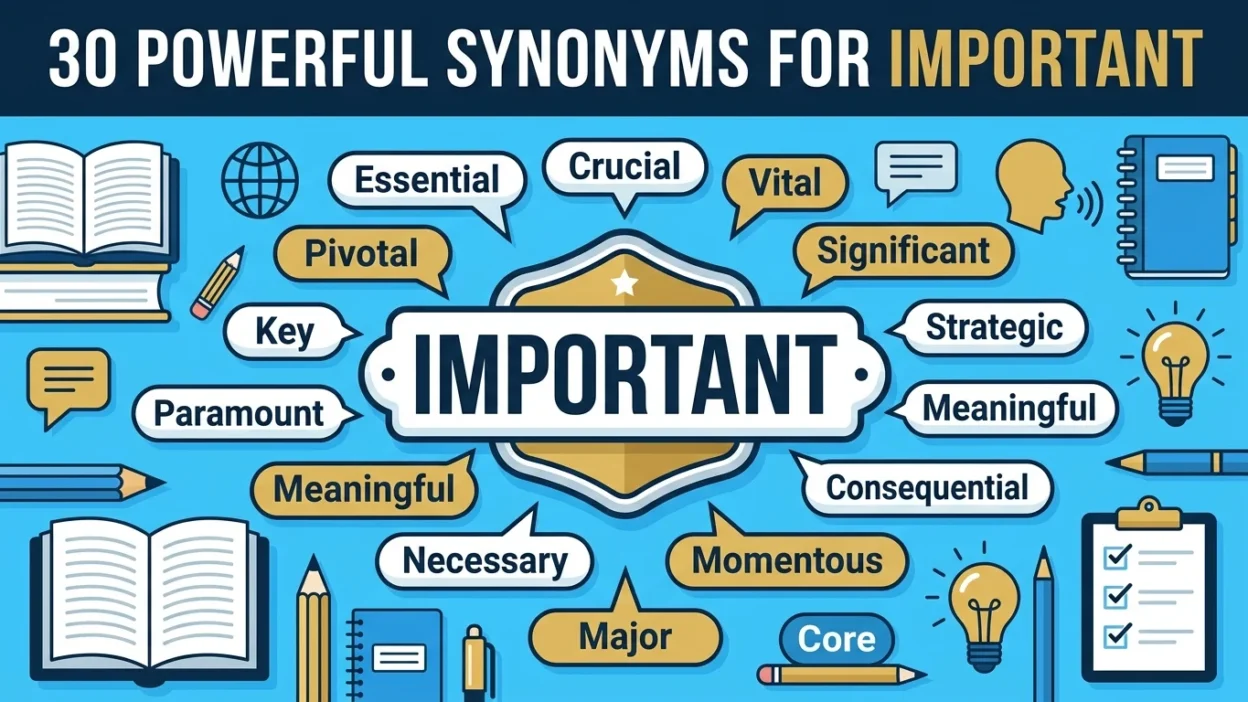
The word important is one of the most commonly used words in English. We use it to describe something that has great value, influence, significance, or priority. Whether you’re writing an essay, speaking in class, creating content, or improving your English vocabulary, relying on the same word repeatedly can make your writing feel repetitive.
Learning different synonyms for important helps you communicate more clearly and accurately. Some alternatives express urgency, while others emphasize value, influence, necessity, or impact. Choosing the right synonym can make your writing more professional, engaging, and expressive.
In this guide, you’ll discover the meaning of important, understand how to choose the best alternative, and explore 30 useful synonyms with meanings, examples, and usage tips.
What Does “Important” Mean?
Important means something that has great value, significance, influence, or effect. It describes people, events, ideas, tasks, or things that deserve attention because they matter.
Simple Definition
Important = Having great value, significance, or influence.
Example Sentences
- Education is important for personal growth.
- It is important to arrive on time.
- This meeting discusses important business decisions.
Usage Context
The word “important” works in academic writing, business communication, everyday conversation, and professional settings.
30 Synonyms for Important
1. Significant
Meaning: Having notable importance or meaning.
Example: The study revealed significant results.
Best Usage Context: Academic and formal writing.
2. Essential
Meaning: Absolutely necessary.
Example: Water is essential for life.
Best Usage Context: Necessities and requirements.
3. Crucial
Meaning: Extremely important for success.
Example: Communication is crucial in teamwork.
Best Usage Context: Critical situations.
4. Vital
Meaning: Necessary for survival or success.
Example: Regular exercise is vital for health.
Best Usage Context: Health and key functions.
5. Critical
Meaning: Extremely important or urgent.
Example: We face a critical decision today.
Best Usage Context: Emergencies and major decisions.
6. Key
Meaning: Most important part of something.
Example: Trust is a key factor in relationships.
Best Usage Context: Business and education.
7. Major
Meaning: Large in importance or influence.
Example: Climate change is a major global issue.
Best Usage Context: News and discussions.
8. Meaningful
Meaning: Having value or purpose.
Example: They had a meaningful conversation.
Best Usage Context: Personal experiences.
9. Influential
Meaning: Able to affect others.
Example: She became an influential leader.
Best Usage Context: People and organizations.
10. Valuable
Meaning: Worth a lot in usefulness.
Example: Your feedback is valuable.
Best Usage Context: Advice and resources.
11. Necessary
Meaning: Required or needed.
Example: Safety equipment is necessary.
Best Usage Context: Rules and requirements.
12. Indispensable
Meaning: Impossible to do without.
Example: Smartphones have become indispensable tools.
Best Usage Context: Essential items.
13. Consequential
Meaning: Producing important effects.
Example: It was a consequential decision.
Best Usage Context: Formal writing.
14. Prominent
Meaning: Important and well-known.
Example: She is a prominent scientist.
Best Usage Context: Public figures.
15. Weighty
Meaning: Serious and important.
Example: They discussed weighty issues.
Best Usage Context: Serious discussions.
16. Paramount
Meaning: More important than anything else.
Example: Safety is paramount.
Best Usage Context: Policies and priorities.
17. Noteworthy
Meaning: Worth noticing.
Example: The report contains noteworthy findings.
Best Usage Context: Academic writing.
18. Substantial
Meaning: Considerable in importance.
Example: The project made a substantial impact.
Best Usage Context: Reports and research.
19. Fundamental
Meaning: Forming the basic foundation.
Example: Reading is fundamental to learning.
Best Usage Context: Education and principles.
20. Central
Meaning: At the core of something.
Example: Communication is central to success.
Best Usage Context: Main ideas.
21. Principal
Meaning: First in importance.
Example: Our principal concern is safety.
Best Usage Context: Formal writing.
22. Prime
Meaning: Of highest importance.
Example: Customer satisfaction is our prime goal.
Best Usage Context: Business communication.
23. Serious
Meaning: Requiring careful attention.
Example: This is a serious matter.
Best Usage Context: Problems and concerns.
24. Impactful
Meaning: Having a strong effect.
Example: Her speech was impactful.
Best Usage Context: Presentations and content.
25. Historic
Meaning: Important in history.
Example: It was a historic achievement.
Best Usage Context: Historical events.
26. Strategic
Meaning: Important for long-term goals.
Example: They formed a strategic partnership.
Best Usage Context: Business planning.
27. Decisive
Meaning: Determining an outcome.
Example: The final vote was decisive.
Best Usage Context: Competitions and decisions.
28. Imperative
Meaning: Absolutely necessary.
Example: It is imperative to act quickly.
Best Usage Context: Formal communication.
29. Momentous
Meaning: Very important and far-reaching.
Example: The agreement marked a momentous occasion.
Best Usage Context: Major events.
30. Pivotal
Meaning: Extremely important in determining results.
Example: Technology played a pivotal role.
Best Usage Context: Turning points and change.
Quick Comparison Table
| Synonym | Best For | Tone |
|---|---|---|
| Essential | Necessities | Neutral |
| Crucial | Urgent situations | Strong |
| Vital | Health and survival | Strong |
| Significant | Research and academics | Formal |
| Key | Everyday and business use | Neutral |
| Paramount | Highest priority | Formal |
| Strategic | Planning and business | Professional |
| Meaningful | Personal experiences | Warm |
| Impactful | Presentations and content | Modern |
| Pivotal | Turning points | Professional |
How to Choose the Right Synonym
Different situations require different words. Here’s a simple guide:
For Academic Writing
Use:
- Significant
- Noteworthy
- Fundamental
- Substantial
- Consequential
Example
“The research produced significant findings.”
For Business and Professional Writing
Use:
- Strategic
- Key
- Prime
- Principal
- Pivotal
Example
“Customer trust is a key business asset.”
For Urgent or Serious Situations
Use:
- Crucial
- Critical
- Vital
- Imperative
- Paramount
Example
“It is crucial to respond immediately.”
For Personal or Emotional Topics
Use:
- Meaningful
- Valuable
- Impactful
Example
“The experience was deeply meaningful.”
For Major Events and Achievements
Use:
- Historic
- Momentous
- Decisive
Example
“It was a momentous day for the nation.”
Common Mistakes When Replacing “Important”
Don’t Use Formal Words in Casual Speech
Instead of:
“That pizza was paramount.”
Use:
“That pizza was great.”
Match the Context
Instead of:
“Water is significant for survival.”
Use:
“Water is essential for survival.”
Avoid Overusing Strong Synonyms
Words like critical, crucial, and paramount should be reserved for situations that truly deserve emphasis.
Why Learning Synonyms for Important Matters
Using different words instead of repeatedly saying “important” can:
- Improve writing quality
- Increase vocabulary
- Make essays more engaging
- Help ESL learners sound more natural
- Improve SEO content readability
- Create stronger communication
The more alternatives you know, the easier it becomes to express precise meanings.
Conclusion
The word important is useful, but it isn’t always the best choice. Depending on the situation, words like essential, crucial, vital, significant, pivotal, and paramount may communicate your message more effectively.
Understanding these synonyms for important allows students, writers, ESL learners, and content creators to improve vocabulary, write with greater precision, and avoid repetitive language. By choosing the right synonym based on tone and context, your writing becomes clearer, stronger, and more engaging.
Whether you’re writing an academic paper, creating online content, or simply improving your English skills, these alternatives will help you express ideas with confidence and accuracy.

Lucas Smith is a skilled language writer at Synomity.com, passionate about synonyms, vocabulary enrichment, and word meanings. He develops engaging content that helps readers strengthen communication skills and expand their understanding of language.