The phrase synonyms for complex is commonly searched by students, writers, ESL learners, and professionals who want to express ideas more accurately. While the word complex is useful, repeating it too often can make writing sound repetitive and less engaging.
Learning different synonyms helps improve vocabulary, strengthen communication skills, and make your writing more precise. Some alternatives describe something difficult to understand, while others emphasize detail, sophistication, or interconnected parts.
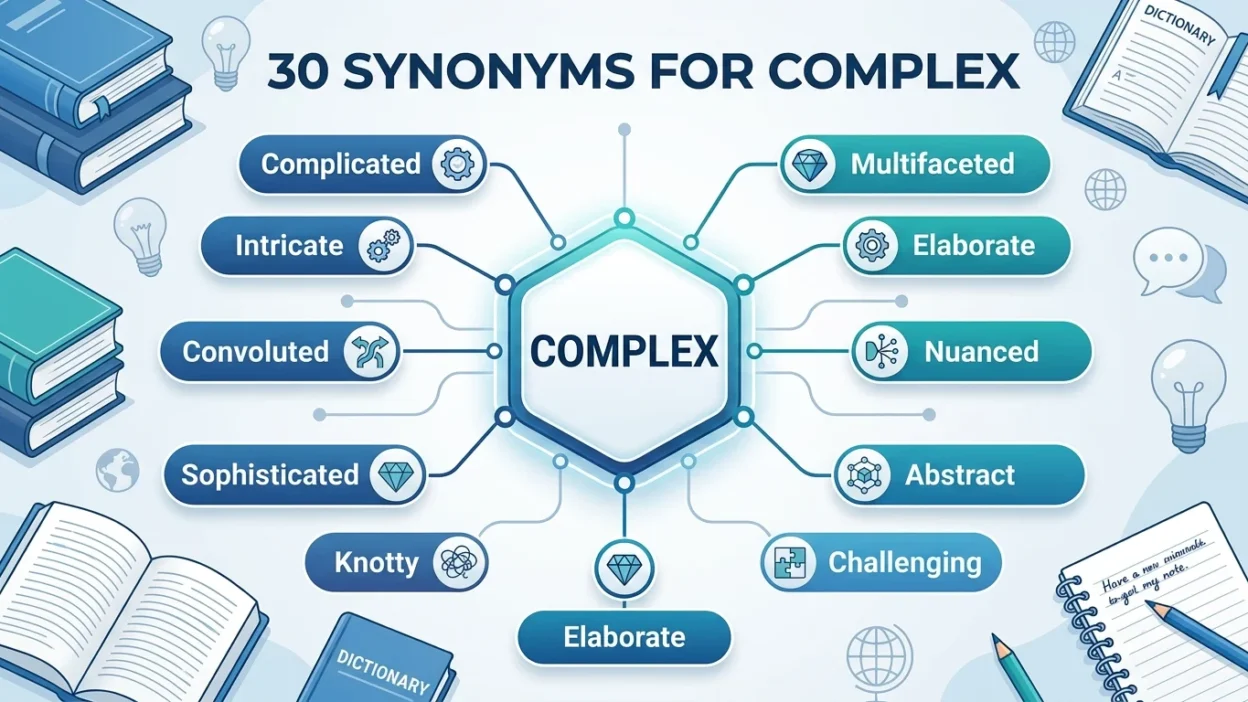
In this guide, you’ll discover the meaning of complex, explore 30 useful synonyms for complex, understand their subtle differences, and learn when to use each one confidently.
What Does “Complex” Mean?
The word complex describes something that is difficult to understand because it contains many parts, details, or connections.
It can refer to ideas, systems, emotions, problems, situations, or structures that are not simple or straightforward.
Usage Context of “Complex”
People use complex in many situations, such as:
- A complex scientific theory
- A complex computer system
- A complex emotional situation
- A complex legal issue
- A complex piece of machinery
Example sentence:
“The teacher explained the complex topic in a simple way.”
30 Synonyms for Complex
1. Complicated
Meaning: Having many parts that make it difficult to understand.
Example Sentence:
“The instructions were complicated for first-time users.”
Best Usage Context: Everyday discussions, education, technical topics.
2. Intricate
Meaning: Containing many small details or carefully connected parts.
Example Sentence:
“The artist created an intricate design on the wall.”
Best Usage Context: Art, design, craftsmanship.
3. Sophisticated
Meaning: Advanced, refined, or highly developed.
Example Sentence:
“The company uses sophisticated software.”
Best Usage Context: Technology, business, innovation.
4. Elaborate
Meaning: Detailed and carefully planned.
Example Sentence:
“They prepared an elaborate presentation.”
Best Usage Context: Events, projects, explanations.
5. Detailed
Meaning: Including a lot of information.
Example Sentence:
“The report provides a detailed analysis.”
Best Usage Context: Academic and professional writing.
6. Multifaceted
Meaning: Having many aspects or features.
Example Sentence:
“Leadership is a multifaceted skill.”
Best Usage Context: Business, psychology, personal development.
7. Involved
Meaning: Difficult because many factors are connected.
Example Sentence:
“The process is more involved than expected.”
Best Usage Context: Procedures and systems.
8. Advanced
Meaning: Highly developed or beyond basic levels.
Example Sentence:
“Students studied advanced mathematics.”
Best Usage Context: Education and technology.
9. Knotty
Meaning: Hard to solve or understand.
Example Sentence:
“The lawyer faced a knotty legal problem.”
Best Usage Context: Difficult issues and debates.
10. Challenging
Meaning: Requiring effort and skill.
Example Sentence:
“Learning a new language can be challenging.”
Best Usage Context: Education and self-improvement.
11. Difficult
Meaning: Not easy to do or understand.
Example Sentence:
“The exam was difficult for many students.”
Best Usage Context: General conversations.
12. Confusing
Meaning: Hard to understand clearly.
Example Sentence:
“The directions were confusing.”
Best Usage Context: Instructions and explanations.
13. Puzzling
Meaning: Causing uncertainty or curiosity.
Example Sentence:
“The mystery remained puzzling.”
Best Usage Context: Stories and unusual situations.
14. Byzantine
Meaning: Extremely complicated and hard to navigate.
Example Sentence:
“The regulations were byzantine in nature.”
Best Usage Context: Formal writing and bureaucracy.
15. Convoluted
Meaning: Unnecessarily complicated.
Example Sentence:
“The speech had a convoluted argument.”
Best Usage Context: Criticism and analysis.
16. Tangled
Meaning: Mixed up or difficult to separate.
Example Sentence:
“They faced a tangled financial situation.”
Best Usage Context: Problems and relationships.
17. Interconnected
Meaning: Linked together in many ways.
Example Sentence:
“Global markets are highly interconnected.”
Best Usage Context: Economics and systems.
18. Layered
Meaning: Having multiple levels or meanings.
Example Sentence:
“The novel has a layered storyline.”
Best Usage Context: Literature and art.
19. Comprehensive
Meaning: Covering many areas completely.
Example Sentence:
“The guide offers comprehensive information.”
Best Usage Context: Reports and educational materials.
20. Technical
Meaning: Requiring specialized knowledge.
Example Sentence:
“The explanation became too technical.”
Best Usage Context: Science and engineering.
21. Dense
Meaning: Packed with information.
Example Sentence:
“The textbook contains dense material.”
Best Usage Context: Academic writing.
22. Sophisticatedly Structured
Meaning: Carefully organized in an advanced way.
Example Sentence:
“The program is sophisticatedly structured.”
Best Usage Context: Professional contexts.
23. Compound
Meaning: Made up of several parts.
Example Sentence:
“They dealt with a compound issue.”
Best Usage Context: Science and formal writing.
24. Extensive
Meaning: Large in scope and detail.
Example Sentence:
“The study involved extensive research.”
Best Usage Context: Research and projects.
25. Nuanced
Meaning: Having subtle differences or meanings.
Example Sentence:
“Her opinion was nuanced and thoughtful.”
Best Usage Context: Writing and discussions.
26. Abstract
Meaning: Difficult because it deals with ideas rather than physical things.
Example Sentence:
“Philosophy often includes abstract concepts.”
Best Usage Context: Education and philosophy.
27. Systematic
Meaning: Organized according to a method.
Example Sentence:
“They used a systematic approach.”
Best Usage Context: Processes and planning.
28. Elaborated
Meaning: Expanded with additional detail.
Example Sentence:
“The professor elaborated on the theory.”
Best Usage Context: Academic explanations.
29. Problematic
Meaning: Difficult because it creates challenges.
Example Sentence:
“The issue became increasingly problematic.”
Best Usage Context: Discussions about concerns.
30. Sophisticated
Meaning: Intelligent, advanced, and highly developed.
Example Sentence:
“The engineers built a sophisticated machine.”
Best Usage Context: Technology, business, innovation.
Comparison Guide: When to Use Different Synonyms for Complex
| Synonym | Best For | Tone |
|---|---|---|
| Complicated | General difficulties | Neutral |
| Intricate | Designs and details | Positive |
| Sophisticated | Technology and innovation | Professional |
| Elaborate | Plans and descriptions | Formal |
| Multifaceted | Personalities and concepts | Academic |
| Challenging | Learning and skills | Encouraging |
| Confusing | Unclear information | Informal |
| Convoluted | Overly difficult ideas | Critical |
| Layered | Stories and meanings | Creative |
| Technical | Specialized subjects | Professional |
| Nuanced | Opinions and discussions | Intellectual |
| Dense | Information-heavy material | Academic |
How to Choose the Right Synonym
Choosing the best synonym depends on what you want to communicate.
For Difficult Problems
Use:
- Complicated
- Challenging
- Knotty
- Problematic
- Convoluted
These words emphasize obstacles or difficulty.
For Detailed Structures
Use:
- Intricate
- Elaborate
- Layered
- Detailed
- Multifaceted
These words highlight many connected parts.
For Academic or Professional Writing
Use:
- Sophisticated
- Nuanced
- Comprehensive
- Technical
- Systematic
These alternatives sound polished and formal.
For Creative Writing
Use:
- Puzzling
- Tangled
- Layered
- Abstract
- Intricate
These words create vivid descriptions and add depth.
Why Learning Synonyms for Complex Matters
Expanding your vocabulary offers many benefits.
You can:
- Avoid repeating the same word
- Improve essays and assignments
- Write more naturally
- Communicate ideas clearly
- Sound more professional
- Understand subtle differences in meaning
Writers, students, and content creators often rely on varied vocabulary to keep readers engaged and make content more impactful.
Conclusion
Learning synonyms for complex can significantly improve your writing and speaking skills. Although complex is a useful word, alternatives such as intricate, sophisticated, multifaceted, challenging, and nuanced allow you to express ideas more accurately.
The best synonym depends on context, audience, and tone. Some words describe difficult problems, while others emphasize detail, sophistication, or interconnected ideas.
By practicing these 30 synonyms regularly, you’ll build a stronger vocabulary, communicate more effectively, and gain confidence in both academic and everyday English.

John Morrison is a dedicated content writer at Synomity.com, focused on synonyms, vocabulary development, and word meanings. He creates clear, educational resources that help readers improve language skills and communicate with confidence.