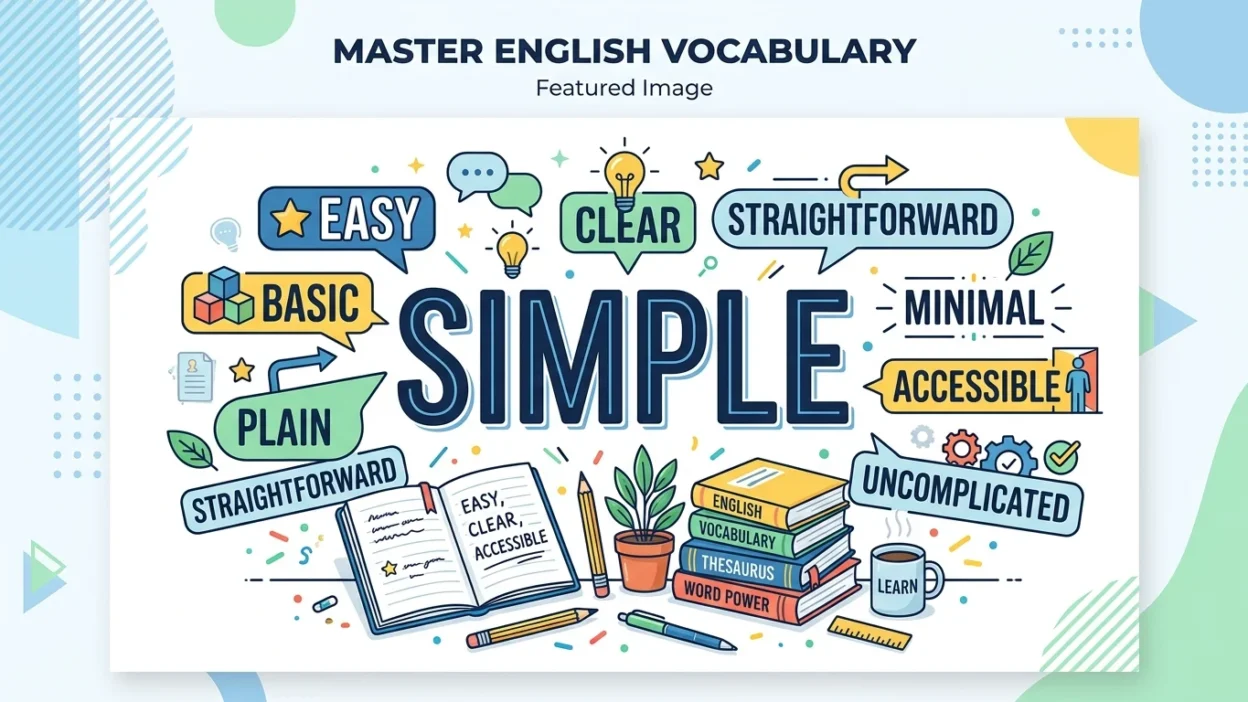
The phrase synonyms for simple is often searched by students, writers, ESL learners, and content creators who want to improve their vocabulary. Using different words instead of repeating “simple” can make writing more interesting, natural, and precise.
The word simple appears in everyday conversations, academic writing, business communication, and creative content. However, depending on the situation, another word may express your idea more clearly. For example, a recipe can be easy, a design can be minimal, and an explanation can be straightforward.
Learning synonyms helps you communicate better and understand subtle differences in meaning. In this guide, you’ll discover 30 useful synonyms for simple, their meanings, examples, and the best situations in which to use them.
What Does “Simple” Mean?
The word simple describes something that is easy to understand, uncomplicated, plain, or not complex.
It can refer to:
- Easy instructions
- Basic ideas
- Plain designs
- Clear explanations
- Uncomplicated processes
Usage Context
People use the word simple when they want to describe something that does not require much effort, knowledge, or experience to understand or complete.
Examples:
- The teacher gave a simple explanation.
- This recipe is simple enough for beginners.
- They chose a simple design for the website.
30 Synonyms for Simple
1. Easy
Meaning: Something that requires little effort.
Example Sentence: The exam was surprisingly easy.
Best Usage Context: Tasks, activities, instructions, learning materials.
2. Basic
Meaning: Having only the most important features.
Example Sentence: She learned the basic rules of grammar.
Best Usage Context: Education, skills, foundations.
3. Straightforward
Meaning: Clear and uncomplicated.
Example Sentence: The directions were straightforward and easy to follow.
Best Usage Context: Instructions, explanations, procedures.
4. Plain
Meaning: Without decoration or unnecessary details.
Example Sentence: He wore a plain white shirt.
Best Usage Context: Appearance, style, design.
5. Uncomplicated
Meaning: Not difficult or confusing.
Example Sentence: Their booking process is uncomplicated.
Best Usage Context: Systems, processes, relationships.
6. Clear
Meaning: Easy to understand.
Example Sentence: Her presentation was clear and informative.
Best Usage Context: Communication, writing, speaking.
7. Elementary
Meaning: Very basic or introductory.
Example Sentence: Students studied elementary mathematics.
Best Usage Context: Academic subjects.
8. Minimal
Meaning: Containing only essential elements.
Example Sentence: The room has a minimal design.
Best Usage Context: Art, design, decoration.
9. Modest
Meaning: Small, plain, or not excessive.
Example Sentence: They live in a modest home.
Best Usage Context: Lifestyle, possessions.
10. Effortless
Meaning: Appearing easy to do.
Example Sentence: She made public speaking look effortless.
Best Usage Context: Skills, talents, performances.
11. Manageable
Meaning: Easy enough to handle.
Example Sentence: The workload became manageable.
Best Usage Context: Projects, tasks, responsibilities.
12. Direct
Meaning: Straight to the point.
Example Sentence: His answer was direct and honest.
Best Usage Context: Communication.
13. Practical
Meaning: Useful and easy to apply.
Example Sentence: She offered practical advice.
Best Usage Context: Solutions, suggestions.
14. Natural
Meaning: Easy and comfortable.
Example Sentence: Their conversation felt natural.
Best Usage Context: Speech, behavior.
15. Clean
Meaning: Free from clutter or complexity.
Example Sentence: The website has a clean layout.
Best Usage Context: Design, visuals.
16. Pure
Meaning: Without additions or complications.
Example Sentence: The artist preferred pure forms.
Best Usage Context: Art, concepts.
17. Bare
Meaning: Having very little decoration.
Example Sentence: The apartment looked bare.
Best Usage Context: Interiors, appearance.
18. Concise
Meaning: Expressing ideas in few words.
Example Sentence: Keep your report concise.
Best Usage Context: Writing, presentations.
19. Accessible
Meaning: Easy for people to understand or use.
Example Sentence: The guide is accessible for beginners.
Best Usage Context: Education, websites.
20. User-Friendly
Meaning: Easy for people to use.
Example Sentence: The software is user-friendly.
Best Usage Context: Technology, products.
21. Neat
Meaning: Simple, tidy, and organized.
Example Sentence: She keeps her desk neat.
Best Usage Context: Organization, design.
22. Familiar
Meaning: Easy because it is already known.
Example Sentence: The interface felt familiar.
Best Usage Context: Experiences, systems.
23. Understandable
Meaning: Easy to comprehend.
Example Sentence: The teacher used understandable language.
Best Usage Context: Teaching, explanations.
24. Plainspoken
Meaning: Using simple and honest language.
Example Sentence: His plainspoken advice was appreciated.
Best Usage Context: Communication, writing.
25. Transparent
Meaning: Easy to see or understand.
Example Sentence: The company maintained transparent policies.
Best Usage Context: Business, communication.
26. Down-to-Earth
Meaning: Practical and uncomplicated.
Example Sentence: She has a down-to-earth personality.
Best Usage Context: Character descriptions.
27. Basic-Level
Meaning: Suitable for beginners.
Example Sentence: The course offers basic-level training.
Best Usage Context: Education.
28. Beginner-Friendly
Meaning: Designed for newcomers.
Example Sentence: This guide is beginner-friendly.
Best Usage Context: Tutorials, learning resources.
29. Intuitive
Meaning: Easy to understand naturally.
Example Sentence: The application has an intuitive interface.
Best Usage Context: Technology, design.
30. Simple-Minded
Meaning: Unsophisticated in thinking.
Example Sentence: The character was portrayed as simple-minded.
Best Usage Context: Literature and personality descriptions.
Comparison Guide: When to Use Different Synonyms
| Synonym | Best Used For | Tone |
|---|---|---|
| Easy | Tasks and activities | Casual |
| Basic | Learning fundamentals | Educational |
| Straightforward | Instructions | Professional |
| Plain | Appearance and style | Neutral |
| Minimal | Design and aesthetics | Modern |
| Concise | Writing | Professional |
| Accessible | Education and websites | Friendly |
| User-friendly | Technology | Informal |
| Transparent | Policies and communication | Formal |
| Intuitive | Digital products | Technical |
How to Choose the Right Synonym
Choosing the right word depends on your purpose, audience, and tone.
For Education
Use:
- Basic
- Elementary
- Beginner-friendly
- Accessible
- Understandable
These words work well for lessons, tutorials, and study materials.
For Writing and Communication
Choose:
- Clear
- Concise
- Straightforward
- Direct
- Plainspoken
These synonyms help create readable and effective content.
For Design and Appearance
Consider:
- Minimal
- Plain
- Clean
- Neat
- Bare
These words describe visual simplicity.
For Technology
Good choices include:
- User-friendly
- Intuitive
- Accessible
- Manageable
These terms are common in software reviews and product descriptions.
For Everyday Conversation
Use:
- Easy
- Natural
- Practical
- Familiar
- Down-to-earth
They sound friendly and natural in daily speech.
Why Learning Synonyms for Simple Matters
Expanding your vocabulary makes your communication stronger and more engaging.
Benefits include:
- Avoiding repetitive language
- Improving essays and assignments
- Writing more naturally
- Enhancing professional communication
- Building confidence in speaking and writing
- Understanding subtle differences in meaning
Using the right synonym can make your message more accurate and impactful.
Conclusion
Understanding synonyms for simple allows writers, students, and English learners to communicate with greater clarity and variety. Although simple is a useful everyday word, alternatives such as easy, straightforward, basic, minimal, and accessible often express ideas more precisely.
By learning these 30 synonyms, their meanings, examples, and contexts, you can choose vocabulary that matches your audience and purpose. Whether you are writing an essay, creating content, designing a website, or teaching English, selecting the right synonym helps your message become clearer, more engaging, and more effective.

John Morrison is a dedicated content writer at Synomity.com, focused on synonyms, vocabulary development, and word meanings. He creates clear, educational resources that help readers improve language skills and communicate with confidence.