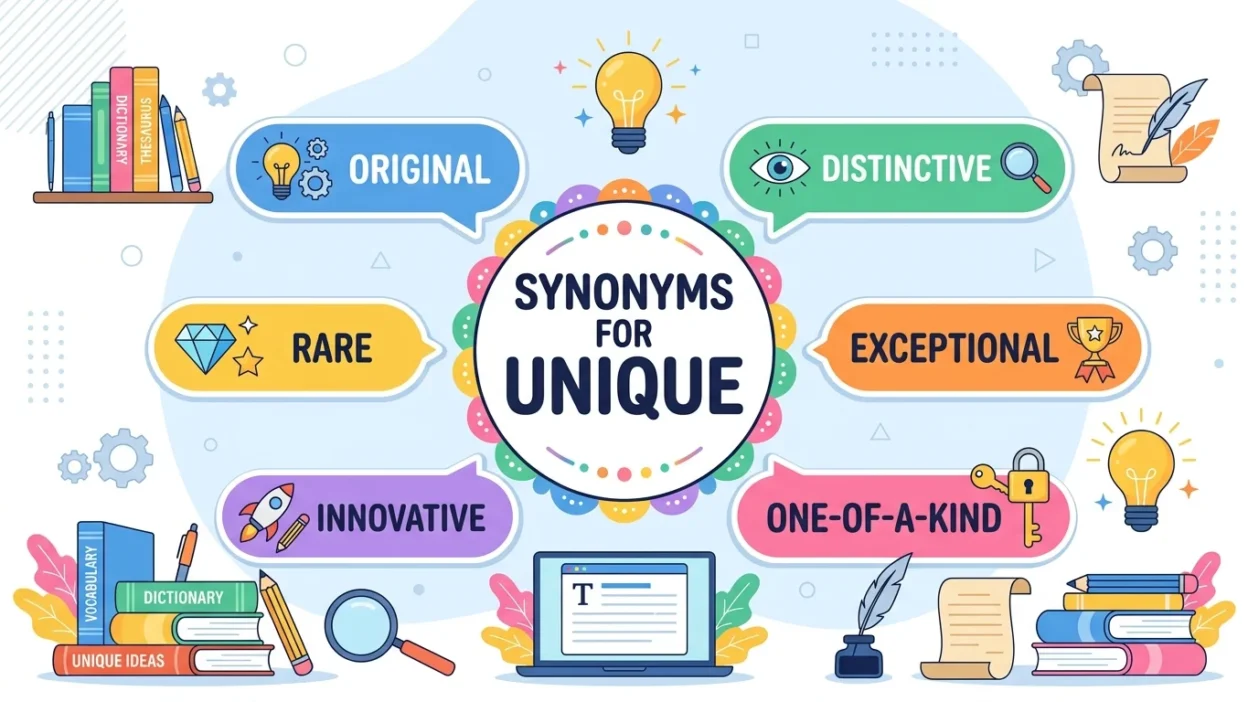
People often use the word unique to describe something special, different, or unlike anything else. However, repeating the same word can make writing sound repetitive. Learning various synonyms for unique helps students, writers, and English learners express ideas more clearly and creatively.
Whether you are writing essays, stories, social media captions, or professional content, understanding alternative words for unique allows you to match the right tone and context. Some synonyms sound formal, while others are more casual or expressive.
In this guide, you’ll discover the meaning of unique, explore 30 useful synonyms, learn when to use them, and understand the subtle differences between these words.
What Does “Unique” Mean?
The word unique means something that is one of a kind, special, or different from everything else.
It describes a person, object, idea, style, or quality that stands out because it is uncommon or distinctive.
Usage and Tone
Unique is commonly used in everyday conversation, academic writing, business communication, and creative content.
Examples:
- She has a unique way of solving problems.
- The artist created a unique painting style.
- Every person’s experiences are unique.
The word usually has a positive meaning because it highlights individuality and originality.
30 Synonyms for Unique
Here are thirty useful synonyms for unique along with meanings, examples, and usage notes.
1. Distinctive
Meaning: Easy to recognize because it is different from others.
Example Sentence: The restaurant has a distinctive interior design.
Best Usage Context: Describing styles, features, or characteristics.
2. Original
Meaning: New and not copied from something else.
Example Sentence: She presented an original idea during the meeting.
Best Usage Context: Creative projects, writing, and inventions.
3. Uncommon
Meaning: Not seen or found very often.
Example Sentence: It is uncommon to see snow in this region.
Best Usage Context: Everyday observations and descriptions.
4. Rare
Meaning: Difficult to find because it exists in small numbers.
Example Sentence: The museum displayed a rare artifact.
Best Usage Context: Collectibles, events, and valuable items.
5. Exceptional
Meaning: Much better or different than usual.
Example Sentence: Her exceptional talent impressed everyone.
Best Usage Context: Skills, achievements, and performances.
6. Extraordinary
Meaning: Beyond what is ordinary or expected.
Example Sentence: They had an extraordinary travel experience.
Best Usage Context: Memorable events and accomplishments.
7. Singular
Meaning: Remarkably unusual or one of a kind.
Example Sentence: His singular vision transformed the company.
Best Usage Context: Formal and literary writing.
8. Special
Meaning: Different in a positive or meaningful way.
Example Sentence: This gift is special because it was handmade.
Best Usage Context: Personal conversations and informal writing.
9. Remarkable
Meaning: Worth noticing because it is impressive.
Example Sentence: She made remarkable progress in English.
Best Usage Context: Achievements and positive qualities.
10. Unusual
Meaning: Different from what is normal.
Example Sentence: He wore an unusual outfit to the event.
Best Usage Context: General descriptions.
11. Exclusive
Meaning: Limited to a certain person or group.
Example Sentence: Members received exclusive benefits.
Best Usage Context: Marketing and business.
12. Individual
Meaning: Belonging to one specific person or thing.
Example Sentence: Each student has individual learning needs.
Best Usage Context: Education and personal development.
13. Inimitable
Meaning: Impossible to copy successfully.
Example Sentence: Her inimitable sense of humor entertained everyone.
Best Usage Context: Creative talents and personalities.
14. Matchless
Meaning: Without equal.
Example Sentence: The scenery offered matchless beauty.
Best Usage Context: Literary and descriptive writing.
15. Novel
Meaning: New and interesting.
Example Sentence: Scientists developed a novel treatment.
Best Usage Context: Science, technology, and innovation.
16. Peculiar
Meaning: Strange or noticeably different.
Example Sentence: He noticed a peculiar sound in the room.
Best Usage Context: Curious situations and observations.
17. Outstanding
Meaning: Extremely good or impressive.
Example Sentence: She delivered an outstanding presentation.
Best Usage Context: Academic and professional settings.
18. Memorable
Meaning: Easy to remember because it is special.
Example Sentence: They enjoyed a memorable vacation.
Best Usage Context: Experiences and events.
19. Innovative
Meaning: Introducing new ideas or methods.
Example Sentence: The company launched an innovative product.
Best Usage Context: Business and technology.
20. Unparalleled
Meaning: Better than anything comparable.
Example Sentence: The athlete achieved unparalleled success.
Best Usage Context: Formal praise and achievements.
21. One-of-a-Kind
Meaning: Completely unique.
Example Sentence: The handmade vase is one-of-a-kind.
Best Usage Context: Art, crafts, and products.
22. Distinct
Meaning: Clearly different from others.
Example Sentence: The two cultures have distinct traditions.
Best Usage Context: Comparisons and analysis.
23. Personalized
Meaning: Made especially for one person.
Example Sentence: She received a personalized notebook.
Best Usage Context: Gifts and customer services.
24. Individualistic
Meaning: Showing independence and originality.
Example Sentence: His individualistic approach inspired others.
Best Usage Context: Personality descriptions.
25. Unrepeatable
Meaning: Impossible to happen exactly the same way again.
Example Sentence: Watching the eclipse was an unrepeatable experience.
Best Usage Context: Special moments and events.
26. Phenomenal
Meaning: Extremely impressive or extraordinary.
Example Sentence: The singer gave a phenomenal performance.
Best Usage Context: Entertainment and achievements.
27. Characteristic
Meaning: Typical or identifying quality.
Example Sentence: Her kindness is a characteristic trait.
Best Usage Context: Personal qualities and features.
28. Idiosyncratic
Meaning: Having unusual personal characteristics.
Example Sentence: The author is known for his idiosyncratic style.
Best Usage Context: Academic and literary writing.
29. Exceptionalized
Meaning: Made distinct from others.
Example Sentence: The company exceptionalized its services through customization.
Best Usage Context: Specialized business discussions.
30. Nonstandard
Meaning: Different from common rules or practices.
Example Sentence: The engineer proposed a nonstandard solution.
Best Usage Context: Technical and professional contexts.
Comparison Guide: When to Use Different Synonyms
| Synonym | Best For | Tone |
|---|---|---|
| Original | Creativity and ideas | Positive |
| Rare | Valuable objects | Neutral |
| Distinctive | Features and appearance | Professional |
| Exceptional | Skills and achievements | Formal |
| Special | Personal relationships | Friendly |
| Innovative | Technology and business | Modern |
| Peculiar | Strange situations | Neutral |
| Extraordinary | Remarkable experiences | Strong |
| Memorable | Events and memories | Positive |
| Exclusive | Premium services | Marketing |
How to Choose the Right Synonym
Choosing the best synonym depends on your message, audience, and writing style.
For Creative Writing
Use words like:
- Original
- Inimitable
- Novel
- Distinctive
- One-of-a-kind
These words emphasize imagination and creativity.
For Academic Writing
Consider using:
- Exceptional
- Distinct
- Singular
- Innovative
- Idiosyncratic
These sound more formal and professional.
For Everyday Conversations
Simple alternatives work best:
- Special
- Unusual
- Rare
- Memorable
- Different
These are easy to understand and commonly used.
For Marketing and Branding
Strong choices include:
- Exclusive
- Premium
- Distinctive
- Personalized
- Innovative
These words help products and services appear more appealing.
For Describing People
Useful options are:
- Individualistic
- Exceptional
- Remarkable
- Distinctive
- Inimitable
These emphasize personality and unique qualities.
Why Learning Synonyms for Unique Matters
Expanding your vocabulary makes communication more effective. Instead of repeatedly using the word unique, you can choose alternatives that better fit your purpose.
For example:
- Use innovative for technology.
- Use rare for valuable items.
- Use remarkable for achievements.
- Use special for emotional situations.
- Use original for creative work.
Using the right synonym improves writing quality, enhances clarity, and helps readers understand your intended meaning more precisely.
Conclusion
Learning these synonyms for unique can greatly improve your English vocabulary and writing skills. While unique remains a useful and powerful word, alternatives such as distinctive, original, exceptional, rare, and innovative provide more precise ways to express your ideas.
Students, ESL learners, writers, and content creators can benefit from understanding these subtle differences because selecting the right synonym strengthens communication and makes writing more engaging. Keep practicing these words in everyday conversations and writing exercises to build confidence and express yourself more naturally.

Lucas Smith is a skilled language writer at Synomity.com, passionate about synonyms, vocabulary enrichment, and word meanings. He develops engaging content that helps readers strengthen communication skills and expand their understanding of language.