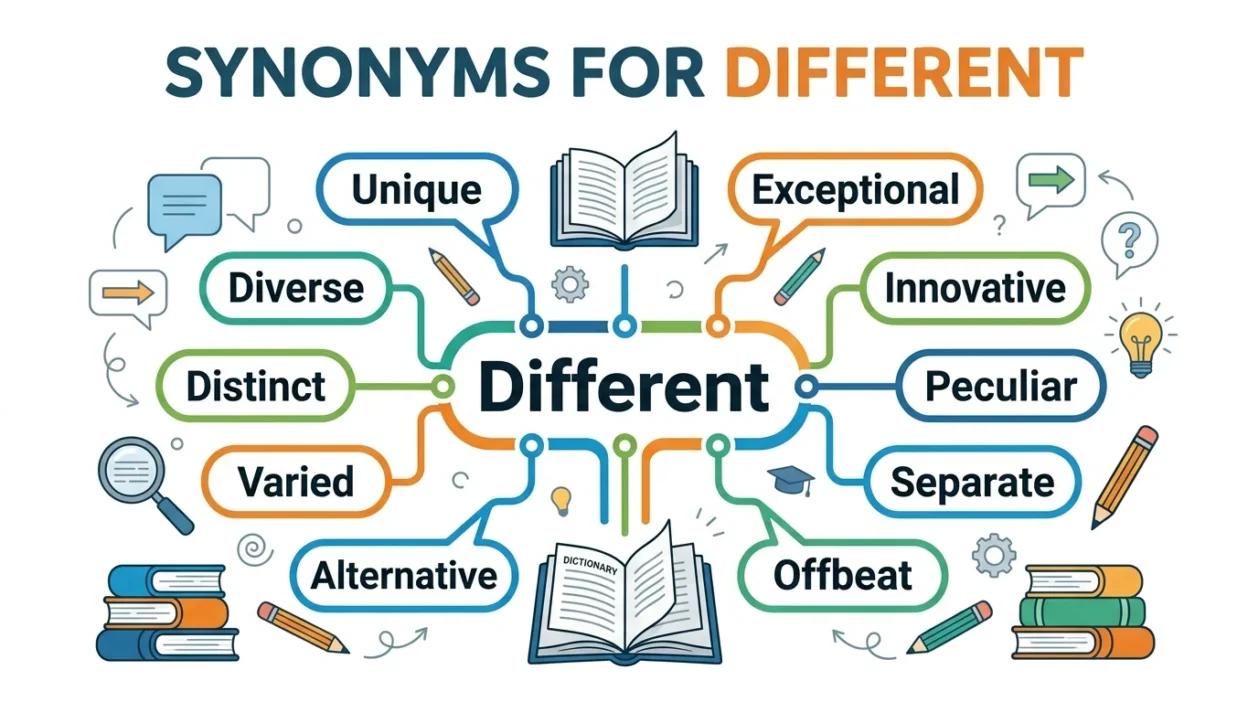
The phrase synonyms for different is commonly searched by students, writers, ESL learners, and content creators who want to improve their vocabulary and avoid repeating the same word too often.
The word different is useful in everyday English, but using the same word repeatedly can make writing sound repetitive. Learning alternative words helps make your communication clearer, more engaging, and more precise.
In this guide, you’ll discover 30 useful synonyms for different, along with their meanings, example sentences, and the situations where they work best. Whether you’re writing essays, articles, emails, or creative content, these words can help you express ideas more effectively.
What Does “Different” Mean?
Meaning of Different
The word different describes something that is not the same as another thing. It can refer to appearance, behavior, ideas, opinions, styles, qualities, or characteristics.
Simple Explanation
If two things are different, they have features or qualities that make them unlike each other.
Usage Context
People use the word different when talking about:
- Opinions
- Cultures
- People
- Designs
- Experiences
- Products
- Ideas
- Choices
- Methods
- Behaviors
Example:
“My experience was completely different from yours.”
30 Synonyms for Different
1. Distinct
Meaning: Clearly separate and easy to recognize.
Example sentence:
The two species have distinct characteristics.
Best usage context: Academic writing, formal discussions.
2. Unique
Meaning: One of a kind or unlike anything else.
Example sentence:
She has a unique style of painting.
Best usage context: Creativity, branding, descriptions.
3. Diverse
Meaning: Showing variety or many types.
Example sentence:
The city has a diverse population.
Best usage context: Culture, society, workplaces.
4. Varied
Meaning: Made up of many different kinds.
Example sentence:
The restaurant offers a varied menu.
Best usage context: General writing, business.
5. Unusual
Meaning: Not common or ordinary.
Example sentence:
He wore an unusual outfit to the event.
Best usage context: Descriptions, storytelling.
6. Alternative
Meaning: Another option or choice.
Example sentence:
We found an alternative solution.
Best usage context: Problem-solving, discussions.
7. Separate
Meaning: Existing independently from something else.
Example sentence:
The files are stored in separate folders.
Best usage context: Organization, technical writing.
8. Distinctive
Meaning: Having special qualities that stand out.
Example sentence:
Her voice has a distinctive sound.
Best usage context: Branding, descriptions.
9. Contrasting
Meaning: Showing noticeable differences.
Example sentence:
The colors create a contrasting effect.
Best usage context: Art, design, comparison.
10. Divergent
Meaning: Moving in different directions or opinions.
Example sentence:
The team had divergent views on the project.
Best usage context: Formal and academic writing.
11. Uncommon
Meaning: Rare or not frequently seen.
Example sentence:
Snowfall is uncommon in this region.
Best usage context: Reports, descriptions.
12. Individual
Meaning: Separate and personal.
Example sentence:
Each student has individual learning needs.
Best usage context: Education, workplace.
13. Independent
Meaning: Not influenced or controlled by others.
Example sentence:
She made an independent decision.
Best usage context: Professional communication.
14. Unalike
Meaning: Not similar in appearance or nature.
Example sentence:
The twins look surprisingly unalike.
Best usage context: Informal conversations.
15. Miscellaneous
Meaning: Consisting of many unrelated items.
Example sentence:
The drawer contained miscellaneous objects.
Best usage context: Lists and categories.
16. Heterogeneous
Meaning: Made up of varied elements.
Example sentence:
The class is culturally heterogeneous.
Best usage context: Academic writing.
17. Assorted
Meaning: Collected from different types.
Example sentence:
She bought assorted chocolates.
Best usage context: Shopping, descriptions.
18. Distinguishable
Meaning: Easy to tell apart.
Example sentence:
The two brands are easily distinguishable.
Best usage context: Comparison writing.
19. Novel
Meaning: New and original.
Example sentence:
Researchers introduced a novel approach.
Best usage context: Innovation, research.
20. Exceptional
Meaning: Better or unlike the ordinary.
Example sentence:
He showed exceptional talent.
Best usage context: Praise and evaluation.
21. Peculiar
Meaning: Strange or unusual.
Example sentence:
There was a peculiar smell in the room.
Best usage context: Storytelling and descriptions.
22. Special
Meaning: Different in a positive or meaningful way.
Example sentence:
Today is a special occasion.
Best usage context: Personal conversations.
23. Singular
Meaning: Remarkably unique.
Example sentence:
She possesses a singular ability.
Best usage context: Formal writing.
24. Atypical
Meaning: Not following the usual pattern.
Example sentence:
His behavior was atypical for him.
Best usage context: Academic and medical contexts.
25. Odd
Meaning: Strange or unexpected.
Example sentence:
That was an odd question.
Best usage context: Casual conversations.
26. Irregular
Meaning: Not following a standard pattern.
Example sentence:
The shape has irregular edges.
Best usage context: Science, geometry.
27. Nonidentical
Meaning: Not exactly the same.
Example sentence:
The designs are nonidentical.
Best usage context: Technical comparisons.
28. Innovative
Meaning: Introducing new ideas.
Example sentence:
The company developed innovative products.
Best usage context: Business and marketing.
29. Experimental
Meaning: Trying something new or untested.
Example sentence:
The chef prepared an experimental recipe.
Best usage context: Creativity and research.
30. Offbeat
Meaning: Unusual in an interesting way.
Example sentence:
She enjoys offbeat movies.
Best usage context: Informal and creative writing.
When to Use Different Synonyms
Quick Comparison Guide
| Synonym | Best For | Tone |
|---|---|---|
| Unique | Creativity | Positive |
| Diverse | Culture and society | Neutral |
| Distinct | Academic writing | Formal |
| Varied | General descriptions | Neutral |
| Alternative | Choices and options | Neutral |
| Exceptional | Praise | Positive |
| Peculiar | Strange situations | Informal |
| Novel | Innovation | Formal |
| Offbeat | Creative subjects | Casual |
| Divergent | Opinions and ideas | Formal |
How to Choose the Right Synonym
For Academic Writing
Choose words such as:
- Distinct
- Divergent
- Heterogeneous
- Atypical
- Novel
These terms sound professional and precise.
For Creative Writing
Good choices include:
- Unique
- Offbeat
- Peculiar
- Exceptional
- Distinctive
These words add personality and interest.
For Business Communication
Consider using:
- Alternative
- Innovative
- Diverse
- Independent
- Varied
These fit well in reports, presentations, and professional content.
For Everyday Conversations
Simple alternatives include:
- Special
- Different
- Odd
- Separate
- Unusual
These are easy to understand and commonly used.
For Positive Descriptions
Use words like:
- Exceptional
- Unique
- Distinctive
- Innovative
- Special
These create a favorable impression.
For Neutral Comparisons
Choose:
- Diverse
- Varied
- Separate
- Distinct
- Assorted
These work well in informative writing.
Why Learning Synonyms for Different Matters
Improve Vocabulary Skills
Knowing multiple ways to say different expands your vocabulary and helps you communicate more effectively.
Make Writing More Engaging
Using varied vocabulary keeps readers interested and prevents repetition.
Express Meaning More Clearly
Each synonym carries a slightly different meaning, allowing you to select the most accurate word for your message.
Strengthen Academic and Professional Writing
Precise word choice can make essays, reports, and presentations sound more polished and professional.
Common Mistakes to Avoid
Using “Unique” for Everything
Unique means one of a kind. It should not replace different in every sentence.
Choosing Overly Formal Words
Words like heterogeneous and singular may sound unnatural in casual conversations.
Ignoring Tone
Always consider whether your writing is formal, informal, creative, or professional before choosing a synonym.
Conclusion
Learning synonyms for different is a simple but powerful way to improve your English vocabulary. Although the word different is useful, alternatives such as unique, distinct, diverse, varied, and innovative can make your writing stronger and more engaging.
The best synonym depends on your purpose, audience, and tone. Students can use these words in essays, writers can enhance storytelling, and content creators can make articles more appealing.
By understanding the meanings, examples, and contexts of these 30 synonyms, you’ll be able to communicate ideas more naturally, confidently, and effectively in both spoken and written English.

John Morrison is a dedicated content writer at Synomity.com, focused on synonyms, vocabulary development, and word meanings. He creates clear, educational resources that help readers improve language skills and communicate with confidence.